Active Recall vs Spaced Repetition in 2026: What to Test Now and What to Review Later
One night you answer five study questions in a row, feel sharp, close the laptop, and think the topic is done. The next morning you try to explain one of those same answers without help and stall out halfway through.
That little whiplash is the easiest way to understand active recall vs spaced repetition.
They are not competing study methods. They handle different moments in the same workflow.
Active recall is the attempt to pull the answer out of your head right now.
Spaced repetition is the system that decides when that same idea should come back later.
If you want the short version, it is this: active recall tests now. Spaced repetition schedules later.
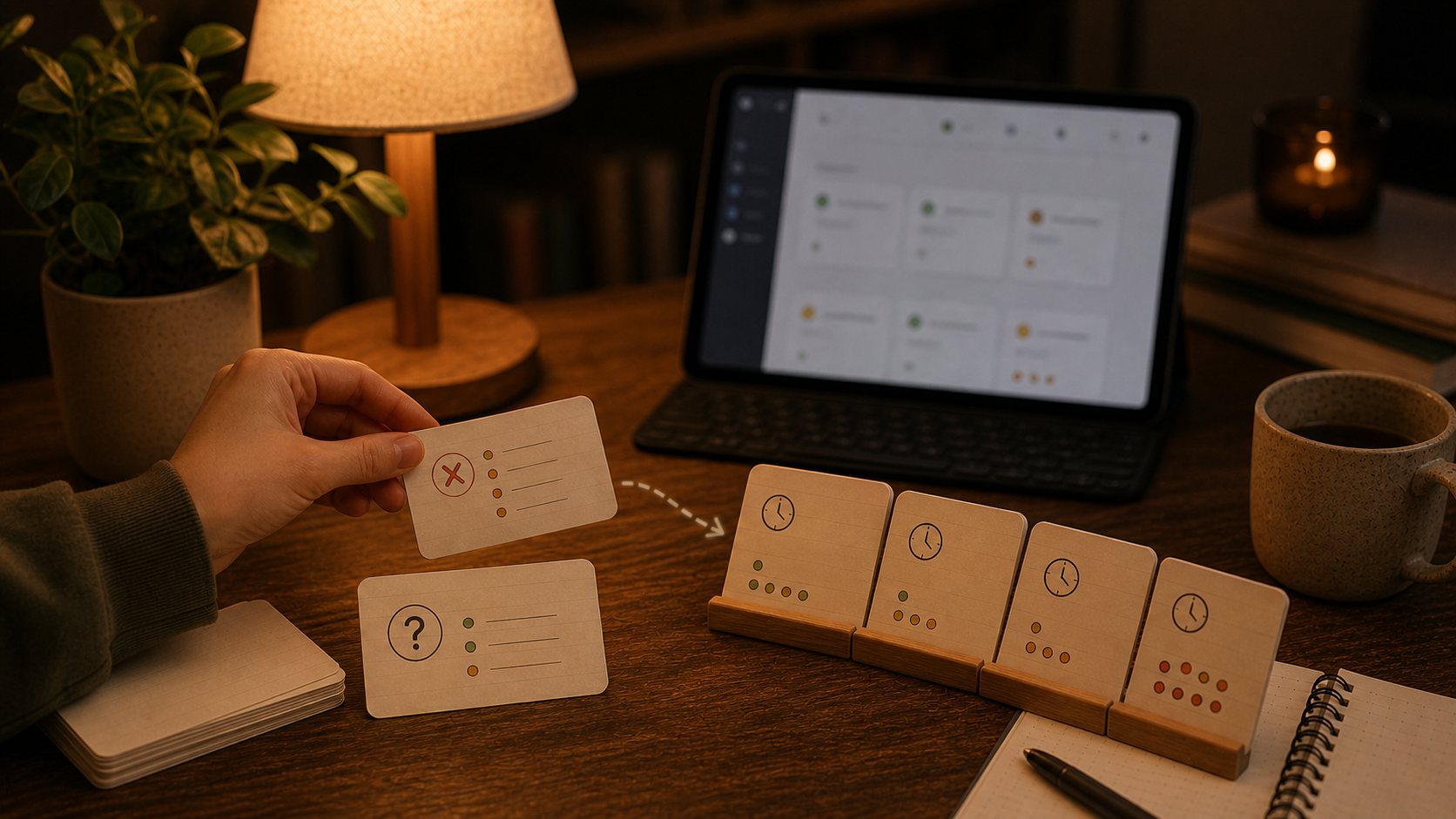
Why people keep mixing them up
The confusion is understandable because good flashcard systems often use both at once.
When you review a solid card, two things happen:
- you try to answer from memory
- the app decides when to show the card again
The first part is active recall. The second part is spaced repetition.
Same review. Different jobs.
That is why people say things like "flashcards are active recall" or "flashcards are spaced repetition." Both can be partly true. What matters is which part you are talking about.
A practice quiz can be active recall with no spacing at all.
A review app can use spaced intervals badly if the cards only test recognition.
An AI tool can generate twenty shiny cards in one click and still give you neither useful recall nor useful scheduling.
The labels got even blurrier once study tools started combining tutoring, quizzes, flashcard drafts, and review queues in one screen. The interface looks unified. The memory jobs are still separate.
Active recall is the testing move
Active recall starts the moment you stop looking and try to produce the answer yourself.
That can mean:
- answering a free-response question
- blurting on a blank page
- explaining the topic out loud
- doing the practice problem before reading the solution
- letting an AI tutor ask first and help second
The point is not familiarity. The point is retrieval.
You are checking whether you can actually produce the definition, step, formula, distinction, or explanation without support.
That is why active recall often feels slightly annoying when it is working. Reading notes feels smoother. Recognition feels nicer. Retrieval is where the cracks show up.
If you want method-specific versions of that step, these are the closest companions:
Spaced repetition is the timing layer
Spaced repetition starts after you already know something is worth another look.
Say you just found one of these weak spots:
- you mixed up meiosis and mitosis
- you forgot which exception changes the rule
- you knew the formula but missed when to use it
- you kept confusing a demand shift with movement along the curve
Now the question changes. It is no longer "Can I retrieve this?" It is "When should I see this again before it disappears?"
That is the scheduling problem spaced repetition solves.
A good scheduler brings unstable material back earlier, then backs off as the memory gets easier. In Flashcards, that timing layer runs on FSRS, which matters once your review queue grows beyond a tiny deck. If you want the scheduler comparison itself, FSRS vs SM-2 in 2026 is the deeper version.
So spaced repetition is not the replacement for active recall. It is the calendar for the material that earned another review.
The real decision boundary: test now or schedule later?
This is the part most articles skip.
The practical question is not "Which one is better?" The practical question is when each one should take over.
I use active recall when I need diagnosis.
Usually that means:
- after reading one short section
- after a lecture, video, or tutoring session
- after missing a practice question
- before turning anything into cards
- before checking the polished explanation
At that stage I want evidence.
I want to know what I can say cleanly, what I hesitated on, what I confused, and what only felt obvious once the answer was back in front of me.
Then I use spaced repetition after the diagnostic step, once the misses are specific enough to store.
I would move something into a review queue only if at least one of these is true:
- I missed it
- I answered slowly
- I confused it with something nearby
- I will still need it next week or next month
- the answer fits a clean front/back card
That is the whole boundary.
Active recall tells you whether a memory is shaky.
Spaced repetition decides whether that shaky memory deserves a return visit.
What "test now" should produce
Good active recall gives you misses with names.
Instead of "I need to review chemistry," you get something you can actually use:
- forgot which reagent oxidizes the alcohol
- mixed up hypertonic and hypotonic
- could define TCP but could not explain why UDP was wrong here
- remembered the court case outcome, not the rule it established
Those are real card candidates.
This is also why I would not start with a giant deck export every time an AI tutor, quiz app, or notes tool offers one. The useful output from a recall session is usually much smaller than the app wants you to save.
Keep the misses. Keep the hesitations. Keep the repeated confusions.
Do not keep the whole performance.
If you care about that broader handoff from tutor or notes into review, How to Use AI to Study in 2026 is the closest companion article.
What "review later" should filter out
This is where spaced repetition becomes helpful instead of heavy.
Not every fact from a study session deserves a future review slot. In 2026 it is cheap to generate more cards than you will ever review honestly. That is true whether the source is notes, a lecture summary, or an AI chat.
I would skip a card if:
- the answer needs a paragraph
- the prompt only makes sense with the full notes open
- the point already felt stable
- the card tests vague recognition instead of a clean answer
If the answer needs a paragraph, split it.
If the card depends on surrounding context, rewrite it.
If the material was obvious and stayed obvious, leave it alone.
These companion guides go deeper on that filtering step:
What breaks when you use only one of them
Active recall without spacing usually leaks.
You do the hard part. You answer out loud, blurt on paper, or work through free-response questions. You find the weak spots. Then the weak spots stay in notebook margins, chat transcripts, or vague intentions.
For a day or two, that can feel fine.
After that, timing gets sloppy. Some holes come back too soon. Some disappear for a week. Some only feel familiar because you remember seeing them, not because you can retrieve them cleanly.
Spaced repetition without real recall breaks in the other direction.
You get a deck full of cards that look polished and review terribly:
- copied textbook sentences
- AI-generated paragraphs
- prompts that reveal half the answer
- cards so broad that honest self-grading becomes nonsense
That is still spaced repetition in the technical sense.
It is weak in practice because the retrieval signal is weak.
If the front says "Explain cellular respiration" and the back reads like half a lecture, the scheduler is working with noise.
The workflow that still makes sense in 2026
The sequence is boring, which is one reason it keeps working.
- Learn the topic from notes, a lecture, a textbook section, practice problems, or a tutor.
- Stop early enough to test yourself before the source turns into fake familiarity.
- Use active recall to expose the misses, hesitations, and mix-ups.
- Keep only the weak spots that are small enough to review later.
- Turn those into straightforward front/back cards.
- Let spaced repetition handle the timing from there.
That order matters.
If you generate cards before you know what you actually missed, you usually create too much review work.
If you do retrieval practice and never move the useful misses into a real review system, you are counting on memory to organize memory. That tends to go badly.
Where Flashcards fits
Flashcards fits after the explanation, after the tutor, after the quiz, and after the practice session.
It is the retention layer, not the whole learning process.
That is the part I find most useful:
- do the retrieval work first
- keep the small set of misses worth saving
- clean those into simple cards
- let FSRS decide when they come back
That is also where the product-specific part matters:
- front/back cards for the things you actually want to remember
- FSRS scheduling for the things you were not solid on yet
- an open-source codebase if you want visibility into the system
- a self-hosted path if you want your study stack under your own control
If you want the product entry points after that handoff, start with the features page, the getting started guide, or the self-hosting guide. If the open-source angle is the main reason you are here, Self-Hosted Open Source Flashcards App for Spaced Repetition is the more direct read.
The practical answer
If you are still deciding between active recall or spaced repetition, the answer is less dramatic than the search query makes it sound.
Use active recall to find what your brain cannot produce yet.
Use spaced repetition to decide when those exact weak spots should come back.
Do not treat them like interchangeable study aesthetics.
They are two parts of the same memory workflow, and 2026 AI tools make more sense once you keep that split clear.