How to Use the Blurting Method With Flashcards in 2026: Turn Blank-Page Recall Into FSRS Reviews
Eight minutes into a physiology blurt, the page looked convincing. Arrows everywhere. Half-finished pathways. A definition I felt weirdly proud of until I checked the notes and realized it was wrong.
That is blurting in one scene.
The page looks busy, but the useful part is not how much you wrote. It is what you could not produce cleanly without help.
That is also where the method starts to break on its own. A blurt is excellent at exposing gaps. It is much worse at bringing those exact gaps back three days later, when the topic is already fading again.
This is where flashcards fit. The blurt gives you evidence. Flashcards keep only the weak spots that deserve another pass. FSRS handles the timing after that.
If you want a practical answer to blurting method flashcards, that is the workflow I would keep.
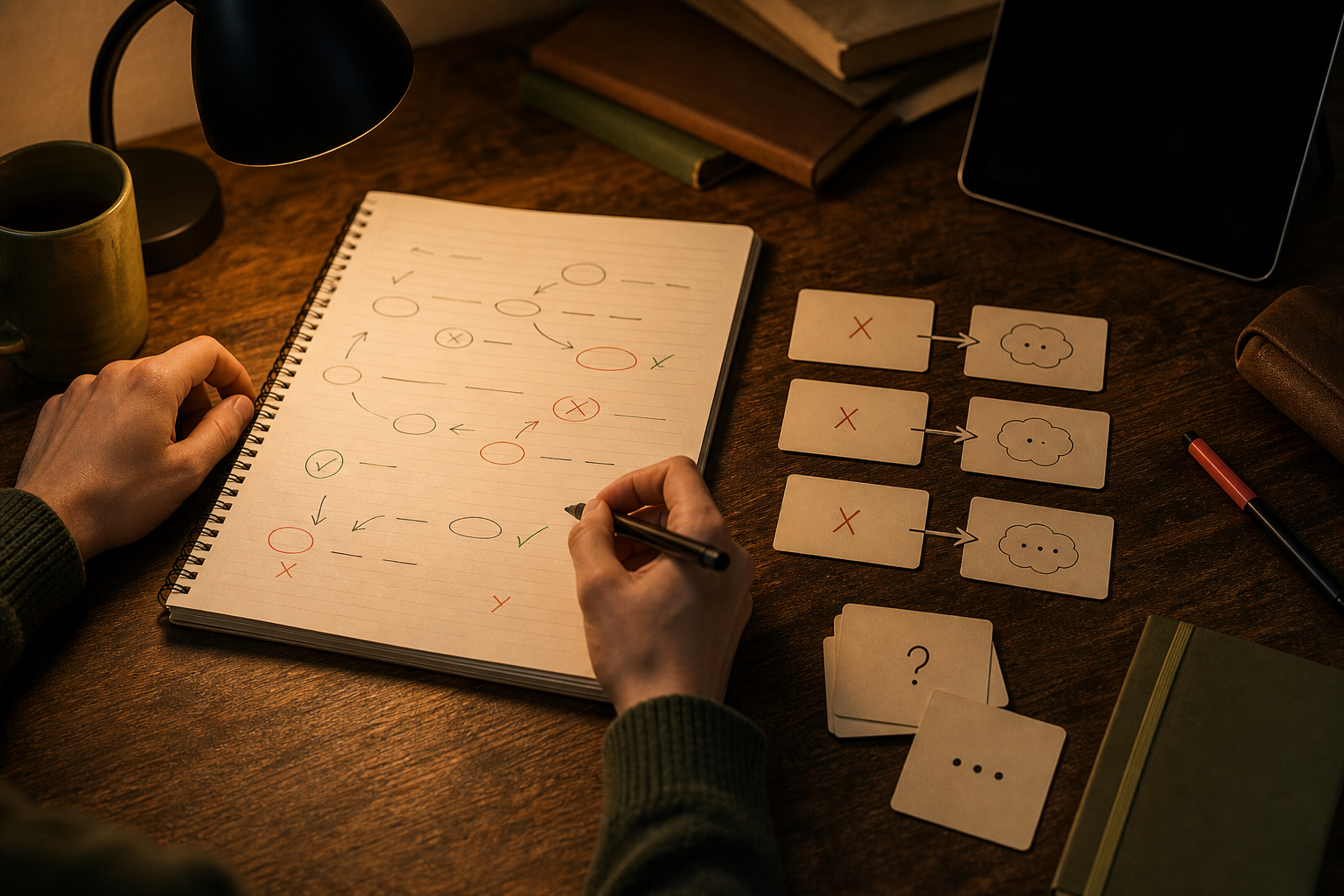
Blurting is basically the blank page method with a student nickname
If you keep seeing "blurting" on study TikTok or YouTube, the underlying method is older and more ordinary than the name makes it sound.
You study a small chunk, hide the source, and write down everything you can remember from memory. Then you compare your page to the original material, mark what you missed, and come back later.
Student-support pages describe the same pattern in slightly different language:
- Birmingham City University says to start with smaller topics, mark what you missed, combine blurting with flashcards or past papers, and spread the sessions across several days.
- Ohio State's study-skills guidance describes the blank page method as closing your books, writing everything you remember, then checking what you missed.
- West Coast University's 2026 study-skills guide puts the blank page method right beside flashcards, self-quizzing, and spaced repetition.
So this is not some exotic study trick. It is retrieval practice with a catchy label.
The better question is what to do after the page is full.
Blurting is strong at diagnosis and weak at scheduling
This is the part people notice in practice.
Blurting shows:
- what you can produce cleanly
- what you can sort of produce with vague hand-waving
- what you mixed up
- what disappeared completely
That is great feedback.
What blurting does not do by itself is decide when those misses should come back.
You can repeat the same blurt later, and you should. But if every weak spot lives only on marked-up notebook paper, the follow-up gets messy fast. Some misses come back too soon. Some vanish for a week. Some need to be relearned from scratch because you never turned them into a reusable question.
Flashcards fix that part.
The page exposes the weak spots. The cards preserve them. FSRS decides when they should reappear.
Do not blurt whole chapters unless you enjoy messy pages
Birmingham City University gives the right advice here: start smaller.
A good blurting session is usually one of these:
- one lecture
- one textbook subsection
- one process
- one concept cluster
- one page of formulas
- one case or one reading
Not "all of cellular respiration." Not "everything from week three." Not "the whole unit because I am behind."
When the scope is too big, the page turns into a confidence ritual. You write broad fragments, circle a few holes, and end up with nothing clean enough to convert into cards. Smaller topics make the misses specific enough to survive the handoff.
If your material still needs cleanup before the blurting step, these are the better starting points:
What a good blurt actually gives you
The page itself is not the finished product.
It is a map of weak spots.
After you compare your blurt with the source, most misses fall into one of four buckets:
1. Fact gaps
You simply did not retrieve one fact.
Example:
- forgot which ion moves first
- forgot the year of a court decision
- forgot the definition of entropy
2. Distinction gaps
You remembered the neighborhood but mixed up two nearby ideas.
Example:
- confused mitosis with meiosis
- mixed up demand shift with movement along the curve
- swapped TCP and UDP use cases
3. Sequence gaps
You knew the pieces but lost the order.
Example:
- missed step three in glycolysis
- reversed the order of constitutional amendments
- skipped the second stage of incident response
4. Application gaps
You knew the phrase, but could not use it in context.
Example:
- could define positive feedback but could not spot it in a scenario
- knew the legal rule but missed the fact pattern that triggered it
- recognized a formula but could not choose it under pressure
That is why the blank page method works so well with flashcards. These misses already want to become prompts.
Flashcards after blurting: what to make and what to skip
This is the part that usually decides whether the workflow stays useful or turns into admin work.
Do not make cards from everything on the page.
Make cards from:
- what you missed
- what you hesitated on
- what you got partly right for the wrong reason
- what you kept confusing with something nearby
If the blurt showed you know something cold, leave it alone.
That matters because blurting creates a strong illusion of productivity. You wrote a page from memory, so now it feels reasonable to build a heroic deck from the whole thing. Usually that just means you spend the next week reviewing material the blurt already proved was stable.
The better deck is smaller and sharper.
It remembers the misses for you.
Turn blurting misses into small front-and-back cards
The most common mistake here is copying a corrected chunk of notes into one oversized card.
That preserves the page. It does not preserve recall.
Say your blurt showed this:
- you knew ATP was involved
- you forgot where the electron transport chain happens
- you mixed up NADH and FADH2
Bad card:
- Front: Explain oxidative phosphorylation.
- Back: A large paragraph covering location, inputs, steps, exceptions, and outputs.
Better cards:
- Front: Where does the electron transport chain occur in eukaryotic cells? Back: Inner mitochondrial membrane.
- Front: Which electron carrier donates electrons earlier in the chain: NADH or FADH2? Back: NADH.
- Front: What is the main outcome of oxidative phosphorylation? Back: ATP production through the electron transport chain and chemiosmosis.
Same weak area. Much better review material.
If you want stricter card-writing rules after the blurting pass, How to Make Better Flashcards in 2026 is the right follow-up.
Blurting checks the whole topic. Flashcards protect the unstable parts.
I would not frame this as blurting versus flashcards.
They solve different problems.
Blurting is better when you want to test whether you can reconstruct a topic without prompts. Flashcards are better when you want the exact weak spots to return at useful intervals without rebuilding the whole topic every time.
That is why the pairing works:
- blurting checks the structure of your knowledge
- flashcards isolate the unstable pieces
- spaced repetition keeps those unstable pieces from disappearing again
Trying to replace blurting entirely with flashcards can make studying too atomized. Trying to replace flashcards entirely with blurting can make follow-up too random.
Use the page to expose the cracks. Use the cards to keep pressure on the parts that still fail.
Where AI helps and where it gets in the way
AI can help here, just not at the most important moment.
The important moment is still the blank-page attempt.
If AI starts talking before you try to recall, you lose the point.
I like AI after the blurt, for narrower jobs:
- turning a gap list into draft front/back cards
- splitting overloaded cards
- rewriting vague wording
- generating a few application questions from a concept you partly knew
That is a good place to borrow ideas from How to Fix AI Flashcards in 2026 and How to Use AI for Active Recall in 2026.
The rule is simple:
- use your own memory to expose the gap
- use AI only after the gap has a name
Otherwise the tool becomes a very efficient way to interrupt retrieval.
A blurting-to-flashcards workflow that survives a normal week
This is the version I would actually repeat:
- Pick one narrow topic.
- Study it briefly.
- Hide the source and write everything you can remember for five to ten minutes.
- Reopen the source and mark misses, confusions, and half-right answers.
- Turn only those misses into small front/back cards.
- Add the cards to a deck or tag for that class or exam.
- Let FSRS schedule the follow-up reviews.
- Come back later with another blurt on the same topic and check whether the page got cleaner.
That last step matters.
The goal is not to replace blurting with cards forever. The goal is to make each future blurt less dramatic because the earlier misses are already being handled by your review system.
How many flashcards should one blurt create?
Usually fewer than you think.
A solid blurting session might produce:
- 4 to 8 cards from a small topic
- 8 to 15 cards from a dense lecture
- 0 cards from a topic you already know well
Zero is a perfectly good result.
It means the blurt did its job and did not find much worth storing.
If every ten-minute blurt turns into 30 new cards, one of two things is probably happening:
- the topic chunk is too large
- you are turning nice-to-know details into permanent review debt
That is where How Many New Flashcards Per Day in 2026 becomes useful. The right number is the number you can still review when motivation is ordinary.
This gets more useful as the exam gets closer
Ohio State's study-skills guidance makes a good point about pre-exam review: the final stretch should focus more on older material getting rusty than on endless new exposure.
Blurting helps here because it shows whether the topic still holds together when the notes disappear.
Flashcards help because each weak spot comes back as a short review instead of a full reteach.
That combination is especially useful in the last two weeks before an exam:
- use blurting to sample whole-topic recall
- turn only the misses into cards
- use due reviews to keep those misses alive
- repeat on the next topic
If your exam workflow needs more structure than that, How to Study for an Exam With FSRS in 2026 is the right companion piece.
Where Flashcards fits
Flashcards fits this workflow because the product covers the part blurting does not:
- front/back cards for the exact misses you found
- decks and tags for class, exam, or source organization
- AI chat when you want help cleaning up weak spots after the recall attempt
- FSRS scheduling so the misses come back before they fully fade
If you want the quick product overview, start with Features. If you want the fastest setup path, use Getting Started. If you are still deciding whether the workflow fits your study setup, Pricing gives the short version without making this article turn into a product page.
The important part is the handoff.
Blank-page recall is great at exposing weaknesses. A review system is great at protecting next week from the same weaknesses.
The rule I would keep
Blurt for breadth. Card for precision.
Use the blurting method when you want an honest check on whether you can reconstruct a topic from memory. Then resist the temptation to preserve the whole page forever. Keep only the misses that earned another encounter.
That is where flashcards stop being generic study furniture and start doing a very specific job.
They remember the parts your blurt said were still unstable, and FSRS decides when those parts deserve another shot.