How to Use AI for Active Recall in 2026: Let the Tutor Ask First, Then Keep the Weak Spots
Tuesday night I let an AI tutor walk me through a stats concept I thought I knew. Everything sounded clear. Wednesday morning I tried to explain it without looking and immediately mixed up the terms.
That is the problem with most "AI for studying" workflows. AI is now very good at explaining, coaching, and quizzing. It is also very good at making you feel ready a little earlier than you actually are.
The version that holds up is simpler: let the AI ask first, answer in your own words, keep only the misses and slow spots, then turn those weak spots into small flashcards and review them with FSRS. The AI tutor exposes the gap. Flashcards stores, organizes, and schedules the follow-up.
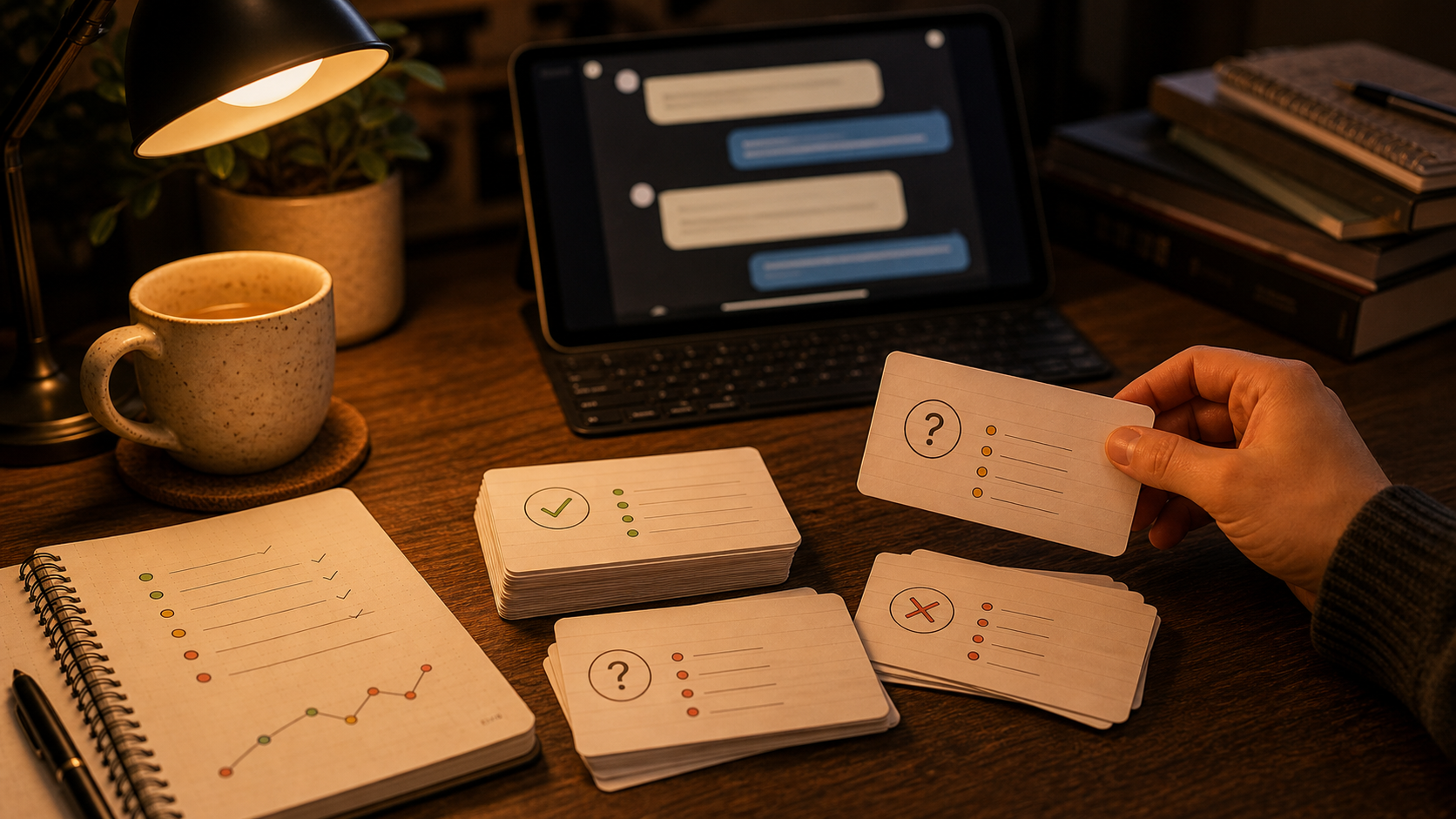
AI study tools finally moved toward question-first learning
This matters more now because the products changed.
OpenAI launched Study Mode on July 29, 2025 and described it as a step-by-step learning experience built around active participation, cognitive load, metacognition, and knowledge checks. Google's Guided Learning write-up says Gemini can walk you through each step and make you do the work rather than only show the result. Perplexity's Learn Mode help page describes the product as search optimized for active learning, with guided questions, gentle hints, mini-quizzes, and study material generated from uploaded notes.
The pattern across these tools is consistent:
- less "here is the answer"
- more "show me what you know first"
- more built-in quizzes, checks, and tutor-style back-and-forth
- more help turning course material into practice instead of just summary
Google pushed that same idea even further in its Learn Your Way announcement, which said students using the experiment scored 11 percentage points higher on a long-term recall test than students using a standard digital reader.
So when people search for ai active recall in 2026, they are not inventing some niche study hack. The major tools already lean that way. What still breaks for most people is the handoff after the session.
Active recall with AI fails when the AI gets too helpful
This is the trap.
You ask for help. The AI gives a clean explanation, a better definition, maybe a neat analogy. You read it and feel the click.
Then you close the tab.
The next day you can still recognize the explanation, but you cannot produce the key idea cleanly on your own. That is not fake learning. It is unfinished learning.
Older retrieval-practice research still matters here. A widely cited classroom review in Educational Psychology Review screened almost 2,000 abstracts, coded 50 experiments, and found that retrieval practice improved learning across education levels, subjects, timing, and test formats, with most effect sizes landing in the medium-to-large range.
Newer AI evidence points the same way. A 2025 empirical study on LLM-generated retrieval practice questions in two college data science courses found higher knowledge retention in the week with LLM-generated practice than in the week without it, while still warning that instructors needed to verify and revise the generated questions.
That also matches what tends to happen in real study sessions:
- reading an AI answer feels smooth
- producing an answer before the AI helps feels harder
- the harder version is usually the one that sticks
So the point of active recall with AI is not to avoid AI. It is to make the AI wait long enough for your brain to do some of the work first.
Use a question-first prompt, not a summary prompt
Most people start with the wrong job.
They ask the AI to summarize the chapter, simplify the topic, or explain the notes. That is fine when you are getting oriented. It is weak when you are trying to remember something later.
If I want AI retrieval practice, I ask for behavior that forces me to answer before the model gets polished:
Teach this like a tutor. Ask one question at a time. Do not give the full answer too early. If I hesitate, answer vaguely, or mix up two ideas, keep track of that weak spot so we can review it at the end.
That one prompt changes the session.
Now the AI is not mainly performing knowledge for you. It is checking whether you can produce any of it yourself.
If you want a slightly stricter version, this one works well too:
Quiz me on this material with short free-response questions. Wait for my answer. Start with a hint if needed, then a fuller correction only after I try. Track anything I miss, answer too slowly, or confuse with a nearby concept. At the end, give me a short weak-spot list and draft flashcards only from that list.
You can make that even stricter:
- ask for hints before answers
- ask for short free-response questions instead of multiple choice first
- ask the AI to compare your answer to the source material you uploaded
- ask it to point out exactly what was missing, not just whether you were "close"
If you are using a tool that already supports this style, good. If not, the prompt gets you most of the way there.
Keep the scope narrow enough that your misses still have names
This part sounds boring, but it saves the workflow.
Do not run active recall against an entire semester at once. Do not ask the AI to "quiz me on biology." That is how you get a vague, flattering session that teaches you nothing specific.
One session should stay pointed at one of these:
- one lecture
- one chapter section
- one concept cluster
- one corrected problem set
- one short reading
Narrow scope makes the misses usable.
At the end of the session, I want a list that sounds like this:
- confused elasticity with slope
- forgot the second step in beta oxidation
- could define TCP but not explain why it fit this scenario better than UDP
- kept missing which clause changed the legal rule
Those are real weak spots. "Needs more work on chapter 6" is not.
If your source starts as notes, a study guide, or a PDF, these companion workflows fit naturally before the recall session:
Save the weak spots, not the whole performance
This is where study mode active recall workflows usually get bloated.
People finish a good AI session and then save all of it:
- the explanation
- the follow-up example
- the hint
- the polished recap
- the card draft
- the transcript
That is too much.
The session should produce evidence, not a transcript you never open again.
I want to keep:
- what I missed
- what I answered too slowly
- what I confused with something nearby
- what sounded obvious only after the AI said it
- what would clearly help if I saw it again next week
Everything else can stay in the chat history.
This is also why the brand-specific tutor workflows keep landing in roughly the same place. Whether the session starts in ChatGPT Study Mode, Gemini Guided Learning, or another tutor-style tool, the part worth keeping is still the same short list of misses.
The best cards preserve the miss, not the polished explanation
This is the handoff that matters.
Say the AI asked you to explain the difference between a shift in demand and a movement along the demand curve, and you kept mixing them up. The weak move is saving the model's beautiful paragraph.
The better move is turning the miss into one or two plain cards:
- Front: What changes demand quantity without shifting the demand curve? Back: A change in the good's own price.
- Front: What causes the demand curve itself to shift? Back: A non-price factor such as income, preferences, or related-goods prices.
Same session. Much better review material.
Here is another simple example:
- Weak spot from the AI session: kept mixing up mitosis and meiosis
- Bad card: Explain the full difference between mitosis and meiosis.
- Better card 1: How many daughter cells does mitosis produce? Back: Two.
- Better card 2: How many daughter cells does meiosis produce? Back: Four.
- Better card 3: Which process reduces chromosome number by half? Back: Meiosis.
That is the basic rule behind ai tutor flashcards:
- one weak spot per card
- short front
- direct back
- enough context to stand alone
- no dependency on rereading the whole AI chat
If the answer needs a paragraph, it probably wants to become several cards or stay in notes instead of going into your review queue.
If your AI already drafted cards for you, How to Fix AI Flashcards in 2026 is the next step. If you want the stricter card-writing rules, How to Make Better Flashcards in 2026 goes deeper.
The workflow I would actually repeat
This only works if it stays short enough to survive a normal week.
Here is the version I would use:
- Pick one narrow topic, reading, lecture, or corrected problem set.
- Ask the AI to tutor in question-first mode.
- Answer before reading the full explanation, by typing or saying the answer out loud.
- Keep a tiny scratch list of misses, hesitations, and repeated confusions while the session happens.
- At the end, ask the AI to summarize only those weak spots and turn them into candidate front/back cards.
- Delete, split, or rewrite anything vague immediately.
- Move the surviving cards into a real review app and let FSRS schedule the next exposures.
That is a much better ai spaced repetition workflow than turning a whole tutoring session into a giant export.
The deck should answer one question only:
What did I fail to retrieve cleanly enough that I want another shot at it later?
Where Flashcards fits
Flashcards fits after the tutoring session, once you know what deserves retention.
There is no magic button that turns a good chat into long-term memory. The useful workflow is simpler:
- use the AI tutor to expose the gaps
- keep the small list of real weak spots
- clean those into straightforward cards
- review them with FSRS over time
That is where Flashcards becomes useful:
- front/back cards for the weak spots you actually found
- decks and tags so the cards stay organized by class, exam, or topic
- AI chat with file attachments when the source starts messy
- FSRS scheduling so the cards come back when they are about to slip
- hosted app if you want to start quickly
If you want the product overview, Features is the fast version. If you want the setup path, Getting Started is the practical one. If you are deciding between hosted use and the self-hosted route, Pricing explains the current tradeoffs more directly than a blog post should.
The rule I would keep
Use AI to make retrieval happen, not to dodge retrieval.
That is the whole thing.
The new tutor modes are getting better for real learning because they ask, pause, hint, and check instead of racing to the answer. That is useful. But the workflow still breaks if you save the whole performance instead of the moments where your memory actually failed.
So if you want how to use AI for active recall in one line:
- let the tutor ask first
- answer before the help arrives
- keep only the weak spots
- turn those into small cards
- let FSRS handle the timing after that
That version is simple enough to keep using after the novelty wears off, which is usually the real test.