How to Fix AI Flashcards in 2026: Edit ChatGPT and NotebookLM Drafts Before You Review With FSRS
Yesterday I deleted 34 out of 58 AI-generated flashcards before the first review. Good. I did not want those cards near my queue.
That is the part people skip when they search how to fix AI flashcards.
The generation step feels like the win. Cards appear fast. The wording sounds polished. The deck looks "basically done" in the dangerous way a rough draft often does when you are tired and a little too willing to trust software.
Then review starts, and the problems show up immediately.
One front side is vague. One answer hides three facts. One card confidently states something the source never said. Two more cards test the same point with slightly different wording. By card twelve, the deck already feels heavier than it should.
That is the real job. AI is getting better at producing flashcard drafts. It is still very normal for those drafts to need a hard edit before they deserve a place in a spaced repetition queue.
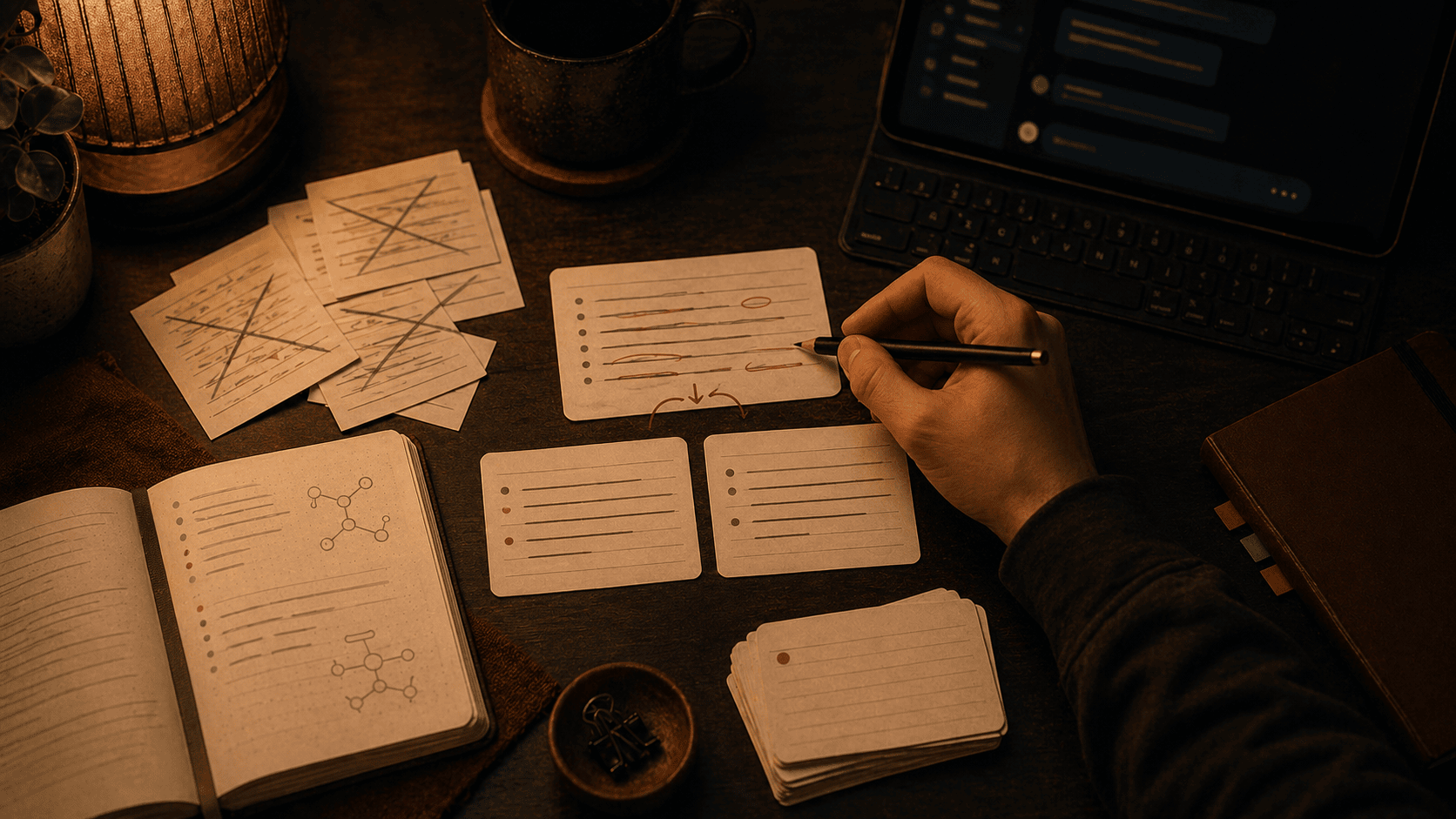
The cards are usually broken in boring ways
Across ChatGPT, NotebookLM, Study Mode follow-ups, PDF tools, and note-to-card generators, I keep seeing the same failures:
- the front is too vague to stand alone
- the back contains multiple answers pretending to be one answer
- the card only works if you still remember the original source
- the wording sounds certain even when the fact needs verification
- the deck contains near-duplicates because the AI kept circling the same idea
Nothing exotic. Just the same quality-control issues, over and over.
AI models are good at compression, paraphrase, and pattern imitation. They are not naturally good at deciding what your tired future self can grade honestly in five seconds. That is a different job.
That is why clean up AI flashcards is a better framing than "find the perfect generator." Cleanup is not proof you chose the wrong tool. It is the normal second half of the workflow.
Fix the deck before the first real review
I would not wait for FSRS to expose the weak cards one review at a time.
You can do that, but it is expensive. Every bad card charges a small tax in attention, hesitation, and annoyance. If the deck starts dirty, the first week of review becomes quality control disguised as studying.
The better move is a short cleanup pass before the cards enter the queue at all.
Not a three-hour editing session. Usually ten or fifteen focused minutes is enough to make the deck much safer.
Start by deleting the cards that never had a chance
This sounds obvious, but people keep trying to rescue mediocre cards because the AI already did the typing.
Delete fast when a card has one of these smells:
- the front asks "why is this important" without naming what "this" is
- the back reads like a paragraph instead of an answer
- the card only makes sense if you still remember the exact article, lecture, or chat turn
- the prompt is broad enough to invite three different correct answers
- the fact looks suspicious and you cannot verify it quickly in the source
The fastest way to fix AI flashcards is usually subtraction.
Bad generated cards are cheap to create and expensive to keep. If a card feels weak on first read, it usually does not become charming later.
Split every card that uses "and" like a cargo container
This is one of the biggest problems in AI decks.
The model gives you a card like this:
- Front: "What are the causes and effects of X?"
- Back: "Cause A, cause B, effect C, effect D"
Technically that is a flashcard. Practically it is a small oral exam.
I would usually split it into separate cards:
- one cause card
- one effect card
- one comparison card if the distinction matters
The same rule applies to definition-plus-example cards, formula-plus-exception cards, and any card where the answer starts turning into a mini outline.
If you want the deeper card-writing version of this idea, How to Make Better Flashcards in 2026 goes further.
Rewrite the front so tired future-you can understand it instantly
The front side should not assume the source is still open in your head.
This is where a lot of ChatGPT flashcards wrong complaints are really card-writing complaints. The model often preserves the local context of a paragraph instead of producing a clean standalone prompt.
Weak AI fronts often look like this:
- "Why did this happen?"
- "What was the main issue?"
- "How did the author solve it?"
- "Why is this method better?"
Better versions name the thing directly:
- "Why did TCP become the better fit than UDP in this case?"
- "What problem does spaced repetition solve better than fixed review intervals?"
- "Why did the study switch from method A to method B?"
That tiny rewrite changes the whole review experience. The card stops relying on recognition theater and starts asking for actual recall.
Verify facts against the source, not against confident wording
This is the step people most want to skip, and the one that saves the most pain later.
NotebookLM, ChatGPT, and other study tools often produce answers that sound cleaner than the source they came from. Sometimes that is useful. Sometimes it quietly changes the claim, removes a condition, or upgrades a guess into a fact.
I would verify aggressively when the card contains:
- numbers
- dates
- exceptions or qualifiers
- steps in a process
- legal, financial, or medical wording
- comparisons between similar concepts
- words like "always," "never," "most," or "least"
If the source is right there, keep it open and check.
If the source is messy, rewrite the card conservatively instead of letting the polished version win by confidence alone.
That is a big part of AI flashcards wrong facts in practice. The card often sounds more finished than the evidence behind it.
Keep the answer short enough that grading stays honest
Long answers slow everything down.
You read the front, think you mostly know it, scan the paragraph on the back, and then start negotiating with yourself about whether your answer was "close enough." That is how a 40-card deck starts feeling like a bureaucratic process.
Keep the back side plain:
- one direct answer
- one short extra detail if it genuinely helps
- maybe one example when the example is the point
Anything beyond that usually wants to become another card.
This matters even more if you care about review speed later. How to Review Flashcards Faster in 2026 is basically the downstream consequence of this editing decision.
Use AI for second-pass editing, not as the final authority
This is the part I actually like. You can use AI again during cleanup, just with a narrower job.
Do not ask:
"Make flashcards from this."
Ask something closer to:
"Rewrite these draft cards so each card tests one fact or concept, remove duplicates, shorten long answers, and preserve only claims supported by the source text below."
That is much better.
Now the model is helping with editing work instead of improvising curriculum design.
I would still check the results, but this second pass can save time when the raw deck is bloated. It is especially useful when you already know the cards are too long and too repetitive and you want help compressing them before manual review.
ChatGPT and Study Mode drafts need one kind of cleanup
When the cards come from ChatGPT, ChatGPT Study Mode, or another tutoring-style session, the biggest problem is usually conversational residue.
The card inherits things that were useful in the session but weak in long-term review:
- hints
- partial answers
- scaffolding phrases
- references to what you "just discussed"
- gentle tutor wording instead of direct recall wording
That is why I would mine those sessions for misses and weak spots, not export the entire conversation into permanent cards. The tutoring session can stay broad. The surviving cards should not.
If your workflow begins earlier than cleanup, these companion pieces are the better fit:
- How to Use ChatGPT to Make Flashcards in 2026
- How to Turn ChatGPT Study Mode Into Flashcards in 2026
This article starts one step later: the cards already exist, and now they need to become reviewable.
NotebookLM drafts need a different kind of cleanup
NotebookLM usually starts from real sources, so the failure mode is slightly different.
The cards are often more grounded, but they still tend to be:
- too broad because one source chunk contained several ideas
- too smooth because the model merged distinctions from different passages
- too loyal to source phrasing when the source itself was wordy
That is why NotebookLM flashcards edit is mostly about narrowing and trimming, not rescuing total nonsense.
I would go through exported or copied cards and ask:
- Is this one concept or three?
- Does the front still work without the document beside it?
- Did the answer keep the important qualifier from the source?
- Would I want to grade this in five seconds?
If not, rewrite or delete it.
The source-to-spaced-repetition bridge is covered more directly in How to Turn NotebookLM Flashcards Into Real Spaced Repetition in 2026. This article is the stricter cleanup pass after that bridge starts.
A simple cleanup workflow that actually holds up
If I were fixing an AI deck this week, I would do it in this order:
- Delete obvious junk and duplicates.
- Split any card that tests more than one thing.
- Rewrite vague fronts so they stand alone.
- Shorten long backs until grading feels clean.
- Verify suspicious facts against the source.
- Only then move the survivors into regular review.
That order matters. Deletion first keeps you from polishing cards that should not survive. Splitting early makes the later edits easier. Fact-checking after the rewrites is faster because fewer cards remain.
It is not glamorous, but it works.
FSRS should schedule cleaned cards, not raw AI drafts
FSRS is the right place for the final deck.
It is not the right place for the first messy draft.
This distinction matters because people sometimes expect the scheduler to compensate for weak cards. It cannot. A strong scheduler can reduce pointless repetition. It cannot turn fuzzy prompts into good retrieval practice.
What FSRS does well is handle timing once the cards are clear enough to trust:
- easier cards stop coming back so often
- harder cards get more believable spacing
- the review queue feels calmer over time
If you want the scheduler comparison itself, FSRS vs SM-2 in 2026 covers that part.
Where Flashcards fits this workflow
Flashcards is a good fit for how to fix AI flashcards because the product already covers the awkward middle that most generators leave behind:
- create front/back cards in the hosted web app
- use AI chat with workspace data and file attachments, including plain text uploads
- browse the collection and clean cards before review
- review the finished deck with FSRS
The useful workflow is not "generate and hope." It is:
- draft cards with ChatGPT, NotebookLM, Study Mode notes, or another AI source
- paste or upload the rough material
- edit the deck until the prompts are clear and the facts are trustworthy
- review the final version with FSRS
That is a much calmer system than leaving the cards stranded inside a chat thread or source notebook.
The better rule
Do not ask whether the AI can make flashcards.
Assume it can make drafts. Then do the smaller, stricter job that actually determines whether the deck will survive three review sessions: delete the weak cards, split the overloaded ones, verify the facts, and only let the cleaned set enter spaced repetition.
That is the version of how to fix AI flashcards I trust in 2026.