How to Use AI to Study in 2026: Keep the Tutor, Add Flashcards That Actually Stick
A student can now upload a messy PDF, ask AI to explain it like a patient tutor, get a short quiz, and feel productive in under ten minutes. Then Friday arrives and half of it is gone.
That is the gap inside a lot of searches for how to use AI to study. The understanding part got much faster. The remembering part did not magically disappear.
So this is the workflow I trust in 2026: use AI for explanation, summaries, and practice questions. Then turn only the parts you actually missed into flashcards and review those with FSRS.
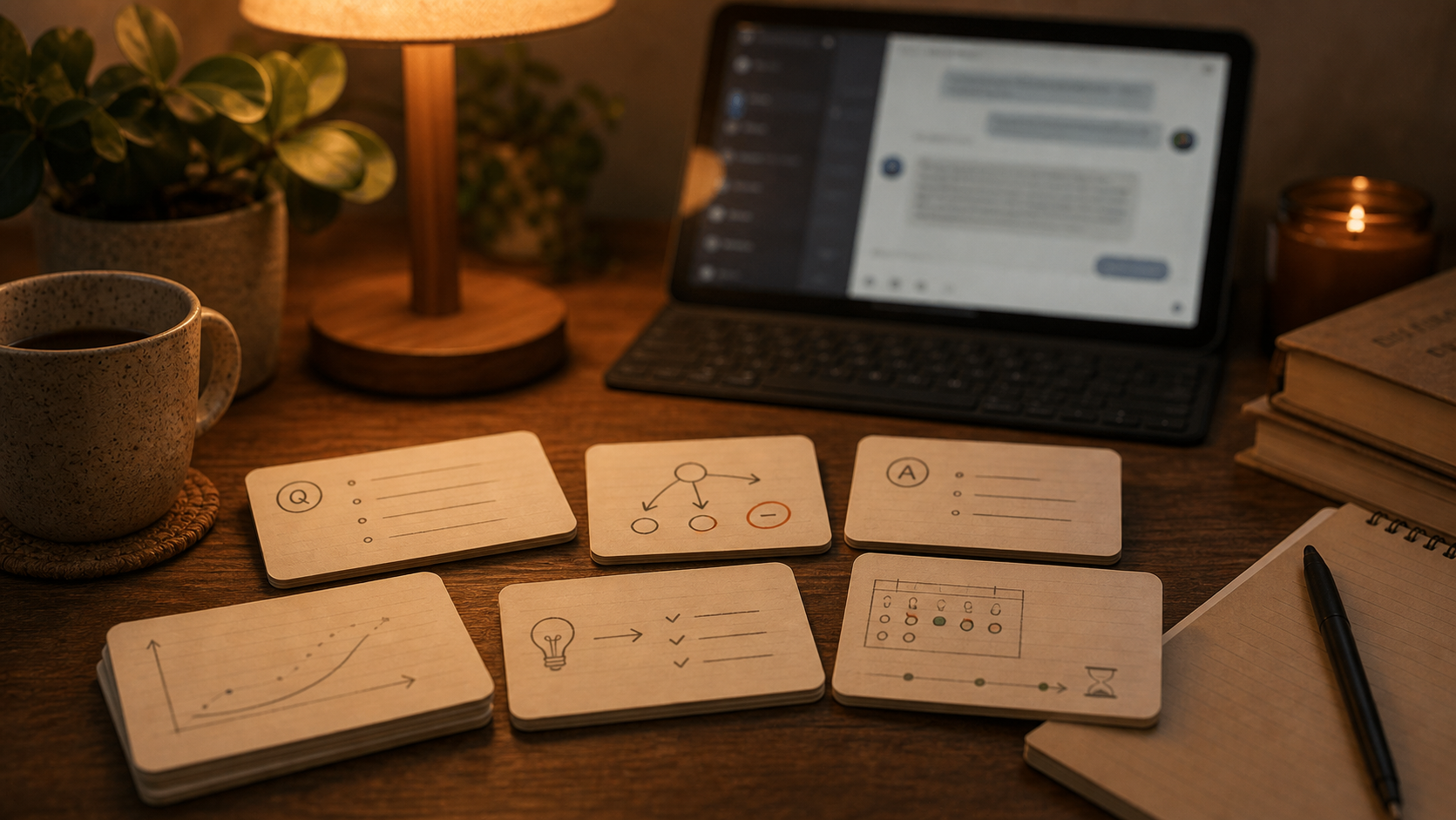
AI got better at tutoring. It did not replace memory.
This topic feels bigger now because the tools changed.
In 2025 and 2026, a lot of AI study products moved away from "here is the answer" and toward guided explanation, quizzes, follow-up questions, and source-based help. That part is real. A modern AI tool can save a lot of time when you are staring at a chapter, a lecture slide, or a messy PDF and do not know where to start.
What it still does badly is decide what belongs in your long-term memory.
If the tutor feels smart, it is easy to assume the whole workflow is handled. Usually it is not.
Modern AI tools are strong at:
- explaining a concept from a different angle
- summarizing long readings or messy notes
- turning one source into a short practice quiz
- helping you work through a PDF, slide deck, or screenshot faster
They are much weaker at deciding what deserves long-term review and what should be forgotten after one session. That is still your job.
That is why I think the best AI study workflow in 2026 is not "replace studying with AI." It is "use AI for understanding, then save only the weak spots into a retention system."
Use AI for understanding first
I would happily use AI for the parts of studying that are slow and annoying:
- clarifying a confusing paragraph
- turning rough notes into a cleaner outline
- asking me questions before showing the full answer
- comparing my answer to the source
- generating a few practice questions from one narrow topic
That is where AI feels most useful to me. It reduces friction without pretending it can do the remembering for you.
A lot of people still search for a chatgpt study workflow, but the pattern is broader than one product. The useful version is the same almost everywhere:
- use AI to understand the material
- let it test you a little
- notice where you were weak
- move only those weak spots into review
The handoff matters. Without it, you end up with a nice session and no durable memory.
Keep the tutor. Do not keep the whole session.
This is the part where people quietly create too much work for themselves.
If your current workflow is:
- upload notes
- ask AI for a summary
- ask for quiz questions
- turn the entire result into flashcards
you are probably making too many cards.
Most AI study sessions contain plenty of material that helped in the moment but reviews badly later:
- setup explanation
- repeated hints
- polished wording you would never need to recall exactly
- partial answers you should not preserve
- filler that only made sense inside that conversation
The better move is simpler: keep the tutoring session for understanding, then turn only your misses, hesitations, and confusions into flashcards.
That is the version of ai tutor flashcards I trust.
The workflow I would actually repeat
- Pick one narrow topic or one short source chunk.
- Ask the AI tool to explain it step by step instead of dumping the final answer immediately.
- Let it quiz you before it explains too much.
- Mark the questions you missed, the terms you mixed up, and the steps you could not recall cleanly.
- Turn only those weak spots into plain front/back flashcards.
- Review the final cards with FSRS.
That is it.
No giant export. No "save everything" deck. No pretending that every decent paragraph from an AI summary deserves a permanent slot in your queue.
If you are already using a guided tutor flow and want the narrower source-conversion version, How to Turn ChatGPT Study Mode Into Flashcards in 2026 goes deeper on that specific path. This article is the broader study-system version.
Study with AI without cheating yourself
This is where the workflow either becomes useful or quietly collapses.
The biggest risk in AI studying is not only wrong facts. It is over-help. The tool is so quick to explain, hint, polish, and rescue that you stop doing enough retrieval to build memory in the first place.
So when people ask me about study with AI without cheating, I would use a few boring rules:
- ask for hints before full solutions
- ask the tutor to quiz you before it explains
- answer in your own words before you read the polished version
- make the AI compare your answer to the source instead of replacing your answer immediately
- stop the session once you understand the idea, then move the weak parts into review
This matters because AI can create fake fluency very easily. You feel good during the session, then discover two days later that the concept never settled.
Understanding is not storage.
That is why I like separating the jobs:
- AI tutor for explanation
- flashcards for retrieval
- FSRS for timing
Each part does one thing well.
What should become a flashcard?
This is the mistake AI makes cheaper.
If the tutor can generate unlimited summaries, questions, and candidate cards, the natural impulse is to save all of it. That feels efficient right up until the review queue starts behaving like a punishment for your past optimism.
I would only make a flashcard when at least one of these is true:
- I missed the question
- I confused it with something similar
- I want the fact or distinction next week, not just today
- the answer can fit on one direct back side
- reviewing it again would clearly help
If a point was easy, obvious, or only interesting in context, I would leave it inside the notes or inside the AI conversation.
This pairs well with two existing problems students run into fast:
The fastest way to break a promising AI study system is still overproduction.
Good AI-study flashcards are still boring on purpose
The tools changed.
The card-writing rules barely did.
A card that survives real review usually does one plain thing well:
- one question or one prompt on the front
- one answer or one tight distinction on the back
- enough context to stand alone
- no paragraph-length explanation unless the paragraph is the point
That is why I would not turn one AI tutoring session into twenty sprawling cards that each feel like mini lessons. I would rather keep six clean cards that target six real memory gaps.
If your AI drafts already exist and now need cleanup, How to Fix AI Flashcards in 2026 is the next step. If you want the more general card-quality rules, How to Make Better Flashcards in 2026 is the better companion.
Keep source work and memory work separate
This is one of the cleanest habits you can build.
Source work is where you:
- read the chapter
- upload the PDF
- ask for the explanation
- generate a few practice questions
- clarify what you do not understand
Memory work is where you:
- review the cards that are due
- rewrite weak prompts
- delete bad cards
- stop adding new material once the queue gets too large
When those two workflows blur together, it becomes very easy to spend an hour feeling productive without doing much retrieval at all.
I think that is why ai flashcards spaced repetition is such an important framing. The value is not just that AI can draft material. The value is that a real review system can hold on to the small part worth remembering.
If you care about the scheduler side specifically, FSRS vs SM-2 in 2026 explains why I would rather put the final cards into FSRS than leave them inside a chat transcript or a static export.
Where Flashcards fits
Flashcards is not the AI tutor for everything.
It fits best as the retention layer after AI tutoring, summaries, and generated questions have already done their job.
That is a good fit because the product already covers the practical next step:
- hosted web app
- AI chat with file attachments
- front/back card creation and editing
- FSRS review scheduling
- offline-first clients
- open-source codebase with a self-hosted path
So the workflow stays honest:
- use your AI tutor or study assistant to understand the material
- bring the useful weak spots into Flashcards
- clean them into simple cards
- review them with FSRS until they actually stick
If you want the product overview first, the features page and getting started guide are the cleanest entry points. If you care about running your own stack, the self-hosting guide is there too.
A realistic weekly rhythm
This is what I think a human-sized study loop looks like:
On Monday, use AI to work through one lecture, chapter, or problem set section.
On Tuesday, turn the misses and confusions into maybe five to fifteen flashcards, not fifty.
During the week, review the due cards with FSRS and add only the new cards you can realistically keep up with.
At the end of the week, delete the cards that still feel vague, overloaded, or pointless.
That is a much calmer answer to how to use AI to study than trying to build a giant auto-generated deck after every session.
The better question is not whether AI can help
It obviously can.
The better question is whether your workflow still creates retrieval, judgment, and repetition after the impressive AI moment passes.
For me, the best 2026 version looks like this:
- let AI teach
- let AI summarize
- let AI generate a few questions
- keep only the parts you actually failed to retain
- review those with spaced repetition
That gives you the speed of AI without pretending the speed is the same thing as memory.
And that is why I would keep the tutor, add the flashcards, and stay unusually skeptical of any system that promises to study for you instead of with you.