Flashcards vs Practice Tests in 2026: When to Use Each and How to Combine Them
Wednesday night I scored 18 out of 22 on a practice set, closed the laptop feeling decent, and still blanked on two definitions Thursday morning. That is the whole flashcards vs practice tests problem in one small, annoying loop.
People usually ask this when they are already studying hard and still do not trust what will be there next week or on exam day. They have notes, maybe an AI tutor, maybe a stack of quiz results, and they are trying to decide what actually deserves time.
The short version is simple:
- use flashcards for small pieces you want to retrieve again later
- use practice tests for mixed, exam-style retrieval under a little pressure
Most students do worse when they force one tool to do both jobs. Flashcards alone can leave you good at isolated facts and shaky on applied questions. Practice tests alone can turn into repeated rediscovery of the same weak spots, with no retention system for the fix.
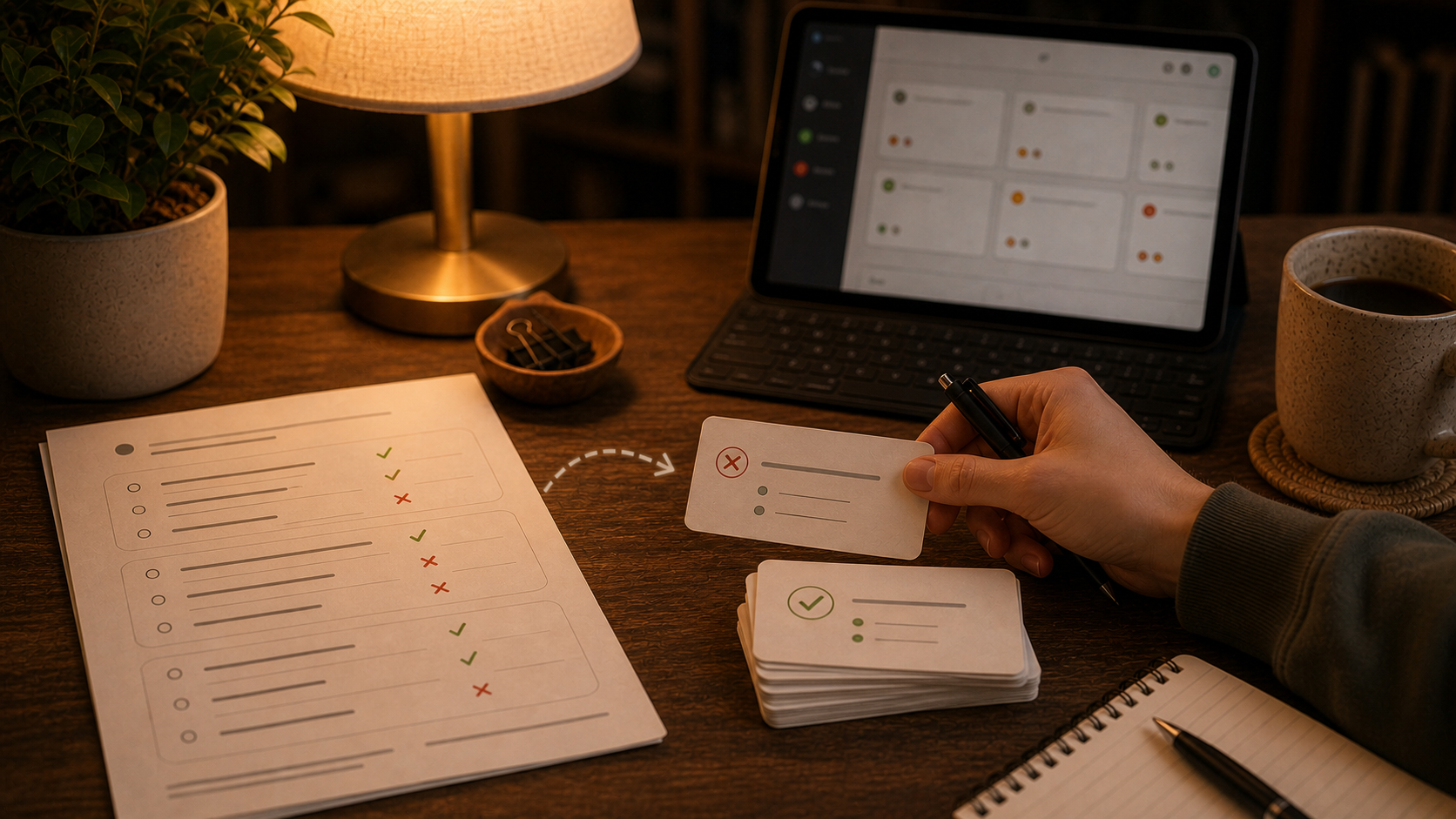
This question got louder in 2026
Part of the confusion is that study tools now offer both outputs from the same source material.
OpenAI's Study Mode leans into guided questions and knowledge checks. Google's NotebookLM app update from November 6, 2025 pushed quizzes and flashcards into the same mobile workflow. Meta published a June 5, 2026 guide to making practice exams from uploaded study material.
So students now see one pile of notes and get offered three buttons:
- make flashcards
- make a quiz
- make a practice exam
That looks like a format choice. Usually it is a memory-job choice.
Flashcards are better when the target is small and reusable
Flashcards work best when the answer is short, stable, and worth seeing again after today.
That usually means:
- definitions
- formulas
- vocabulary
- anatomy labels
- historical dates you actually need
- confusing pairs
- steps that are easy to swap
- rules with one key exception
This is where spaced repetition earns its keep. You are not only checking whether you know the answer now. You are deciding that the answer should still be available next week, next month, or by finals.
That is why flashcards help so much with the "I studied all day and forgot it the next morning" feeling. The material often made sense in the moment, but nothing kept bringing back the parts that were about to fade.
If you want the timing rule for card creation itself, When to Make Flashcards in 2026 is the direct companion.
Practice tests are better when the task is bigger than one card
Practice tests and practice questions do a different job.
They show whether you can still use the material when:
- the topic is mixed with other topics
- the wording is unfamiliar
- you have to choose between tempting answer options
- the problem takes several steps
- the exam is timed
- the skill is closer to diagnosis, analysis, or application than raw recall
Practice tests often tell the truth faster than rereading or even a clean deck because they expose whether the pieces still work together.
A biology flashcard might ask:
- What organelle is responsible for ATP production?
A practice question might ask you to read a short passage, notice which experimental change affects ATP output, and choose the best explanation.
The Cell Organelle Flashcards package is a bounded example of the first job: 48 text-only cards pair 24 common structures with their primary functions in both directions. It does not cover diagrams, pathways, or the applied reasoning in the practice question.
Those are related.
They are not interchangeable.
Practice tests are especially important once the course starts caring about judgment:
- math and physics problem solving
- economics interpretation
- reading comprehension
- nursing prioritization
- clinical scenarios
- law-school issue spotting
- standardized-test pacing
Flashcards can support those subjects. They usually cannot stand in for the full task.
The easiest rule: flashcards store pieces, practice tests stress the pieces
This is the cleanest way I know to separate them.
Flashcards ask:
- Can I retrieve this one thing?
Practice tests ask:
- Can I still use the right things when the question gets messy?
That is why the overlap feels real. Both are active recall. Both can expose weakness. Both can help memory.
The difference is granularity: flashcards zoom in, practice tests zoom out.
If you already liked the framing in Active Recall vs Spaced Repetition in 2026, this article sits one layer beside it: not "test now or schedule later," but "which kind of test reveals the problem you actually have?"
When flashcards are the wrong main tool
I like flashcards a lot. They still fail in predictable ways.
They are a weak main tool when:
- the answer needs a paragraph to be honest
- the skill is mostly problem solving
- the exam rewards choosing a method, not recalling a fact
- the material depends heavily on context
- you are using cards to avoid doing the harder practice set
That last one is common. A deck feels organized. A practice set feels risky. So people keep polishing cards because cards feel cleaner than missing questions in public, even if "public" only means the score report on their own screen.
If flashcards keep disappointing you, Why Flashcards Do Not Work in 2026 covers the broader failure modes.
When practice tests are the wrong main tool
Practice tests also break when people use them for everything.
They are a weak main tool when:
- you keep missing the same small facts
- you never store the misses anywhere
- the source of failure is one exact distinction
- you need long-term retention, not just this week's score
- you are burning full-length tests to learn content that should have been smaller first
I see this a lot with students who say they do practice questions all day and still forget the content later. Usually the questions did their diagnostic job. The follow-up job never happened.
They found the holes. They just did not build a retention layer for the holes worth keeping.
That is where How to Turn Practice Questions Into Flashcards in 2026 fits. The useful move is not turning every question into a card. It is preserving the repeated weak spots in a cleaner form.
A quick decision table
If you want a boring rule you can actually use, this is the one I would keep nearby:
| Use flashcards when... | Use practice tests when... |
|---|---|
| The answer is short and stable | The answer depends on interpreting the question |
| You want the fact next week, not only tonight | You need exam-like pacing or stamina |
| You keep mixing up two close ideas | You need to choose between plausible options |
| The miss can become a clean front/back card | The task takes multiple steps |
| You are fixing a repeated memory gap | You are checking whether the pieces still work together |
If both columns feel true, that usually means you need both in sequence.
The best workflow is usually sequential, not competitive
This is the part that saves the most time. Do not ask whether flashcards or practice questions should own the whole course. Give each one a narrower job.
The workflow I trust looks like this:
- Learn one small chunk from notes, lecture, textbook, or AI tutor.
- Make a small set of flashcards for the core facts, distinctions, or steps that clearly deserve retention.
- Do a focused practice set or mini practice test on that chunk.
- Review the misses and slow answers.
- Add only the reusable weak spots to the deck.
- Later, use bigger practice sets and full-length exams to check integration and pacing.
That sequence keeps the deck from becoming a second textbook. It also keeps practice tests from turning into repetitive rediscovery.
If you want the source-based quiz side first, How to Make a Practice Exam From Your Notes With AI in 2026 is the companion piece.
Do not duplicate the same idea in both formats without a reason
This is where people quietly create extra work.
Say you missed a question because you confused mitosis and meiosis.
You probably do not need:
- the full original multiple-choice question saved forever
- three screenshots of the explanation
- one giant flashcard asking for the whole comparison
- a second giant flashcard copied from the answer key
You probably need a smaller cleanup:
- one or two flashcards for the exact difference you missed
- maybe one more practice question later to check whether the distinction survives in context
That is enough. The goal is to stop missing the same thing twice, not to preserve the entire study event.
This is also where students overbuild decks. If your queue is already getting rude, How Many New Flashcards Per Day in 2026 and How to Review Flashcards Faster in 2026 are worth reading before you add another 40 cards from one practice session.
If you forget everything the next day, the issue is usually between the two
That complaint shows up constantly because people often do one of these two broken loops:
Broken loop one:
- read, highlight, do a quiz, move on
Broken loop two:
- generate a huge deck, review definitions, never test under exam conditions
The first loop gives you diagnosis without storage. The second gives you storage attempts without enough realistic retrieval.
The fix is not glamorous:
- use questions to expose the weak spots
- use flashcards to keep the small weak spots that are worth another look
- go back to bigger questions later and see whether the fix transferred
That is usually how "I forget everything the next day" turns into "I still missed a few things, but now I know exactly which few things."
Where Flashcards fits honestly
Flashcards is not the product I would describe as a full practice-test platform.
It fits better as the retention layer after explanation, tutoring, quizzes, and practice questions have already done their job.
That makes the product fit well here:
- create front/back cards from the specific misses that keep repeating
- use AI chat with workspace data and file attachments when the source material is messy
- organize cards by deck and tags instead of leaving them in quiz screenshots and chat transcripts
- let FSRS handle the timing once the cards are small enough to deserve repeated review
If you want the fast product overview, Features is the shortest version. If you want the practical setup path, Getting Started is the better next stop.
The honest pitch is smaller than a lot of study-software marketing:
Use the practice test to find the problem.
Use Flashcards to keep the part of the problem that should still be fixed later.
A realistic weekly rhythm
This is the version I would actually repeat during a normal semester:
Monday: learn one topic and make a few cards from the parts that are clearly worth keeping.
Tuesday: do a small practice set on that same topic.
Wednesday: turn repeated misses into 3 to 8 additional cards, not 25.
Later in the week: review due cards with FSRS and do another mixed set to check whether the correction held up.
Weekend or pre-exam block: use a larger practice test for timing, pressure, and topic mixing.
That gives each tool a job without turning your whole study system into maintenance.
So which one should you use?
Use flashcards when the problem is "I need to remember this specific thing later."
Use practice tests when the problem is "I need to prove I can still use the material when the question stops being nice."
Use both when the course expects both memory and performance, which is most real courses.
That is why flashcards vs practice questions is usually the wrong fight.
The better question is where the current failure lives:
- in the small retrievable pieces
- or in the bigger exam-style performance
Once you know that, the next step gets much less mysterious.