What Should Go on a Flashcard in 2026? A Practical Filter for Notes, AI Drafts, and Lecture Slides
Monday night I watched an AI study tool turn twelve lecture slides and two pages of notes into 84 draft flashcards in less time than it took me to make tea. The speed was nice. The draft was not the win. The real work started one minute later, when I had to decide whether any of those cards deserved to follow me into next week.
That is the real version of what should go on a flashcard in 2026.
Making cards is easy now. Keeping only the ones worth reviewing is the hard part.
A flashcard is not a saved sentence. It is a promise that future-you will see this thing again, grade it, and spend time on it. Once you look at cards that way, the filter gets stricter in a healthy way.
The standard I trust is simple: a fact, distinction, or step belongs in a deck only if it is useful later, easy to test cleanly, and likely to slip without review.
That sounds harsh. Good. Better decks usually start with more deletion.
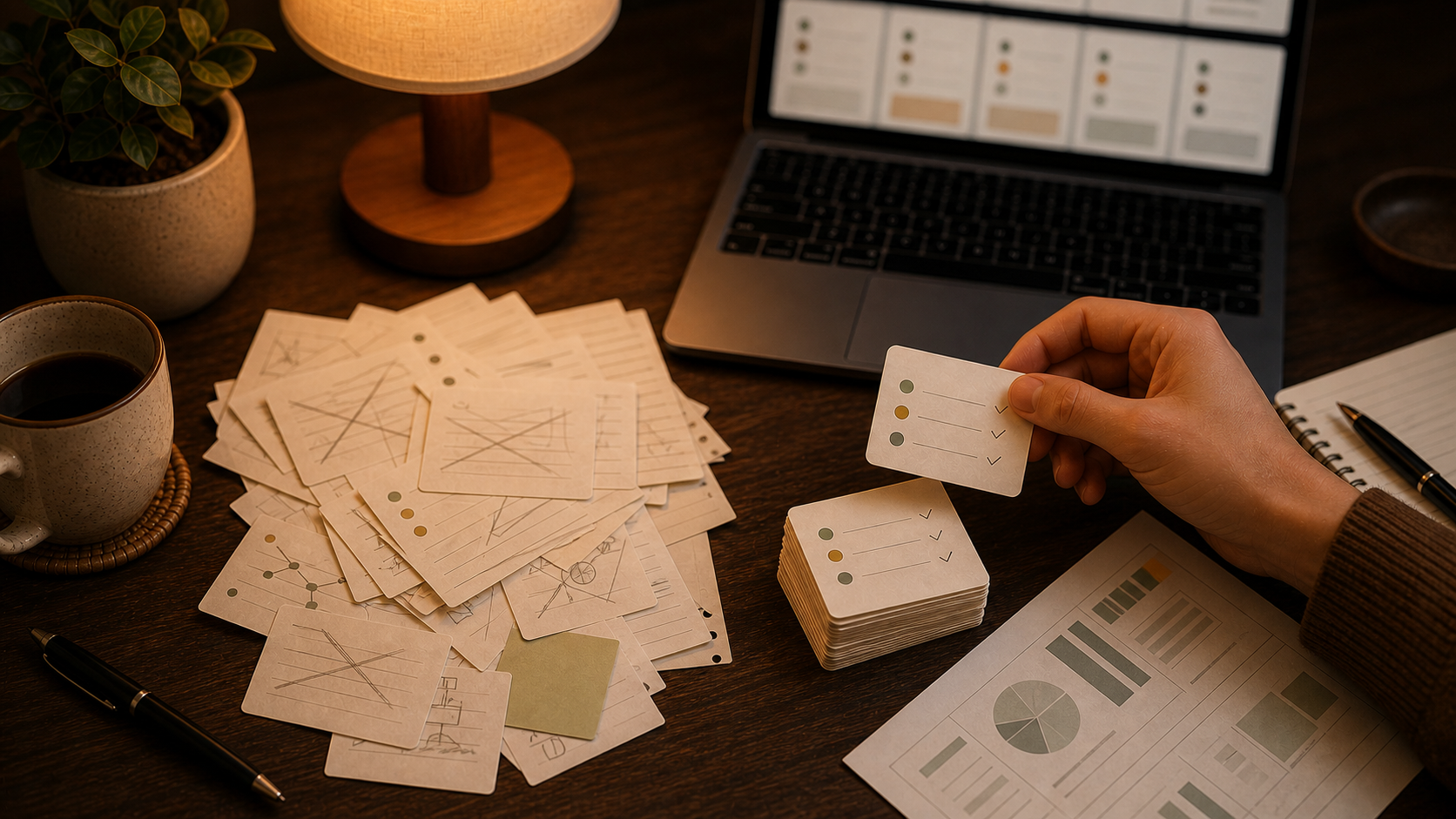
A card should earn its reviews
When people ask what belongs on a flashcard, they often mean "What seems important?" That is too fuzzy to help.
I would use four checks instead:
- you are likely to forget it without review
- getting it right would actually help on an exam, in practice, or in later understanding
- you can ask for it with one clear prompt
- the answer is stable enough to verify right now
If one of those breaks, the material probably belongs somewhere else:
- in notes if it adds context
- in a summary if it helps with broad understanding
- in the source if it is useful once but not worth repeated retrieval
- nowhere if it is filler
This is the part people skip when an AI tool can draft fifty cards from anything. The generation looks productive, so the acceptance step disappears. Then the deck gets heavier, while the actual learning gets worse.
FSRS can space good cards well. It cannot rescue weak ones.
Good cards usually come from friction
The cards that survive longest in my decks usually come from material that already caused trouble.
That trouble might look like:
- a definition you keep mixing up with the next one
- a process step you always leave out
- a condition on a formula that keeps disappearing from memory
- a comparison that changes the answer
- a missed practice question you do not want to miss twice
- an exception that breaks your first instinct
That is what I mean by card-worthy notes. Not "everything I highlighted." More like "the lines that would still catch me next week."
If something felt obvious, temporary, or only interesting in the moment, it usually does not deserve scheduled review. The deck should preserve future trouble, not your past attempt to be thorough.
How to Turn Practice Questions Into Flashcards in 2026 works well for exactly this reason. Missed questions already tell you where the friction is.
Most bloated decks start here
People save:
- every bullet from the lecture slides
- every bold term from the textbook
- every AI-generated card that sounds polished
- every sentence from their notes because deleting feels wasteful
That is how you end up making flashcards from every sentence and calling it good study hygiene.
Most of that material should stay out of the deck:
- broad summaries that are better understood than memorized
- examples that helped once but do not need scheduled review
- sentences that only make sense with the full slide or paragraph open
- one-off numbers or dates you do not actually need later
- repeated paraphrases of the same idea
- AI filler that sounds clean but tests nothing cleanly
If the front makes tired future-you reconstruct the whole page before even answering, skip it.
If the back reads like a paragraph, split it or leave it in notes.
If a card is correct but trivial, delete it anyway.
Use three piles: keep, rewrite, skip
When I am sorting note fragments or AI drafts, I do not use a complicated scoring system. I want three piles.
Keep
Keep the card if it already tests one thing, uses language you can grade honestly, and points to something you would be glad to remember later.
Examples:
- Front: What changes quantity demanded without shifting the demand curve? Back: A change in the good's own price.
- Front: Which stage comes after metaphase in mitosis? Back: Anaphase.
Rewrite
Rewrite it if the idea matters but the card is clumsy.
Usually the problem is one of these:
- the front is vague
- the back is overloaded
- the card duplicates another card with slightly different wording
- the answer is buried inside explanation
- the useful fact is wrapped in too much source context
If the idea is worth keeping, tighten it. How to Make Better Flashcards in 2026 goes deeper on that part.
Skip
Skip it if the idea does not survive outside the source, is too broad to test cleanly, or simply is not worth seeing again next week.
This is where good flashcard selection matters more than beautiful formatting. A polished low-value card is still a low-value card.
Notes are not a queue
This is the mistake I see most often: treating notes as a waiting room for future flashcards.
Notes have a wider job. They help you follow the lecture, capture examples, keep context, and mark what might matter. Flashcards do a narrower job. They trigger retrieval later.
So when you ask which notes deserve flashcards, I would look for:
- what you got wrong
- what you almost got wrong
- what you had to stop and decode twice
- what will still matter after the source is gone
I would not aim for completeness.
When to Make Flashcards in 2026 covers the timing question in more detail, but the short version holds up: understand the chunk first, then card the parts that still feel slippery.
Treat AI drafts like candidates, not decisions
This is the biggest shift for 2026.
AI can draft cards from notes, files, and study sessions fast. Fine. Let it draft. The mistake is acting as if drafted means approved.
I like thinking in terms of promotion rate.
If an AI batch gives you 100 candidates and only 12 survive, that can be a great batch. If 70 survive because deleting feels rude, you are building review debt.
That is the real answer to AI flashcards too many cards. The important number is not how many were generated. It is how many are strong enough to schedule.
I keep AI drafts when they do one of these jobs well:
- turn a messy note into a clean prompt
- split one overloaded idea into smaller retrieval targets
- surface a distinction I actually need later
- compress a missed question into a reusable card
I reject them when they mostly do this:
- paraphrase the page
- restate the slide title
- preserve tutor chatter from a study session
- produce five versions of the same definition
- sound more certain than the source
If the batch already exists and needs cleanup, How to Avoid AI Flashcard Overload in 2026 and How to Fix AI Flashcards in 2026 cover the repair work. This article is the filter that comes before that.
Slides are short. That does not make them card-ready
Lecture slides trick people because the text is already compressed. It looks like card material before you think about what the slide was doing in the room.
A lot of slide content is just shorthand for the instructor:
- headings
- speaking prompts
- one-line examples
- diagrams that needed narration
- lists that only made sense during class
Slides can still be useful source material. They just need interpretation first.
The best slide-derived cards usually come from:
- labeled structures
- process order
- precise terms
- comparisons the lecture kept returning to
- facts the instructor clearly treated as high-yield
The worst ones usually sound like this:
- "Why is this important?"
- "What was the point of this slide?"
- "How does this process work?"
Those are not clean retrieval prompts. They are signs the idea still belongs in notes.
If lecture material is your starting point, How to Turn Lecture Recordings Into Flashcards in 2026 helps upstream. The selection step still matters after the draft.
Textbooks feel official, so people over-card them
Textbooks create a different kind of temptation. Everything looks serious, so everything starts feeling card-worthy.
Usually a textbook page contains at least four layers:
- the core fact or rule
- the explanation around it
- the examples
- the scaffolding that makes the chapter readable
Only some of that belongs in spaced repetition.
I would usually card:
- exact definitions that matter
- distinctions between similar concepts
- sequences, steps, or processes
- exceptions, thresholds, and conditions
- facts that keep showing up in questions
I would usually not card:
- introductory scene-setting
- smooth prose that is easy to recognize and hard to retrieve
- every anecdote
- every sentence that felt important because it was printed in a textbook
This is where how to filter flashcards stops sounding like productivity advice and starts sounding like editing. You are deciding what survives compression.
If the answer needs a small speech, the card is too broad
This rule removes a lot of weak cards fast.
During review, you want to know whether you got the answer or not without negotiating with yourself. Long answers ruin that.
A card gets suspicious when the back needs:
- multiple clauses joined by "and"
- a mini-outline
- several examples to explain the point
- half the chapter's terminology to make sense
Sometimes the fix is to split the card.
Sometimes the honest answer is that the material should stay as a note, summary, or concept map instead of turning into a flashcard at all.
A flashcard app is not storage for every useful sentence. It is a retrieval system.
Bigger source, smaller acceptance rate
This feels backward until you try it.
The larger the source material, the harsher the filter should become.
One chapter does not deserve one chapter-sized deck. A dense AI tutoring session does not deserve a transcript export. A sixty-slide lecture does not deserve sixty cards by default.
That is one reason I prefer small source chunks:
- one lecture segment
- one textbook subsection
- one set of missed questions
- one narrow AI tutoring session
Smaller chunks make duplicates and weak prompts easier to spot. Once you start from the entire pile, everything begins to look equally valuable. It is not. Most of it is support material. A small slice is review material.
The filter I would actually use
If you want a plain answer to how to decide what goes on a flashcard, this is mine:
- Learn one small chunk first.
- Mark the facts, steps, distinctions, and misses that still feel slippery.
- Draft candidate cards yourself or with AI help.
- Delete anything trivial, duplicated, vague, or source-dependent.
- Rewrite the few cards that matter but are still clumsy.
- Promote only the survivors into real review.
That is the whole workflow.
Nothing fancy. That is part of why it works.
Where Flashcards fits
Flashcards works best after you stop treating every source sentence as a future card.
The useful workflow is narrower:
- create or draft front/back cards from notes, files, or AI-assisted study sessions
- edit them until each card tests one thing clearly
- organize the survivors by deck or tag
- review the final set with FSRS
That matches the public product surface today: card creation, AI chat with file attachments, deck organization, and scheduled review. If you are setting that up for the first time, Getting Started is the shortest path.
The goal is not to prove you captured everything.
The goal is to keep the small set of facts and distinctions that will actually help when they come back on the right day.
That is what should go on a flashcard in 2026.
Not every sentence you can convert. Not every polished AI draft. Not every highlighted line from a lecture or textbook.
Just the material that still earns another review.