JLPT Flashcards 2026: Kanji, Grammar, and Listening
The two JLPT sittings in 2025 recorded 1,940,852 applicants across 92 countries and areas, 12.9% more than in 2024 (official past test data). Yet the organizers no longer publish a Test Content Specification containing a fixed vocabulary, kanji, and grammar list.
Useful JLPT flashcards start with the decisions in the official question types. Read a kanji inside a word, choose a paraphrase from context, put sentence chunks into grammatical order, and save the exact clue you missed in reading or listening practice. Keep complete passages, timed sections, and audio-first listening outside the deck, where you can still practice the full task.
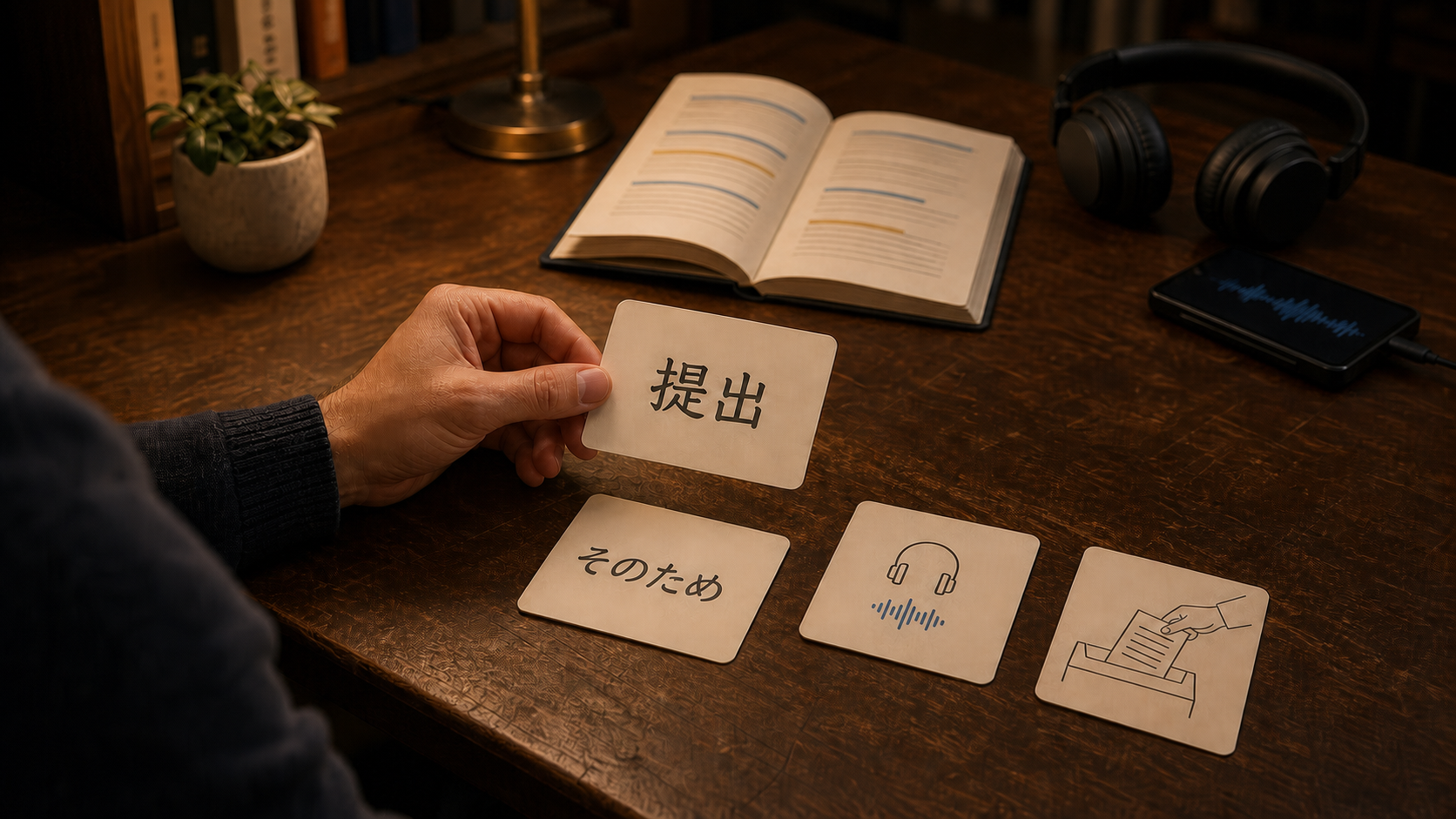
Build around the official question types
The JLPT organizers publish the test sections and item types for every level. They also provide one sample question for each item type and two larger official practice workbooks.
Those pages are a better deck outline than a download called “all JLPT words.”
The official FAQ explains why the Test Content Specification disappeared after the 2010 revision. The test measures language knowledge and the ability to use it for communicative tasks. The organizers therefore decided that publishing a specification with lists of vocabulary, kanji, and grammar items was not appropriate (JLPT FAQ).
This does not make third-party textbooks or lists useless. They can provide a practical curriculum. Label them accurately, though: a publisher’s N3 vocabulary list is that publisher’s interpretation, not a complete official JLPT list.
The item types give you a reliable map:
| Official item-type group | Levels where it appears |
|---|---|
| Kanji reading, contextually defined expressions, and paraphrases | N1–N5 |
| Orthography | N2–N5 |
| Vocabulary usage | N1–N4 |
| Word formation | N2 only |
| Grammar-form selection, sentence composition, and text grammar | N1–N5 |
| Short-passage, mid-size-passage, and information-retrieval reading | N1–N5 |
| Long-passage comprehension | N1 and N3 |
| Integrated and thematic reading | N1 and N2 |
| Task-based, key-point, and quick-response listening | N1–N5 |
| General-outline listening | N1–N3 |
| Verbal-expression listening | N3–N5 |
| Integrated listening | N1 and N2 |
This table shows why changing levels should change part of your deck. N5 does not have the vocabulary-usage item type. N2 alone has word formation. N1 and N2 include comparison and integration across multiple texts or listening information sources. A general Japanese deck may improve your language, but it does not automatically cover the decisions made at your JLPT level.
If you are still learning the script, Hiragana Flashcards: All 46 Basic Characters with Romaji provides exactly 92 cards covering all 46 modern basic hiragana in both kana → Hepburn-style learner romaji and romaji → kana directions. It is a foundational script drill, not an official JLPT list or a substitute for level-specific vocabulary, grammar, reading, and listening practice.
The matching basic katakana deck covers all 46 modern basic katakana with 46 katakana-to-romaji cards and 46 romaji-to-katakana cards—92 independently reviewed cards in total.
For kanji, JLPT N5 Kanji Flashcards: 80 Beginner Characters & Readings is an installable, offline-ready study set built around 80 independently selected N5-aligned characters. Its 120 cards combine recognition with selective production and anchor priority readings in common words; the deck is unofficial and does not claim to be an exhaustive JLPT list.
Turn kanji and vocabulary into small decisions
A card with 提出 = submission may help at first. The official item map asks for more than a translation. Depending on the level, vocabulary work includes reading kanji, selecting the written form, understanding meaning from context, finding a close paraphrase, judging usage, or recognizing word formation.
Give each card one of those jobs.
Read the kanji inside a real word
Use a short original sentence so the reading belongs to a word and context:
Front
申込書を提出してください。

「提出」の読み方は?
Back
ていしゅつ
to submit; to hand in
Do not turn the back into a dictionary page. If the word has several common readings or meanings, test the one used in this sentence and make another card when a second use matters.
For N2 through N5, orthography deserves a separate direction. Show the reading in a sentence and retrieve the kanji; N5 also tests katakana for words written in hiragana. Recognition and production can fail independently.
Ask for the contextual meaning or paraphrase
All five levels include contextually defined expressions and paraphrases. A useful prompt preserves enough context to decide:
Front
会議は来週に延期になった。

「延期」に近い意味は?
Back
予定していた日を後に変えること
postponement; moving the planned date later
The English gloss is support, not the whole answer. As your level rises, use Japanese explanations and closer Japanese alternatives more often.
Test usage with a sentence you have to judge
For N1 through N4, add cards that distinguish a word you recognize from a word you can place naturally.
Front
「支障」の使い方として自然なのはどちら?

A. 電車が少し遅れたが、仕事に支障はなかった。
B. 電車が少し遅れたが、仕事を支障しなかった。
Back
A

「支障がある/ない」または「支障を来す」の形で使う。
The example sentence is original. Check its meaning and naturalness with a trusted dictionary, teacher, or source before saving it. AI can suggest candidates, but fluent-looking Japanese is not proof that the card is correct.
Images and other media can help when the answer is genuinely visual: a sign, an object, or a distinction between similar forms. Avoid adding a decorative picture to every word. The hidden answer still needs to require recall.
Grammar cards should make you choose or assemble
Every JLPT level includes three grammar item types: selecting a grammar form, composing a sentence, and judging grammar in the flow of a text. Three matching card shapes cover more useful ground than a stack of grammar labels.
For grammar-form selection, hide the part that carries the decision:
Front
この資料は初心者___分かりやすい。

Choices: に / にも / には
Choose the option meaning "even for beginners."
Back
にも

この資料は初心者にも分かりやすい。

にも means "even for beginners" here.
Add a short explanation only when it helps you distinguish a tempting alternative. A card that accepts several reasonable answers needs more context or a clearer prompt.
For sentence composition, place the chunks on the front:
Front
並べ替える:
駅 / まで / 歩いて / どのくらい / かかりますか
Back
駅まで歩いてどのくらいかかりますか。
Say or write the full sentence before revealing it. Silent recognition makes an ordering card feel easier than it is. Use every chunk, and revise the prompt if more than one order produces a natural sentence.
Text grammar needs at least two connected sentences:
Front
電車が止まっていた。___、約束の時間に間に合わなかった。

Choices: しかし / そのため / たとえば
Choose the expression meaning "therefore" that links the cause to its result.
Back
そのため

そのため means "therefore" and introduces the result.
Later, test the same connector in a fresh paragraph. The card retains the relationship; a new context shows whether you can use it.
Save the reading mistake, leave the passage intact
Reading questions measure comprehension of connected text. The official purposes vary by level: N5 uses easy short and mid-size texts plus information retrieval, while N3 adds longer texts and logical development. N1 and N2 include tasks that compare or integrate multiple texts and identify broader themes or intended points.
Copying a whole passage onto a card removes the conditions that made it difficult. It can also reproduce copyrighted material unnecessarily; the JLPT organizers explicitly prohibit unauthorized reproduction of test questions (JLPT FAQ).
Complete the passage in its original practice source. Then classify the miss:
- unknown word or reading
- grammar relationship
- reference word such as
それorこの点 - cause and result
- contrast or change in the author’s position
- difference between two texts
- condition overlooked in a notice, schedule, advertisement, or form
- time pressure rather than a knowledge gap
The first seven categories can produce a useful card. Running out of time needs timed reading, not a card that says “read faster.”
Suppose you selected the wrong reason for an author’s objection. Your repair card could say:
Front
Practice set 4, reading 2:
Why was the cost example not the author's main reason
for opposing the proposal?
Back
The cost was supporting evidence. The stated objection
was insufficient preparation time.

Miss: I treated the cost example as the main reason.
Source: [book or official workbook, page]
This card stores the exact distinction and the trap you followed. It does not reproduce the passage or answer choices. If the prompt does not make sense on its own, rewrite or delete it. Then try an unfamiliar passage with the same reasoning demand.
For information-retrieval mistakes, save the selection rule:
Front
案内から条件に合う選択肢を探す前に、何を確認する?
Back
Required date or time, eligibility conditions, and exclusions.
The official item type is present from N5 through N1. The source materials and complexity change, while the habit of checking every condition remains useful.
Turning practice questions into flashcards gives a fuller workflow for reducing a missed question to one reusable lesson. Keep the next unfamiliar passage in your plan; flashcards and practice tests measure different parts of readiness.
Listening starts before the transcript appears
A transcript is excellent for diagnosis. It is poor listening practice when you read it first.
Use official sample audio or another authorized listening source in this order:
- Read only the instructions and any information the item gives before playback.
- Listen once without the transcript.
- Choose an answer and record how certain you were.
- Check the answer.
- Replay the audio for diagnosis and locate the moment that caused the mistake.
- Open the transcript and identify the exact sound, word, grammar form, intention, or relationship you missed.
- Make a card only for that reusable gap.
- Close the transcript and replay the audio.
The official JLPT sample collection provides audio, scripts, and answers for N1 through N5. It was published to explain the 2010 revision; the page warns that actual question counts differ and that some directions have since changed. Use the current item-type page to confirm the task structure.
A transcript-repair card might look like this:
Front
「念のため、もう一度確認しておきます。」

「念のため」が示す話し手の判断は?
Back
問題があると決めたのではなく、用心のために確認する。
The speaker checks as a precaution.
Then listen for the expression in a new recording. Text review can preserve the meaning you missed; it cannot prove that you recognize the phrase at natural speed.
Match practice to your level’s listening types. N3 through N5 include verbal-expression items tied to situations and illustrations. N1 and N2 instead include integrated comprehension of multiple pieces of information. N1 through N3 include general-outline comprehension, while every level includes task-based comprehension, key points, and quick response.
For task-based and integrated listening, save the relationship that failed: who must act, what condition changed, which option satisfies all constraints, or how two speakers’ views differ. Keep the full recording as an audio-first task. A transcript excerpt on a card is the repair, not a substitute performance.
Let your level decide the study balance
The official 2026 test schedule and section guidance lists Sunday, July 5 and Sunday, December 6. Outside Japan, some cities hold the test only once, so confirm the local schedule and registration details.
Section timing also changes by level:
| Level | Language knowledge and reading | Listening |
|---|---|---|
| N1 | Combined vocabulary, grammar, and reading: 110 minutes | 55 minutes |
| N2 | Combined vocabulary, grammar, and reading: 105 minutes | 50 minutes |
| N3 | Vocabulary: 30 minutes; grammar and reading: 70 minutes | 40 minutes |
| N4 | Vocabulary: 25 minutes; grammar and reading: 55 minutes | 35 minutes |
| N5 | Vocabulary: 20 minutes; grammar and reading: 40 minutes | 30 minutes |
The official page notes that allotted times may change and that listening time can vary slightly with the length of the recordings. N1 and N2 combine language knowledge and reading into one test section. N3, N4, and N5 separate vocabulary from grammar and reading. Your study sessions should occasionally follow that structure, including the transitions and sustained attention that cards do not train.
The scoring structure is another reason to keep the deck balanced. N1 through N3 report separate Language Knowledge, Reading, and Listening scores. N4 and N5 combine Language Knowledge and Reading, with Listening separate. Passing requires the overall pass mark and every sectional pass mark, according to the official score-section guidance.
At N1 through N3, every scoring section has a minimum of 19 out of 60. At N4 and N5, the minimum is 38 out of 120 for the combined Language Knowledge and Reading score and 19 out of 60 for Listening. A high total score does not compensate for a section below its minimum.
This does not mean making equal numbers of cards for every section. Use cards where retrieval helps, and schedule complete reading and listening practice for the rest. A weak listening score cannot be repaired by adding another hundred isolated kanji cards.
The CEFR reference did not create a new syllabus
People who pass a JLPT taken from December 2025 onward have a CEFR level from A1 through C1 shown as reference information on the score report, based on the total score. The reference is not shown for a failed test. The official guidance says this addition did not change the test content or require a different way of preparing (JLPT CEFR notice).
It also does not turn the JLPT into a four-skill test. The reference covers the language knowledge and receptive skills measured by the JLPT: language knowledge, reading, and listening. It does not cover production through speaking or writing, or interaction (official CEFR explanation). There is no new official “2026 CEFR vocabulary list” to turn into cards.
Run a small deck beside real Japanese
Start with material you are already studying and mistakes you have actually made. A practical weekly rhythm is:
- After a lesson, add a few verified cards for readings, contextual meanings, close paraphrases, usage, and grammar decisions.
- After reading practice, record one small lesson for each knowledge or reasoning gap. Leave timing and endurance problems in the practice plan.
- After listening practice, inspect the transcript, save the missed clue, and replay the audio without text.
- Review cards when they are due.
- Once a week, complete a mixed block in the official item shapes for your level.
- Regularly complete a longer reading or listening section without help from the deck.
FSRS can schedule later reviews from your history, bringing difficult cards back sooner and spacing familiar cards further apart. It does not know whether a sentence is natural, whether a card belongs at N2, or whether you copied a bad explanation. The FSRS exam workflow explains how to slow new-card creation before a fixed test date.
In Flashcards Open Source App, plain front/back cards are enough for the examples in this guide. Tags can preserve level and item type, such as N3, kanji-reading, paraphrase, text-grammar, or listening-miss. You can add images or related media where they carry useful context, review due cards with FSRS, study offline on mobile, and sync changes when a connection returns. Import and export keep cards, tags, and related media portable.
The app currently offers two premade JLPT study sets: the focused N5 kanji package above and an independent 400-card English JLPT N4 kanji deck. The N4 set covers 170 primary N4-step kanji chosen independently, with 170 recognition cards, 170 spelling cards that go from kana plus English context to kanji, and 60 cards on selected reading, usage, and confusable-character distinctions. Neither deck is official, complete, or exhaustive; the JLPT organizers publish no fixed kanji list, and the N4 deck is not affiliated with or endorsed by them. The app does not provide a JLPT test simulator, and it cannot import Anki .apkg files directly. AI can help draft or shorten card candidates, but it does not verify Japanese, source accuracy, level placement, or test relevance. Check every generated card before saving it. The getting-started guide describes the hosted, mobile, agent, and self-hosted options.
Make the next ten cards from evidence
Open the official item-type page for your level and one source you trust. Choose ten points from current lessons or recent mistakes:
- two kanji readings in context
- two contextual meanings or paraphrases
- one usage or orthography decision that exists at your level
- two grammar decisions
- one reading-repair card
- two listening-repair cards made after audio-first practice
That is enough to begin. Review the cards, repair unclear prompts, and add more only when your coursework or practice exposes a real need.
The strongest JLPT deck is traceable. You know the level, item type, source, and mistake or decision behind each card. The rest of preparation stays larger than the deck: complete texts, unfamiliar audio, timed sections, and Japanese used for real communication.
Build those ten JLPT flashcards, then return to a fresh passage or recording. The deck keeps each small lesson available. The next full task shows whether you can use it before test day.