TOEFL Flashcards in 2026: Vocabulary, New iBT Task Types, and Practice-Test Misses
A TOEFL deck can contain correct English and still prepare you for the wrong exam. Useful TOEFL flashcards in 2026 focus on vocabulary in context, sentence patterns, cues for the 12 current tasks, and mistakes verified in official ETS practice. Review those front/back cards with FSRS, then return to timed practice. Flashcards help you retrieve details. They cannot recreate adaptive Reading and Listening, audio played once, speaking without preparation, or complete writing tasks.
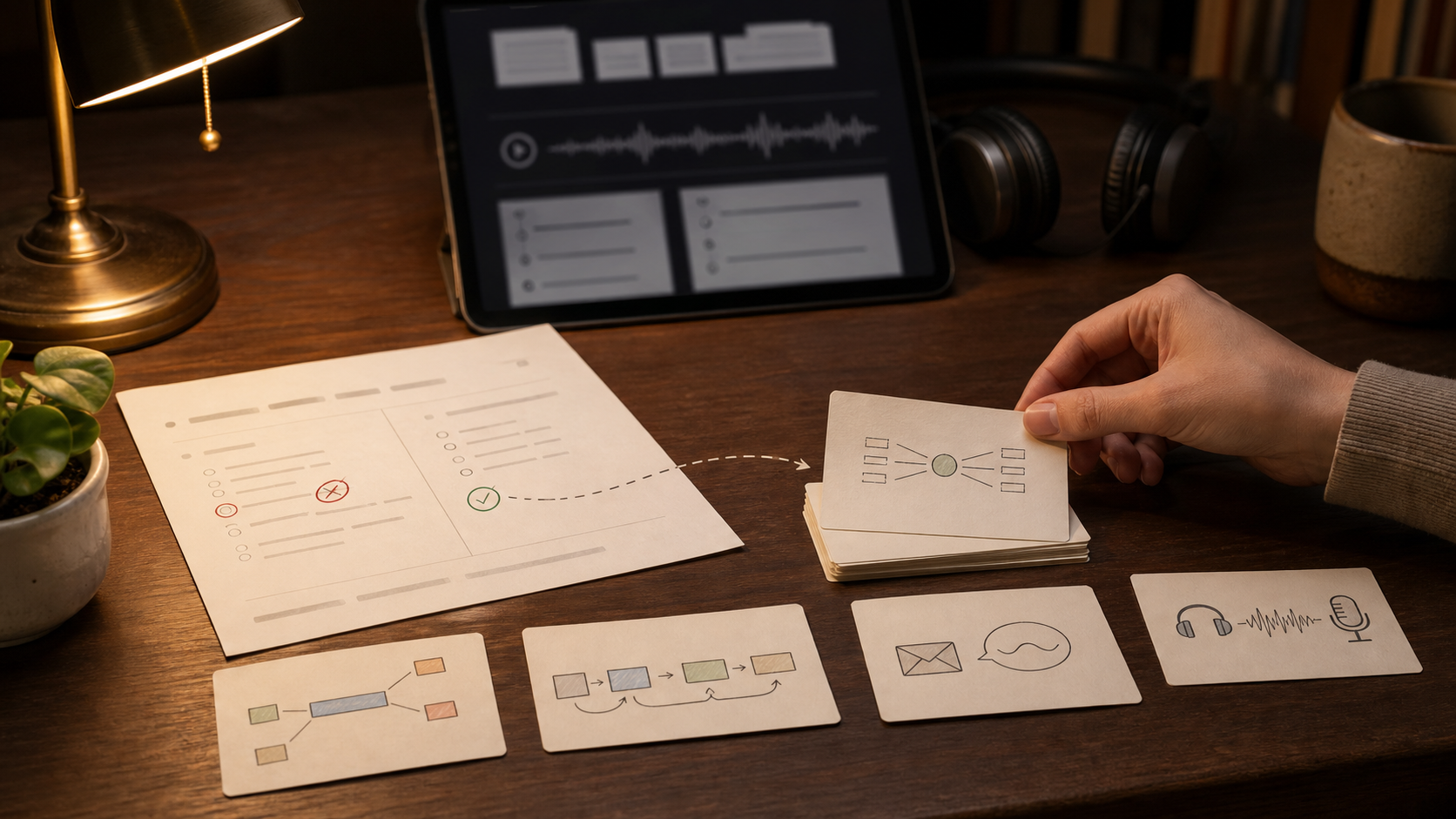
Use the TOEFL iBT format introduced on January 21, 2026
ETS introduced the updated TOEFL iBT worldwide on January 21, 2026. Its current test-content page lists the task types used in all four sections. The 2026 test blueprint says Reading and Listening follow a two-stage adaptive design: performance in the first module helps determine the second module. Writing and Speaking remain linear. ETS gives more context in its transformation announcement.
Section and overall scores now use a 1–6 scale in half-point increments. ETS also provides a comparable estimate of the overall 0–120 score through January 2028. Check the current requirement for each institution instead of memorizing a conversion from an old prep book.
ETS publishes approximate base times and warns that time and item totals can vary as the test adapts. This makes a card such as Reading always has exactly X questions fragile. Task names, language patterns, and your own repeated errors are safer memory targets.
Match every current TOEFL task to the right memory target
The current exam has 12 named task types. This table separates the details worth remembering from the performance that still needs realistic practice.
| Section and current task | Useful memory targets | Practice that stays outside the deck |
|---|---|---|
| Reading: Complete the Words | spelling, word families, suffixes, grammar cues, and choosing a word form from context | completing unfamiliar paragraphs at test pace |
| Reading: Read in Daily Life | purpose, audience, key details, implied meaning, and scanning notices, emails, menus, or posts | reading new formats and choosing between plausible options |
| Reading: Read an Academic Passage | vocabulary in context, idea relationships, rhetorical purpose, inference cues, and repeated trap patterns | reading and reasoning across a whole unfamiliar passage |
| Listening: Listen and Choose a Response | question functions, natural response patterns, negatives, and pragmatic mismatches | hearing a short exchange once and choosing immediately |
| Listening: Listen to a Conversation | speaker purpose, problem, attitude, implied meaning, and likely next action | following unfamiliar speakers at a natural pace |
| Listening: Listen to an Announcement | schedule changes, obligations, locations, sequence, and compact note-taking symbols | extracting details from one-play audio |
| Listening: Listen to an Academic Talk | lecture signposts, main-versus-supporting ideas, inference, rhetorical structure, and academic vocabulary | sustained listening, note-taking, and discrimination under time pressure |
| Writing: Build a Sentence | word order, clause patterns, agreement, tense, connectors, and embedded questions | arranging unfamiliar word sets quickly |
| Writing: Write an Email | audience, purpose, tone, required points, request language, and concise openings or closings | producing a complete response from a new scenario |
| Writing: Write for an Academic Discussion | position, reason, specific support, useful transitions, and recurring grammar fixes | writing a coherent, original contribution under the official time limit |
| Speaking: Listen and Repeat | sentence chunks, function-word order, and patterns that are easy to drop | hearing a sentence once, retaining its sound, and repeating it accurately and intelligibly |
| Speaking: Take an Interview | flexible answer expansion, reason-and-example links, topic language, and personal idea prompts | responding without preparation, with clear speech and natural pacing |
The task names and descriptions come from the current ETS blueprint and specifications. ETS also publishes a teacher practice test with examples of every task family. The PDF aligns with tests from January 21, 2026, but its directions and questions were adapted for paper. It is useful for learning the task shapes; it does not reproduce the live adaptive interface.
Build TOEFL vocabulary flashcards around context and word form
A definition-only card can introduce a word. Context cards show whether you can recognize its meaning, choose the right form, and produce it in a sentence.
Definition:
- Front:
allocate - Back:
to distribute for a purpose
Meaning in context:
- Front: In
The university allocated additional rooms to first-year students, what doesallocatedmean? - Back: Assigned or distributed for a particular purpose.
Word form:
- Front: Use a form of
allocateto complete the sentence, then name the word form:The committee approved an ______ of funds to the library. - Back:
allocation— a noun afteranand beforeof.
Production:
- Front: Use the correct form of
allocateto complete this sentence:The department will ______ more funding to laboratory safety. - Back:
allocate.
You rarely need every version. Add another direction when the word keeps failing in practice, you recognize it but cannot use it, or its word family causes repeated errors. Keep the sentence short enough to require retrieval instead of recognition of a memorized paragraph.
The Academic Vocabulary Flashcards: 300 Words in Context deck is a useful starting point for TOEFL preparation, with 300 cross-disciplinary academic words studied through concise meanings, collocations, and original context examples.
If you need a broader system for collocations, sentence cards, and productive vocabulary, How to Use Flashcards for Language Learning in 2026 covers that layer without tying every example to an exam.
Turn sentence patterns into small production cards
Build a Sentence tests sentence structure directly. The same patterns help you keep an email or academic discussion clear under time pressure.
Useful cards make you produce the structure:
-
Front: Reorder these chunks:
asked / whether / the deadline / Mia / had changed -
Back:
Mia asked whether the deadline had changed. -
Front: Correct the embedded question:
Could you tell me where is the advising office? -
Back:
Could you tell me where the advising office is? -
Front: Combine the ideas with a concession:
Online classes are flexible. Some students need more direct interaction. -
Back:
Although online classes are flexible, some students need more direct interaction. -
Front: Use
Could you confirm whether ...?to ask politely and specifically if the workshop begins at 9:00 a.m. -
Back:
Could you confirm whether the workshop begins at 9:00 a.m.?
Keep one clean answer, or a very small set of acceptable answers, on the back. A whole email is too large for one card and too easy to grade vaguely.
For Write an Email and Write for an Academic Discussion, use checklist prompts instead of complete scripts:
- Who is the audience, and what tone fits?
- Which requested point have I not addressed yet?
- What specific reason or example supports my position?
- Which grammar error appears repeatedly in my timed writing?
These prompts stay useful when the topic changes. Memorized full responses often become awkward.
Keep task-strategy cards specific
Some misses reveal a language gap. Others show that you chose the wrong action inside a task. Turn the second kind into a strategy card only when the lesson came from a verified error and will apply again.
Examples:
-
Front: In Read in Daily Life, what should you identify before inspecting small details?
-
Back: The text's purpose, audience, and format.
-
Front: In Listen and Choose a Response, what makes an option wrong even when it repeats a word from the prompt?
-
Back: It does not perform the response the speaker needs, such as confirming, correcting, explaining, or answering.
-
Front: In an academic talk, what did I mistake for the main idea last time?
-
Back: I chose the first example instead of the claim that the examples supported.
-
Front: What is a flexible way to expand a Take an Interview answer?
-
Back: Answer directly, give one reason, then add a specific example or consequence.
-
Front: Before submitting Write an Email, what should I compare with the prompt?
-
Back: Every requested content point, the audience, and the purpose.
The academic-talk card uses personal wording because it records an observed habit. Generic advice would be harder to retrieve and apply.
Keep speaking frames loose. ETS advises against memorized answers in its guide to common TOEFL iBT mistakes. A short expansion cue can organize an answer. A stored monologue cannot train spontaneous speaking.
Turn verified official-practice misses into cards
Turn a practice miss into a card only after you know what went wrong. A guessed diagnosis can teach the same error again.
Use this workflow:
- Choose material from the current ETS preparation hub and confirm that it covers the post–January 21, 2026 test.
- Complete one task block under its stated conditions. Preserve the timing, and play each audio track only once, when the resource supports those conditions.
- Record the task name, your answer, and the exact point of uncertainty.
- Verify the result against the official answer key, scoring guidance, or task directions before drafting a card.
- Classify the miss: vocabulary, sentence pattern, task decision, listening or speaking performance, writing, or timing.
- Create a card only when a short retrieval target addresses the cause.
- Retest the lesson with a different current official item.
Here are five common conversions:
| Verified miss | Useful card | Required follow-up |
|---|---|---|
| Completed a word with the wrong suffix because the sentence needed a noun | A short context sentence asking for the missing noun and the grammar cue | Another unfamiliar Complete the Words paragraph |
| Used question word order inside an embedded clause | A correction or reordering card for that clause pattern | A new timed Build a Sentence set |
| Chose an academic-talk detail instead of its main claim | A personal error-pattern card distinguishing evidence from the supported claim | Another one-play academic talk |
| Omitted one required point from an email | A pre-submission checklist card | A complete timed email with a new scenario |
| Dropped function words while repeating a sentence | At most, a text card for the sentence pattern that was lost | Real listen-and-repeat practice with unfamiliar audio |
Do not copy a whole official question and rationale onto one card. Write the verified lesson in your own words. Leave the full item in the practice material and keep only the small memory target in the deck.
How to Turn Practice Questions Into Flashcards in 2026 goes deeper into fact gaps, distinctions, sequences, and trap-pattern cards. Flashcards vs Practice Tests in 2026 explains why the card and the next fresh question should remain separate steps.
Audit an old TOEFL deck before you review it
Decks created before January 21, 2026 may mix durable English with retired test details. Keep useful language, but inspect every card whose answer depends on the format.
Start by searching the deck for:
- old task names such as Integrated Speaking or Integrated Writing
- fixed claims about the number of passages, lectures, conversations, tasks, or questions
- old section timing
- references to four Speaking tasks
- 0–30 section-score rules presented as the current score display
- full templates designed for a retired response type
Then sort the results into three groups:
- Keep: stable vocabulary, grammar, collocations, and general academic-language distinctions.
- Rewrite: useful language trapped inside an old task shell. An old integrated-writing card about contrast language may still become a clean sentence-pattern card.
- Remove or archive: task instructions, timing, scoring, and templates that describe only the pre–January 21, 2026 format.
Next, compare the remaining task tags with the 12 current ETS task names. Give every format-specific card a current official ETS source. You can also add a verified-2026 tag and the date you checked it as supplemental metadata. Dates matter here because ETS can update the exam. Stable vocabulary does not need the same treatment.
If the deck is large, How to Prune a Flashcard Deck in 2026 gives a practical deletion and rewriting workflow.
Use spaced repetition for retention, not test simulation
Spaced repetition helps keep a word, sentence pattern, or recurring mistake available over several weeks. A front/back prompt still cannot behave like an adaptive language test.
A simple spaced-repetition setup is enough:
- one
TOEFL 2026deck - tags for section and current task type
- a source tag such as
ETS-practice-1 - a miss tag such as
vocabulary,word-order,main-idea,tone, oromitted-requirement - review ratings based on what you actually retrieved
A 2025 digital-flashcard experiment offers narrow support for the retrieval step. In a controlled session, 108 Chinese–English bilinguals learned 60 Swahili–Chinese word pairs. Retrieval practice with feedback produced better cued recall than restudying in tests given after a short interval. The authors say the condensed schedule limits conclusions about long-term learning. This study does not establish TOEFL score gains, transfer to full test tasks, or benefits over weeks of preparation.
FSRS schedules the cards you choose to keep. It cannot judge whether a source is current, a spoken answer is intelligible, or a full response meets the task. How to Study for an Exam With FSRS in 2026 explains how to keep review volume realistic before a fixed test date.
Keep the deck smaller than the preparation course
TOEFL measures broad language performance. If you turn an entire course, vocabulary book, or practice test into cards, you create a second curriculum to finish.
Add a card when at least one of these is true:
- the target appeared more than once
- you recognized it but could not produce it
- you keep confusing two similar forms
- the same task decision caused another miss
- a writing or speaking error has become a pattern
Skip the card when the miss came from a misclick, the answer needs a full essay, or a fresh task would train the lesson better. Broad prompts such as How do I succeed in Listening? also invite vague self-grading.
A practical weekly loop is:
- review due cards
- complete current official practice
- verify the misses
- add a few narrow cards
- rewrite or remove any card that was hard to grade
- return to mixed, timed practice
The deck should become more personal as your preparation continues. A starter list can help, but verified practice-test mistakes show you what deserves repeated review.
What TOEFL flashcards cannot replace
Flashcards cover small, retrievable pieces. The current TOEFL also asks you to read, listen, speak, and write under its timing and task conditions.
They cannot replace:
- Adaptive Reading and Listening. Front/back review does not reproduce unfamiliar passages, new answer choices, or the way first-module performance selects the second module.
- Listening from audio played once. A transcript cannot train you to identify meaning, purpose, or an appropriate response from speech heard once at a natural pace.
- Speaking under current conditions. Text cards can preserve a phrase or answer cue. Listen and Repeat requires accurate, intelligible repetition. Take an Interview requires spontaneous elaboration without preparation.
- Complete writing. Sentence cards can fix word order and recurring grammar. They cannot show whether a full email covers every requested point or an academic-discussion response is coherent, relevant, and supported.
- Current official practice. ETS materials provide current directions, task formats, timing, and scoring expectations. Third-party decks can age without warning.
Use official TOEFL preparation resources throughout your study plan. Full practice also reveals pacing and attention problems that a vocabulary queue cannot expose.
Where Flashcards Open Source App fits
Flashcards covers the retention layer of this workflow. The web app supports front/back cards, AI chat with workspace data and file attachments, including plain-text files, and FSRS review. The review choices are Again, Hard, Good, and Easy.
One careful workflow is:
- Write a short miss log after current official practice.
- Verify every correction against ETS material.
- Add the log to AI chat, or attach it as a supported file, and ask for a few single-target front/back drafts.
- Compare each draft with the verified correction and edit it yourself.
- Review the cards you keep with FSRS. Rate the answer you produced, not how familiar the card looked.
Continue using ETS resources for audio, timed writing and speaking, and adaptive-test practice. Use the app between those sessions to retain vocabulary, sentence patterns, task cues, and recurring mistakes.
The current product surface is documented on Features and Getting Started.
Start with your next official practice block
Open one current ETS task block. After you finish it under the stated conditions, verify each miss and keep only the vocabulary, sentence pattern, or decision that fits a clear front/back card.
Return listening, speaking, adaptive reading, and full writing problems to realistic practice. Audit any old deck against the 12 current task names, then let FSRS schedule the remaining cards.
That is the useful role of flashcards for TOEFL in 2026: a small memory layer built from the exam you will actually take.