How to Turn AI Summaries Into Flashcards in 2026: Keep the Claims, Test the Memory
Last Tuesday an AI summary turned "usually" into "always" in one sentence. The source was careful. The summary was cleaner. If I had turned that cleaner sentence straight into a flashcard, I would have memorized the wrong version with extra confidence.
That is the trap inside how to turn AI summaries into flashcards in 2026.
These workflows are becoming normal fast. Pew Research Center reported on February 24, 2026 that 54% of U.S. teens have used chatbots for schoolwork. Google now promotes Gemini study tools that can create flashcards and study guides from quiz results or class materials. Microsoft has an education workflow that generates flashcards from pasted text or uploaded files. Useful tools. Also a very easy way to memorize the summary instead of the source if you skip one boring step.
The summary helps because it compresses. That is also where it gets risky. Compression drops qualifiers, blends neighboring ideas, and makes partial understanding sound complete. So the workflow I trust is simple: use the summary to find candidate ideas, verify each one against the source, test whether you can recall it without help, and only then save the weak parts into flashcards you will review with FSRS.
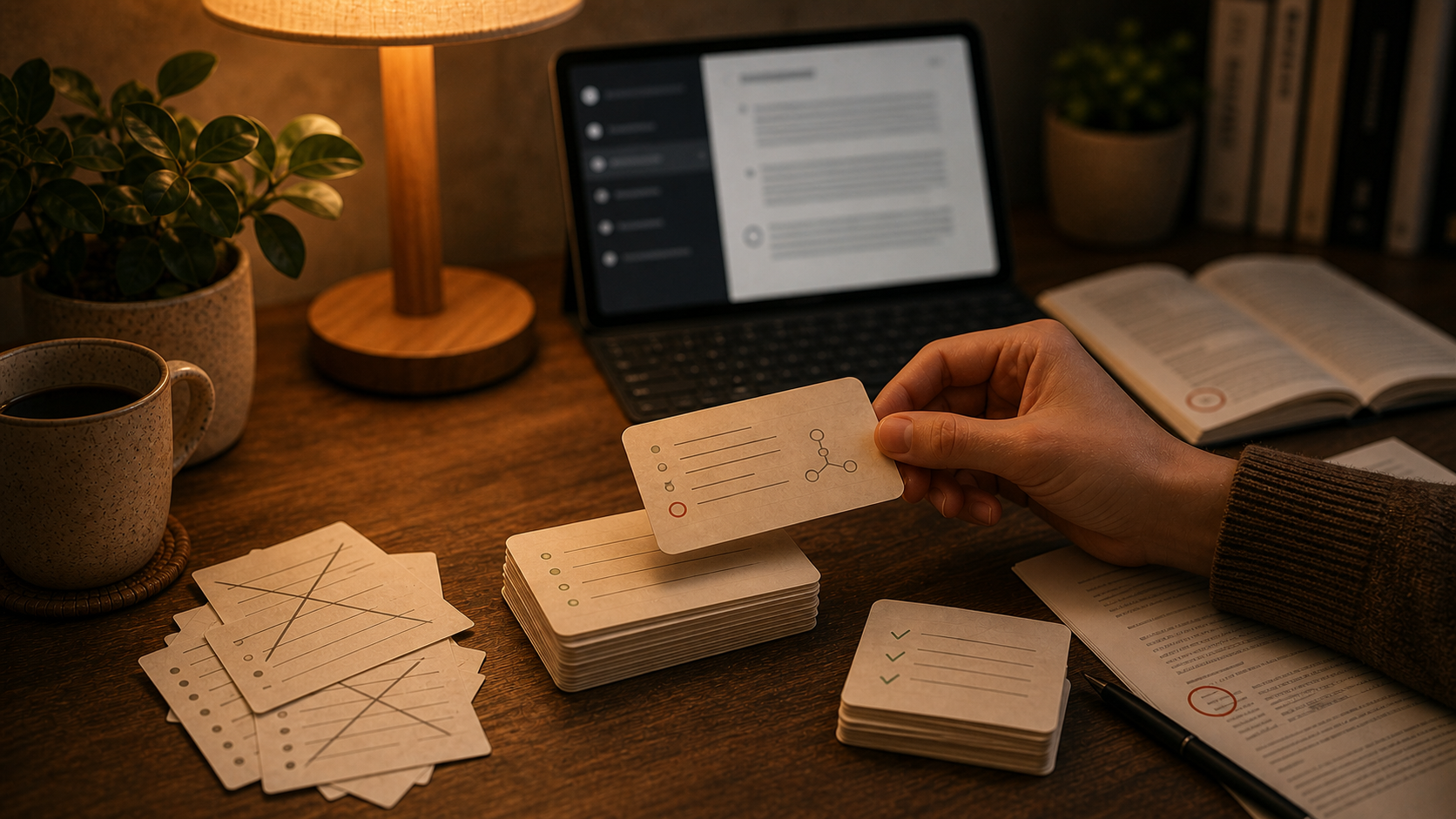
The summary is not the source
This sounds obvious until you are tired and the summary reads better than your notes.
ChatGPT, Gemini, NotebookLM, and similar tools are good at:
- compressing a long source into a short brief
- pulling out major themes
- giving you a cleaner first pass than your own messy notes
- helping you see what might matter
They are much worse at being a final memory artifact.
A summary can quietly:
- flatten an important distinction
- remove a condition or exception
- sound more certain than the source
- preserve the main point while losing the exact claim
- make you feel like you understand something you have only recognized
That is why AI summary to flashcards is a different job from note cleanup. Once something goes into your deck, you are telling your future self to keep bringing it back. That deserves stricter filtering than a nice recap paragraph.
If you want the broader study-system version first, How to Use AI to Study in 2026 is the bigger picture. This article is the narrower handoff after the summary already exists.
Treat AI summaries like a compression layer
This framing keeps me honest.
I do not want to memorize the summary. I want to use it as a compression layer between the raw source and the future deck.
That layer is useful because it helps you spot:
- claims worth checking
- definitions that look central
- distinctions between similar concepts
- steps in a process
- likely exam or discussion targets
But the compression layer should not win automatically.
The goal is not "turn this summary into cards."
The goal is "use this summary to find what is worth verifying and remembering."
That small shift keeps you from building a deck full of tidy paraphrases.
Start with the source open, not just the summary
If the original source is available, keep it nearby while you extract cards.
That source might be:
- your own notes
- a reading passage
- a lecture transcript
- a study guide
- a copied text chunk
- a class handout
You do not need to reread everything. You do need a way back to the original wording before you trust the summary enough to memorize from it.
This matters most when the summary includes:
- numbers
- dates
- ranked lists
- steps in a method
- legal or medical wording
- side-by-side comparisons
- words like "always," "never," "most," or "least"
If the source is missing, I would stay conservative. Keep the card simpler, make the wording less absolute, or skip the card entirely.
That is the boring discipline behind verified flashcards. The AI can help you find the claim. The source still decides whether the claim is worth keeping.
Extract claims, not nice paragraphs
This is where a lot of summary-driven decks go sideways.
A polished paragraph can feel important just because it sounds finished. Flashcards do not care whether the sentence sounds finished. They care whether one idea can be recalled cleanly a week later.
I would pull candidate material from a summary in small units:
- one claim
- one definition
- one distinction
- one cause and effect
- one decision rule
- one exception
I would not keep:
- full recap paragraphs
- executive-summary wording
- "key takeaway" lines that hide several ideas at once
- broad prompts like "Why is this important?"
- answers that only work if the whole summary is still in your head
If a summary sentence contains three ideas, it is not one card candidate. It is three candidate claims or zero.
This is close to the same filter I would use in What Should Go on a Flashcard in 2026?, just one step earlier while the content is still wearing AI polish.
Verify before you draft
Before I write even one card, I do a quick verification pass.
For each candidate idea from the summary, ask:
- Did the source actually say this?
- Did the summary merge two ideas that should stay separate?
- Is there a qualifier or exception missing here?
- Would I want to recall this next week without reopening the source?
- Can this become one direct front/back prompt?
That usually takes less time than fixing a bad deck later.
This is especially important when the summary sounds smoother than the source. Smooth phrasing is one of the easiest ways to memorize the wrong emphasis. The words feel clearer, so your brain starts trusting them before your judgment has caught up.
If your AI-generated cards already exist and now need cleanup, How to Fix AI Flashcards in 2026 is the better companion piece.
Test memory before you save the card
This is the step that saves the most junk cards.
Once you have a verified claim, hide the summary and try to answer it from memory before you commit it to the deck.
That quick test tells you which bucket the idea belongs in:
- I knew it cleanly and do not need a card
- I kind of knew it but mixed up one detail
- I recognized it in the summary but could not produce it myself
- I answered confidently and got it wrong
Only the last three usually deserve a flashcard.
This is where study with AI summaries turns into actual studying instead of neat document management. Recognition is cheap. Retrieval is the part that tells you what stuck.
If you want more on this question-first approach, How to Use AI for Active Recall in 2026 fits right next to this workflow.
Save the weak targets, not the whole summary
A decent summary can hand you twenty lines that look card-worthy. That does not mean you need twenty cards.
I would only save an item if at least one of these is true:
- I missed it when I tested myself
- I confused it with a nearby idea
- the qualifier matters and I would probably forget it
- it is likely to come up again
- the answer can fit on one tight back side
I would skip it if:
- I only like the wording
- it is broad context rather than a recall target
- it makes sense only as part of a larger paragraph
- I already know it after one retrieval attempt
- the source support is weak or missing
This is the part that keeps ChatGPT summary flashcards, Gemini summary flashcards, and NotebookLM summary flashcards from turning into another backlog problem. The summary can stay broad. The deck should stay selective.
If deck size is already becoming the issue, How to Avoid AI Flashcard Overload in 2026 and How Many New Flashcards Per Day in 2026 are the next two reads I would pick.
Three card types work well for AI-summary workflows
Most useful cards from summaries fit into a small set.
1. Claim cards
Use these when the summary surfaced one fact or rule that the source clearly supports.
- Front: What condition makes X happen?
- Back: X happens when Y condition is present.
2. Distinction cards
Use these when the summary brought two similar ideas too close together and you need to keep them separate.
- Front: What is the difference between A and B in this context?
- Back: A does ____. B does ____.
3. Exception cards
Use these when the summary made the main pattern look universal but the source included an important caveat.
- Front: When does the usual rule for X not apply?
- Back: It does not apply when ____.
These usually review much better than one broad card copied from a summary paragraph.
A practical workflow you can repeat in ten minutes
This is the ten-minute loop I would actually keep doing:
- Generate or collect the AI summary.
- Open the original source beside it.
- Highlight only candidate claims, distinctions, and exceptions.
- Verify each one against the source.
- Cover the summary and try to recall each item yourself.
- Turn only the misses and weak recalls into simple front/back cards.
- Delete or split any card that starts sounding like a tiny explainer.
- Review the final cards with FSRS.
That is the full loop.
No giant export. No pressure to preserve the whole summary. No fake productivity from turning a neat page into an even neater deck.
If your source starts one step earlier, these companion posts are closer fits:
The product fit is smaller than the promise, and that is good
Flashcards fits later in this workflow, after you already have the summary and have decided what actually deserves review.
That is a good fit because the useful next steps are narrow:
- paste the verified text or attach the source excerpt in AI chat
- use AI chat or manual editing to shrink it into clean prompts
- create plain front/back cards
- review the final set with FSRS
That is a sensible boundary. The product helps with the draft-and-review handoff without pretending summaries and memory are the same job. If you want the plain overview, the features page is the shortest path. If you want to try the workflow, start with the getting started guide.
In 2026, AI summaries are a good speed layer. They are not a memory layer unless you make them earn that role. Keep the claims, test the memory, and let only the weak verified parts into the deck.