How to Use Flashcards for AP Physics 1 in 2026: Forces, Energy, and FRQ Mistakes That Actually Stick
The AP Physics 1 student who keeps leaking points usually is not forgetting F = ma. It is something pettier. You read a velocity-time graph like it is position. You draw one extra force that is not actually acting. You say "energy is conserved" without choosing a clean system. Or you finish an FRQ with decent algebra and still miss the point because the explanation never gets back to the physics.
That is where ap physics 1 flashcards help.
They are good for quick retrieval, graph cues, unit meaning, and repeated mistakes. They are not a replacement for solving full problems, setting up experiments, or writing complete free-response answers under time pressure.
For 2026, the official exam details matter too. College Board's 2026 AP exam dates page and the AP Physics 1 assessment page list the exam for Wednesday, May 6, 2026 at 12 p.m. local time. The assessment page says AP Physics 1 is still a hybrid digital exam: you answer multiple-choice questions and view free-response prompts in Bluebook, then handwrite your free-response answers in paper booklets. The exam is 3 hours total, with 40 multiple-choice questions in 1 hour 20 minutes for 50% of the score and 4 free-response questions in 1 hour 40 minutes for the other 50%. Calculators are allowed, and College Board says reference materials for the course are available on exam day.
So your deck should not just remember physics facts. It should remember physics in the shape the exam actually uses.
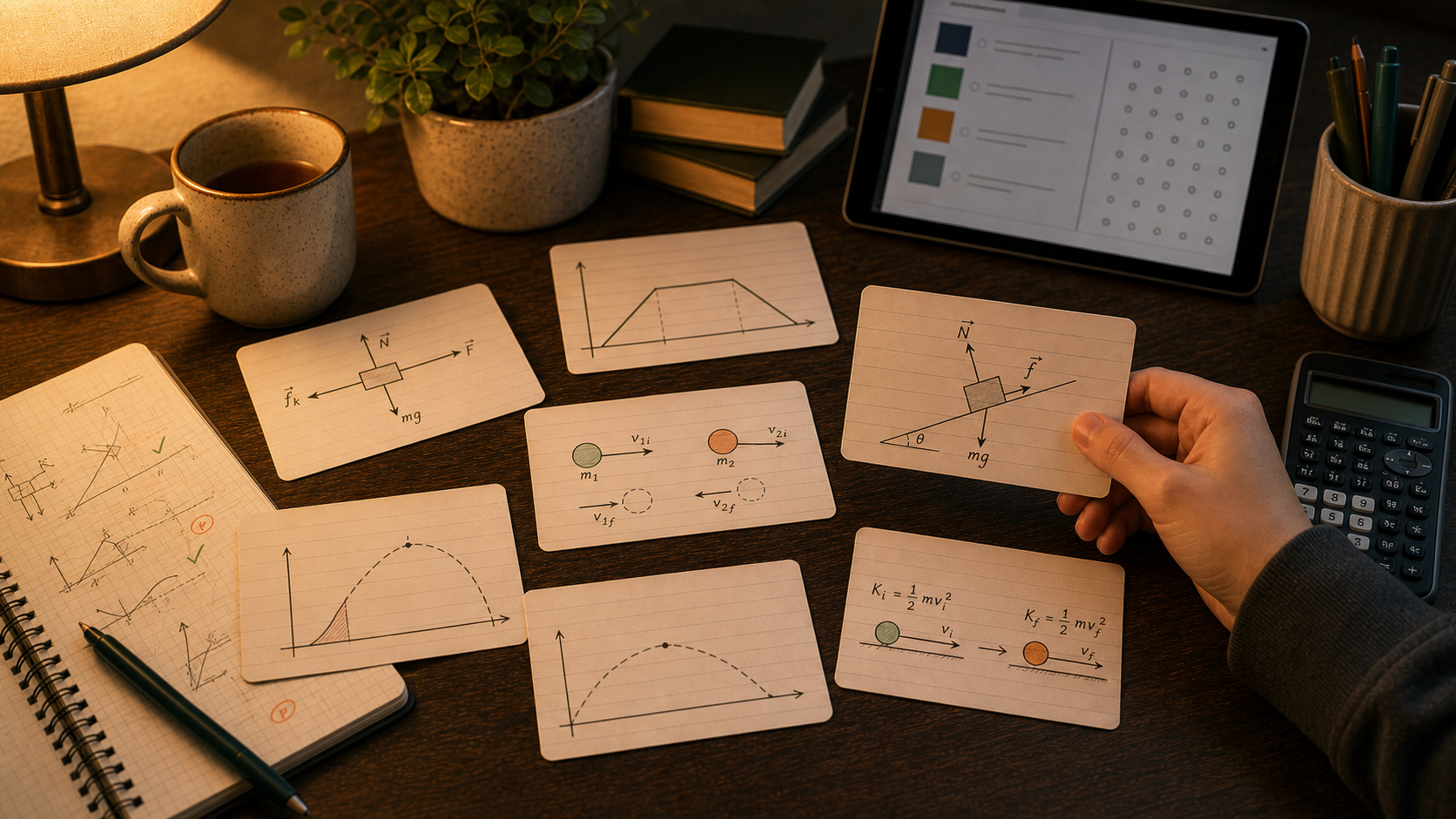
AP Physics 1 is a few different memory problems
Most weak decks treat the course like one long formula sheet. That is why they feel busy and still fail when you get back to real problems.
The useful split looks more like this:
| Area | What you need to retrieve fast | What weak cards usually do |
|---|---|---|
| Kinematics and graphs | what slope means, what area means, what sign changes imply | memorize equations and ignore the graph cue |
| Forces and systems | which forces belong, what the system is, what the diagram should include | save a definition of Newton's laws and stop there |
| Energy and momentum | when conservation applies, what the system boundary is, what changes form | blur every problem into one "use conservation" card |
| FRQ repair | the exact reasoning move or representation miss that cost points | paste the whole prompt and scoring notes into one giant card |
That is the version of how to use flashcards for ap physics 1 that actually holds up. Your deck is not there to preserve the whole course. It is there to protect the parts that should already feel quick before you start solving, justifying, or checking your work.
Start with the units College Board weights most
If you are tightening your deck late in the year, use the official unit weightings instead of your own guilt.
On the AP Physics 1 course page, College Board gives the biggest multiple-choice weight to:
- Unit 2: Force and Translational Dynamics at 18% to 23%
- Unit 3: Work, Energy, and Power at 18% to 23%
The next large chunks include:
- Unit 1: Kinematics at 10% to 15%
- Unit 4: Linear Momentum at 10% to 15%
- Unit 5: Torque and Rotational Dynamics at 10% to 15%
- Unit 8: Fluids at 10% to 15%
College Board also spells out the skills behind the course on that same page: creating representations, doing analysis, and describing experiments while supporting claims. That is a useful sanity check. If a card helps you read a graph correctly, choose the right system, or explain evidence more cleanly, it is probably doing real AP Physics 1 work.
That does not mean you ignore oscillations or rotational energy. It means your ap physics 1 study flashcards should probably spend more time on forces, energy, graph reading, and momentum than on low-value trivia from one lab handout in September.
Physics 1 also punishes students who know the formula but miss the model. So when you choose what becomes a card, prioritize:
- graph and representation cues
- force-identification mistakes
- conservation setup mistakes
- repeated FRQ explanation misses
- unit and sign mistakes that keep coming back
That is a better way to study for ap physics 1 with flashcards than building a deck that mirrors the textbook table of contents too literally.
Kinematics cards should test graphs and signs, not just equations
The worst kinematics cards look like this:
- Front:
kinematic equations - Back: a stack of formulas
That is not useless. It is just not enough.
In AP Physics 1, the pain usually comes from interpretation:
- What does the slope of a position-time graph represent?
- What does the area under a velocity-time graph represent?
- What changes when velocity is negative but acceleration is positive?
- How do you tell whether an object is speeding up or slowing down from signs alone?
- What clue says this is a relative-motion setup rather than a basic one-object problem?
- In two-dimensional motion, what stays independent between the horizontal and vertical directions?
These are better ap physics 1 formula flashcards because they give the formula a job. The point is not only remembering that an equation exists. The point is seeing which relationship the representation is asking for.
This is also why graph cards pay rent in AP Physics 1. A lot of students can do the algebra once the setup is clear. The lost points happen one move earlier, when the graph gets read like the wrong quantity or the sign convention quietly flips.
If your deck quality is the real issue, How to Make Better Flashcards in 2026 is the best cleanup pass before you add more.
Forces cards should capture the system choice and the free-body trap
Force problems are where a lot of students feel like physics is random when it is actually repetitive.
You usually are not missing Newton's Second Law itself. You are missing one of the decisions around it:
- what counts as the system
- which forces act on that system
- which direction should be positive
- whether the motion is translational, circular, or equilibrium-based
- whether the diagram includes a force that does not belong
That is where ap physics 1 flashcards help most, because AP Physics 1 keeps recycling the same decision points in slightly different stories.
Examples of cards that tend to be worth keeping:
- In a free-body diagram, when does friction point opposite motion and when does it point opposite impending motion?
- What is the difference between action-reaction pairs and forces acting on one object?
- What clue says centripetal acceleration is present even if there is no separate "centripetal force"?
- When a block system is treated as one object, which internal forces disappear from the net-force analysis?
- What makes normal force smaller than weight in one setup and equal to weight in another?
These are the cards that stop the same force mistakes from surviving into April.
If you already like the broader math-and-problem-solving version of this workflow, How to Use Flashcards for Math in 2026 is the closest companion article.
Energy and momentum cards should separate the story from the equation
This is where AP Physics 1 decks get fuzzy fast.
Students memorize K = 1/2 mv^2, maybe remember a gravitational potential-energy form, maybe remember impulse, and still freeze when the real question is about system choice, conservation conditions, or what kind of interaction is happening.
I would keep energy and momentum cards in smaller groups:
- work and energy relationships
- conservation of energy setup
- momentum and impulse relationships
- collisions and system boundaries
- rotational analogs only where they are still fragile
Examples of cards that usually help:
- What condition lets you use conservation of mechanical energy directly?
- When is external work the real reason conservation did not apply the way you expected?
- What is the difference between momentum being conserved and kinetic energy being conserved?
- In a collision problem, what tells you the system should include both objects?
- What does the area under a force-time graph represent?
These are much better ap physics 1 study flashcards than one heroic card called energy and momentum formulas.
They also map to the biggest official course weights. Unit 3 carries 18% to 23% of the multiple-choice score, and Unit 4 plus Unit 5 still matter a lot. If your deck does not make work-energy and momentum distinctions feel fast, it is pointed at the wrong target.
AP Physics 1 FRQ cards should store the miss, not archive the whole solution
This is where otherwise serious students build terrible cards.
They miss a free-response question, feel responsible, and save:
- the full prompt
- the scoring guide
- the full worked response
Then the card comes due and nobody wants to review it.
The better move is to ask: what failed here?
Usually it is one of these:
- I translated the representation badly.
- I described the graph without connecting it to physics.
- I wrote a formula without explaining the model or system.
- I used a true statement that did not answer the question asked.
- I mixed up evidence from the experiment with a claim I wanted to make.
- I knew the quantity to calculate but not what it meant physically.
Those are strong ap physics 1 frq flashcards because they stay attached to the scoring move you actually missed.
The official assessment page says the four free-response types are mathematical routines, translation between representations, experimental design and analysis, and qualitative/quantitative translation. That list is useful because it tells you what your FRQ cards should sound like.
Examples:
- In a representation-translation FRQ, what must stay consistent when moving between graph, words, and equation?
- What makes an explanation physics-based instead of descriptive only?
- In an experiment-design FRQ, what kind of variable or measurement detail usually matters most?
- What kind of miss means I need more fresh problems, not more cards?
That last card matters. Some misses are memory misses. Some are execution misses. Flashcards help with the first group. Timed practice fixes the second.
If your raw material mostly comes from corrections, How to Turn Practice Questions Into Flashcards in 2026 is the best next read.
The 2026 hybrid digital format should change a few cards and a few habits
This part is easy to ignore.
College Board's AP Physics 1 assessment page says the exam is hybrid digital. Its general digital testing overview says most 2026 AP Exams are delivered digitally and shows the same basic hybrid setup: Bluebook for multiple-choice and prompt viewing, paper booklets for the handwritten free-response answers.
That does not mean you need a whole deck about the app. It does mean your practice should include a few exam-mode cards and habits:
- What details do I miss when I read the prompt on screen and write by hand?
- What does a clean graph or diagram label set look like when I am moving fast?
- What evidence do I need to copy or reference from the prompt before starting the explanation?
- Which mistakes get worse when I switch between graph, equation, and sentence under time pressure?
- What should I write down first on paper so I do not lose givens while the prompt stays on screen?
This is the rare case where one or two non-content cards can earn their place. If your own errors get worse in the digital-plus-handwritten format, make cards for that. Do not make twenty.
If you use AI, use it to draft cards from mistakes, not to skip the physics
This is a good place to stay honest.
RAND reported on March 17, 2026 that student AI use for homework rose from 48% to 62% between May and December 2025, and 67% of students said AI for schoolwork harms critical thinking. That is exactly the danger in AP Physics 1. If AI turns your homework into clean-looking answers before you have wrestled with the representation, the system, or the graph, you can feel prepared without getting better.
So I would use AI in a narrower way:
- do the problem or FRQ yourself first
- feed it your missed question, correction, or notes
- ask it to explain the exact mistake pattern
- draft one or two smaller cards from that pattern
- edit the cards yourself so they still sound like physics you can retrieve
That keeps the useful part and cuts the fake confidence.
If AI is part of your workflow already, How to Use AI to Study in 2026 is the right companion. The rule stays the same: AI can help you process mistakes, but it should not do the hard thinking you are trying to train.
A weekly AP Physics 1 workflow should stay boring
That is a compliment.
After class, homework, quizzes, labs, or released FRQs:
- Pull only the mistakes that feel reusable.
- Sort them into graphs, forces, energy, momentum, FRQ repair, or experiment-design issues.
- Write one or two small cards per pattern.
- Tag by unit or mistake type.
- Review due cards every day.
- Go back to fresh problems and see whether the same miss survives.
That last step is the real exam. If the miss disappears, the card did its job. If it stays, the card is usually too vague or aimed at the wrong memory target.
For official practice material, start with the free-response links and exam resources on College Board's AP Physics 1 assessment page. Use those corrections to decide what actually deserves a card.
FSRS helps once the cards stop trying to be mini-lessons
This is where spaced repetition ap physics 1 becomes useful instead of irritating.
Some AP Physics 1 cards should become easy quickly:
- slope and area meanings on common graphs
- standard force-identification cues
- momentum versus impulse distinctions
- common sign and unit checks
Other cards should stay close because they are fragile:
- experimental design language
- explanation patterns on FRQs
- system-boundary choices in messy problems
- graph-to-equation translation mistakes
That is exactly what FSRS is good at.
It does not rescue bloated cards, though. If one prompt tests three ideas, your self-rating gets fuzzy. If the back reads like a chapter summary, you start negotiating with the review instead of answering honestly.
So keep the order simple:
- make smaller cards
- delete weak cards early
- let FSRS handle timing
If you want the scheduling side in more detail, How to Study for an Exam With FSRS in 2026 is the direct companion.
Where Flashcards fits in this AP Physics 1 workflow
Flashcards fits this workflow well if you want one place to keep graph cards, force mistakes, and FRQ repair cards without scattering them across notes, screenshots, and old corrections.
The useful parts are practical:
- front/back card editing for clean graph, force, and error cards
- tags and filtered review for
kinematics,forces,frq-misses, orgraphs - AI-assisted drafting from notes and corrected work when you want help with the clerical part
- FSRS scheduling once the cards are worth reviewing
If you want the product overview first, the features page is the clean summary. If you want to start using the app, the getting started guide is the best next link.
The AP Physics 1 rule that actually holds up
Use flashcards for the parts of physics that should become fast:
- graph cues
- force selection
- conservation conditions
- repeated FRQ reasoning misses
- unit and sign checks
Then do real AP Physics 1 work for everything that requires setup, modeling, explanation, and time pressure.
That split is what makes ap physics 1 exam flashcards useful in 2026. Otherwise you end up with a deck that remembers physics vocabulary while the exam keeps asking you to think like a physics student.