How to Use Flashcards for AP Calculus AB and BC in 2026: Limits, Derivatives, and FRQ Mistakes That Actually Stick
The AP Calculus student who keeps losing points usually is not forgetting an entire unit. It is something smaller and meaner. You remember the derivative rule, then miss the chain rule inside a composition. You know the limit exists, then skip the one-sided check. You find the antiderivative, then lose the FRQ point because the answer has no units, no conclusion, or no connection to the graph on the page.
That is exactly where AP Calculus flashcards help.
They do not replace problem sets, timed free-response work, or full corrections. They are much better at making a few things fast: pattern recognition, rule recall, notation, and repeated mistakes that keep showing up after you already "learned" them once.
For 2026, the official exam details matter more than usual because the delivery format changes how you should practice. College Board lists both the AP Calculus AB exam and the AP Calculus BC exam on Monday, May 11, 2026 at 8 a.m. local time, and both are hybrid digital AP Exams. Each exam is 3 hours 15 minutes with 45 multiple-choice questions and 6 free-response questions. You answer multiple-choice questions and view FRQs in Bluebook, then handwrite your free-response answers in paper booklets. Calculator use is still split by part: graphing calculators are used in multiple-choice Part B and free-response Part A, with approved handheld graphing calculators and the built-in Desmos graphing calculator available only where the calculator policy allows them.
That means your deck should not just remember calculus facts. It should remember calculus in the shape the exam actually uses.
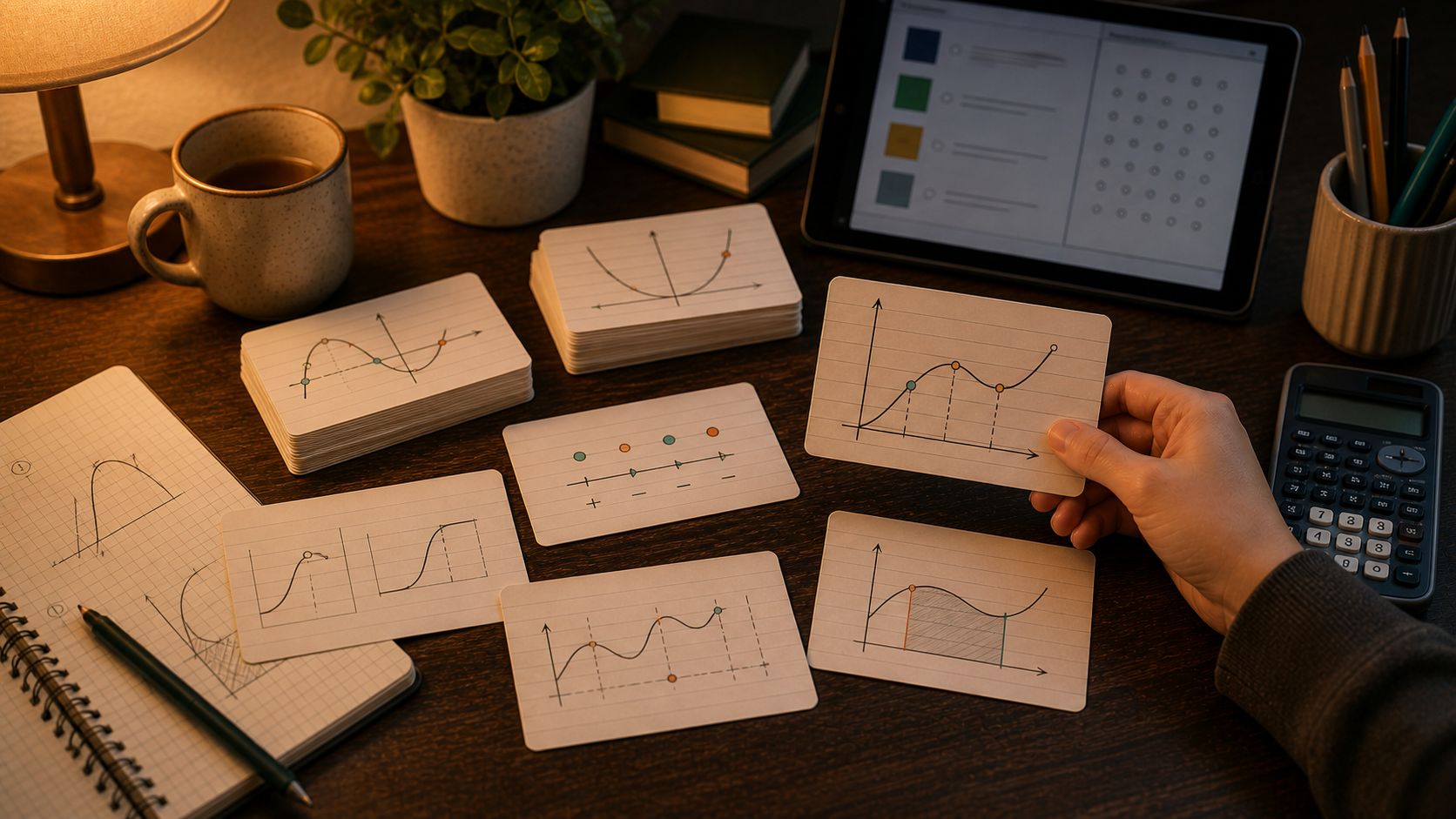
AP Calculus is a few different memory problems
Most weak decks treat the course like one giant formula sheet. That is why they feel busy and weirdly unhelpful once you get back to real AB or BC questions.
The useful split looks more like this:
| Area | What you need to retrieve fast | What weak cards usually do |
|---|---|---|
| Limits and continuity | what to test, which condition matters, what behavior the graph suggests | store a definition and ignore the decision point |
| Derivatives | which rule applies, what the sign means, what the result says in context | memorize formulas without interpretation |
| Integrals and accumulation | when the quantity is area, net change, total change, or average value | blur all integrals into one bucket |
| FRQ repair | the exact point-losing move you keep repeating | paste the whole problem and solution into one card |
| BC-only topics | series tests, convergence language, parametric or polar cues | save giant summary cards you never review honestly |
That is the version of how to study for AP Calculus that actually holds up. Your deck is not there to preserve the whole course. It is there to protect the parts that should already feel quick before you start solving, justifying, or checking a graph.
Start with the parts College Board weights heavily
If you are tightening your deck late in the year, use the official course weightings instead of your own guilt.
On the AP Calculus AB course page, College Board gives the heaviest multiple-choice weighting to:
- Unit 6: Integration and Accumulation of Change at 17% to 20%
- Unit 5: Analytical Applications of Differentiation at 15% to 18%
On the AP Calculus BC course page, the biggest slices include:
- Unit 6: Integration and Accumulation of Change at 17% to 20%
- Unit 10: Infinite Sequences and Series at 17% to 18%
- Unit 9: Parametric Equations, Polar Coordinates, and Vector-Valued Functions at 11% to 12%
That does not mean you ignore limits or basic derivative rules. It means your AP Calculus review deck should probably spend more energy on integration decisions, derivative interpretation, and BC series than on low-value trivia from old notes or one-off teacher examples.
BC students also get one extra scoring detail that is worth knowing: College Board says the Calculus BC exam includes a Calculus AB subscore, and the AB portion is approximately 60% of the exam. In practice, that is another reason not to build a BC deck that only cares about series and forgets the AB core.
Limits cards work best when they test the cue, not the chapter title
The worst limits cards look like this:
- Front:
Definition of continuity - Back: a polished sentence
That card is technically fine. It also does very little when the real question is whether you noticed a hole, a jump, a vertical asymptote, or a mismatch between left-hand and right-hand behavior.
Better AP Calculus AB flashcards for limits ask for a reusable choice:
- What three conditions must hold for continuity at a point?
- What kind of graph behavior tells you to compare one-sided limits first?
- When does an indeterminate form suggest more algebra before any theorem or rule?
- What is the difference between a limit not existing and a function value not existing?
- In a table or graph question, what evidence is enough to support a limit claim?
These are small cards, but they do real work. They train the move that separates "I remember this unit" from "I can start the problem cleanly."
This is also where a lot of students waste time on long explanations when the real issue is recognition. You need to see the cue before anybody explains it to you.
Derivatives should live as rule cards, sign cards, and meaning cards
Derivative decks go bad fast because students stop at formulas.
You do need the rules. Product, quotient, chain, implicit differentiation, inverse-function relationships, and standard derivatives should be quick enough that they do not slow down the rest of the question.
But AP Calculus flashcards become much more useful when derivative cards do three different jobs:
Rule cards
- What derivative rule is easiest to miss in this pattern?
- What changes when a function is defined implicitly instead of explicitly?
- What algebra cleanup do you check before differentiating?
Sign and graph cards
- What does
f'(x) > 0actually tell you? - What does a sign change from positive to negative imply?
- What is the difference between critical points and extrema?
- What clue points to concavity versus increasing or decreasing behavior?
Meaning cards
- In a word problem, what does the derivative represent with units?
- What does it mean if the derivative is negative but the function value is positive?
- What does
dy/dtdescribe thatyalone does not?
That split matters because AP Calculus keeps asking you to move between symbolic work, graphs, tables, and context. The derivative itself is rarely the whole task. Interpreting it correctly is where points leak away.
If your deck style is still too broad, How to Use Flashcards for Math in 2026 is the closest companion article in this blog.
Integral cards should separate antiderivatives from accumulation
A lot of AP Calculus decks turn integration into one fuzzy category. That is how students end up treating every integral like "find an antiderivative and move on."
For AB and BC, I would keep integral cards in smaller groups:
- basic antiderivative recall
- definite integral meaning
- net change versus total accumulated amount
- average value of a function
- Fundamental Theorem of Calculus triggers
- units and context interpretation
Examples of cards that tend to pay rent:
- What does a definite integral represent before you calculate it?
- When can a definite integral be negative even though the region on the graph looks large?
- What is the difference between net change and total distance?
- What does the Fundamental Theorem of Calculus let you connect?
- In an accumulation model, what unit should the final answer have?
These are much better AP Calculus AB flashcards than one oversized card with six formulas and three theorems on the back.
They also map directly to the official weightings. Integration and accumulation are some of the biggest parts of both exams. If your deck does not make signed area, total change, FTC triggers, and units feel fast, your review is pointed at the wrong target.
FRQ cards should capture the miss, not archive the whole response
This is where a lot of otherwise serious students build terrible cards.
They miss a free-response question, feel responsible, and save:
- the full prompt
- the scoring notes
- the full worked answer
Then the card comes due and nobody wants to review it.
The fix is simpler than it looks. After each miss, ask what failed here.
Usually it is one of these:
- I answered numerically without stating the conclusion in context.
- I forgot notation, units, or interval language.
- I used the calculator correctly and explained the math badly.
- I described the graph instead of justifying the claim.
- I solved for something true that the prompt did not ask for.
- I knew the derivative or integral, but not what it meant.
Those are strong AP Calculus FRQ practice cards because they stay attached to the scoring move you actually missed.
Examples:
- In a justification FRQ, what makes an answer mathematical instead of descriptive?
- When a prompt gives a table, what evidence should appear in the sentence with the claim?
- What is the common difference between "find" and "justify" in AP Calculus scoring?
- When should an interval answer use open notation instead of a single point?
- What kind of miss means I need more fresh problems, not more flashcards?
That last card matters. Some misses are memory misses. Some are execution misses. Flashcards help with the first group. Timed practice fixes the second.
If your raw material mostly comes from corrections, How to Turn Practice Questions Into Flashcards in 2026 is the best next read.
Bluebook changes how you should practice even though calculus is still handwritten
This part gets overlooked.
For 2026, both AP Calculus exams are hybrid digital. College Board's assessment pages for AB and BC say you will view FRQs in Bluebook and handwrite your answers in paper booklets. Bluebook also gives you a test preview and device prep flow, and College Board recommends using Practice on Bluebook before test day.
That does not mean you need flashcards about where to click in the app. It means your study routine should include a few cards and habits around exam mode:
- Which parts of the exam are calculator-required and which are not?
- What does a clean handwritten justification look like when the prompt is on screen?
- How do I keep track of a graph, a table, and my written response without getting sloppy?
- What details do I forget when I switch from reading digitally to writing by hand?
This is the rare case where a non-content card can earn its place. If your own misses get worse when you read on screen and write by hand, make one or two cards for that. Do not make twenty.
BC students should keep a separate series deck
If you are in BC, this is the easiest place to be honest.
Series and convergence are not just "extra calculus." They are a heavy part of the official BC weighting, and they punish vague memory. Students mix up convergence tests, forget the condition for a test, or remember the name of the test without remembering when it is useful.
So I would keep a compact AP Calculus BC flashcards tag just for:
- geometric versus p-series recognition
- ratio, root, integral, alternating, and comparison test cues
- absolute versus conditional convergence
- interval and radius of convergence language
- Taylor and Maclaurin pattern recognition
- error-bound conditions and conclusion wording
The rule is the same as everywhere else: do not write a card that says "everything about series." Write the fork in the road that keeps costing you points.
BC also has enough extra motion in parametric, polar, and vector-valued questions that I would keep a smaller side group for those if they are still shaky. Unit 9 is big enough to matter, especially if slope, area, or motion questions still slow you down.
A weekly AP Calculus workflow should be boring
That is a compliment.
After class, homework, quizzes, or released FRQs:
- Pull only the mistakes that feel reusable.
- Sort them into limits, derivatives, integrals, FRQ repair, and BC-only if needed.
- Write one or two small cards per pattern.
- Tag by unit or mistake type.
- Review due cards every day.
- Go back to fresh multiple-choice or FRQs and see whether the same miss survives.
That last step is the real exam. If the miss disappears, the card did its job. If it stays, the card is usually too vague or aimed at the wrong thing.
For official practice material, start with College Board's free-response questions and scoring information for AP Calculus AB and AP Calculus BC. Use those corrections to decide what actually deserves a card.
FSRS helps once your cards stop trying to be mini-lessons
This is where AP Calculus spaced repetition becomes useful instead of annoying.
Some AP Calculus cards should become easy quickly. Standard rules, common limit patterns, notation conventions, and a few core interpretations ought to move out of your way. Other cards should stay close because they are fragile. Maybe it is related-rates setup. Maybe it is interval language. Maybe it is choosing the right convergence test.
That is exactly what FSRS is good at.
It does not rescue bloated cards, though. If the prompt tests three ideas, your self-rating gets fuzzy. If the back is half a page, you start negotiating with the review instead of answering honestly.
So keep the order simple:
- make smaller cards
- delete weak cards quickly
- let FSRS handle timing
How to Study for an Exam With FSRS in 2026 goes deeper on the scheduling side.
Where Flashcards fits in this AP Calculus workflow
Flashcards fits this AP Calculus workflow well if you want one place to keep the whole loop tight without turning the article into a sales pitch.
The useful part is not that it is "for students." The useful part is that it lets you keep rule cards, FRQ misses, and BC series cards in one review system instead of scattering them across notes, screenshots, and old corrections.
The practical parts are the ones that matter:
- front/back card editing for clean rule, interpretation, and error cards
- tags and filtered review for
limits,frq-misses,bc-series, orcalculator-part - AI-assisted drafting from notes, screenshots, and corrected work when you want help with the clerical part
- FSRS scheduling once the cards are worth reviewing
- offline-first review across web, iPhone, and Android
If you want the product overview first, the features page is the clean summary. If you want to start using the app or connect a more technical workflow later, the getting started guide and API docs are the right next links.
The AP Calculus rule that actually survives test week
Use flashcards for the parts of calculus that should become fast:
- limit cues
- derivative meaning
- integral interpretation
- FRQ mistakes you keep repeating
- BC series decisions when they apply
Then do real AP Calculus work for everything that requires setup, algebra, writing, and time pressure.
That split is what makes AP Calculus flashcards useful in 2026. Otherwise you end up with a deck that remembers calculus terms while the exam keeps asking you to think like a calculus student.