How to Use Flashcards for AP Chemistry in 2026: Equations, FRQs, and Lab Mistakes That Actually Stick
The AP Chemistry mistake that keeps coming back is usually not "I never saw this before." It is more like: you remember the formula sheet, you remember the unit, you maybe even remember the teacher's example, and then you still pick the wrong relationship or miss the one detail that changes the answer. K versus Q. Strong versus concentrated. Endpoint versus equivalence point. Oxidation versus reduction when the cell notation gets busy.
That is exactly where AP Chemistry flashcards help, if you give them the right job. They are good for recall, distinctions, and repeated traps. They are not a substitute for solving problems, setting up calculations, or writing full FRQ responses under time pressure.
So the useful version of how to use flashcards for AP Chemistry is narrower than most student decks. You are not trying to squeeze the whole course into cards. You are building a memory layer for the parts that should feel fast before you start working the chemistry.
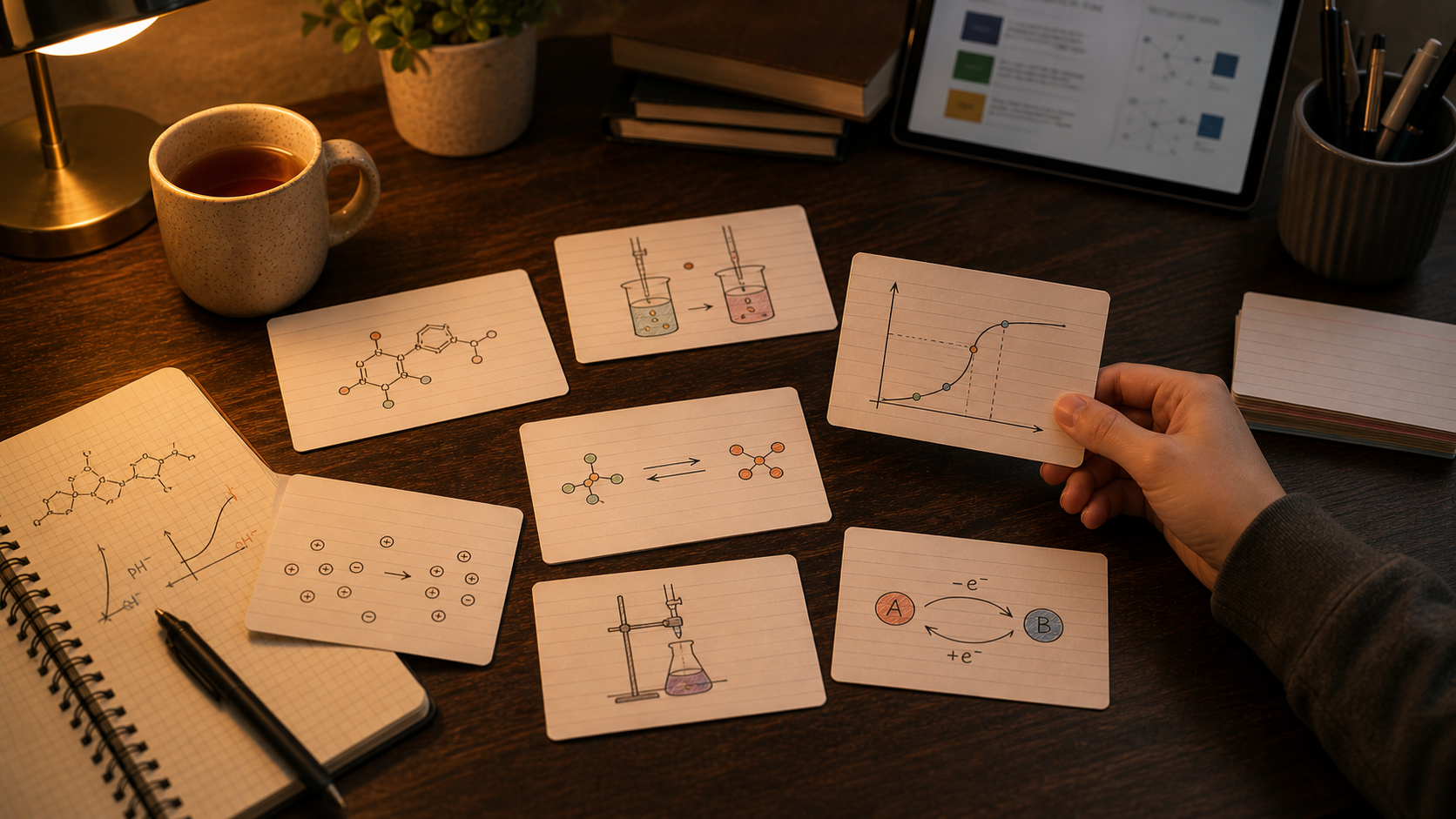
AP Chemistry is not one memory problem
Most students make one AP Chem deck and then wonder why some cards feel useful and others feel dead on arrival. The reason is simple: the course keeps asking you to remember different kinds of things.
Some misses are about pure recall. Some are about choosing between two very similar ideas. Some are about reading what a lab setup or graph is actually telling you. Some are really about FRQ reasoning.
The split I would use looks more like this:
| Area | What you need to retrieve fast | What weak cards usually do |
|---|---|---|
| Core concepts | what a term means, what a trend suggests, what condition matters | save one clean definition and stop there |
| Equations and relationships | when to use the relationship, what each variable means, what change matters | copy a formula sheet into cards |
| Lab and data interpretation | setup clues, controls, observations, graph or table meaning | memorize lab names without the decision logic |
| FRQ repair | the exact reasoning move you missed | paste the whole prompt and scoring guide into one card |
That is why AP Chem flashcards work best when the deck mirrors the course's real friction. The point is not to remember that an equation exists. The point is to recognize what kind of chemistry problem is in front of you.
Equations matter, but trigger conditions matter more
Students usually start with equation cards because it feels productive. Sometimes it is. Sometimes it turns into a stack of fronts like Henderson-Hasselbalch equation and backs full of symbols you already recognized yesterday and still could not use on today's problem.
Better AP Chemistry equations flashcards ask for one small decision:
- When am I comparing
QtoK, and what does that comparison tell me? - What does a large
Ksuggest before I even start calculating? - Which quantities change the reaction quotient, and which do not?
- In Beer-Lambert law, which variable is supposed to track concentration?
- What does half-equivalence tell me in an acid-base setup?
- Which gas-law variable is actually being held constant in this question?
That is still recall. It just has a real job now.
If a formula card keeps failing, it usually means the card is testing the wrong thing. The issue might not be "I forgot the equation." The issue might be:
- I mix up two nearby equations
- I forget the condition for using the relationship
- I do not know what the variable means physically
- I cannot tell what the question is really asking me to solve for
Those are much better card targets than one giant front/back dump from a chapter summary.
If your current deck already feels bloated, How to Make Better Flashcards in 2026 is the best cleanup pass before you add more.
The best AP Chem cards usually come from distinctions
Chemistry punishes near-misses.
You were close, but you confused strong versus concentrated. You recognized the trend, but missed the exception. You remembered Le Chatelier's principle, but forgot that a catalyst does not change equilibrium position. You knew intermolecular forces mattered, but picked the wrong one. That is classic AP Chemistry.
So I would write a lot of cards around distinctions:
- strong acid versus concentrated acid
- ionic compound versus molecular compound when the question is really about the particles present
- molarity versus moles
- limiting reactant versus excess reactant
- endothermic shift versus faster reaction rate
- ionic bonding clue versus intermolecular-force clue
- oxidation versus reduction in the exact context you keep missing
- endpoint versus equivalence point
- precision versus accuracy in lab interpretation
These cards work because they train the fork in the road where points disappear.
This is also why how to study AP Chemistry with flashcards gets better once you stop asking every card to explain a whole topic. One clean distinction card is often more valuable than one heroic card that tries to summarize half a unit.
Build cards from the units where you keep losing the same points
Not because only three units matter. Because AP Chem mistakes are usually repetitive. If you keep missing the same kind of equilibrium setup, the same acid-base relationship, or the same electrochem sign logic, that is exactly what flashcards are for.
For equilibrium, I would focus on:
- what changes
Qversus what changesK - what a shift means versus what faster rate means
- what happens when concentration, pressure, or volume changes
- which species belong in the equilibrium expression and which do not
For acids and bases, I would focus on:
- the exact relationship between
pH,pOH,H+, andOH- - what makes a buffer a buffer
- what happens at half-equivalence
- how to tell whether the question is conceptual, stoichiometric, or both
For electrochemistry, I would focus on:
- anode versus cathode in the AP Chem framing you actually use
- what sign of cell potential tells you
- oxidation and reduction paired to movement of electrons
- what changes concentration cell behavior
I would also keep a smaller set for topics that generate sneaky misses:
- stoichiometry cards about mole ratios, limiting reactant setup, and what the question is solving for
- intermolecular-force cards about picking the strongest relevant force from the actual species present
- thermochemistry cards about sign conventions and what the system is doing
- net ionic equation cards about what stays, what dissociates, and what is really reacting
Those are not random notes. They are repeated decision points. If you want AP Chemistry spaced repetition to be useful, this is where it starts paying rent.
Lab questions are card-worthy because AP Chemistry cares about evidence
A lot of students make chemistry cards that sound smart and still fall apart on lab questions.
They remember what titration is. Then they miss a question about why the indicator changed late, which variable should stay controlled, or what observation actually supports the claim. They remember solubility rules. Then they misread the setup because they did not track what was mixed, what stayed aqueous, and what the precipitate means.
That is why I would keep a separate slice of cards for lab and data interpretation:
- what the control or comparison actually is
- what observation would support the claim
- what source of error shifts the result high or low
- what the graph or table is showing before you explain it
- what unit or measurement detail changes the conclusion
Examples:
- In a titration setup, what usually causes overshooting the endpoint?
- What is the difference between systematic error and random error in a chemistry lab context?
- Before explaining a graph, what should you identify first?
- What observation best supports that a gas-producing reaction occurred?
- What would make measured molarity come out too high in this setup?
These are the cards that keep AP Chemistry FRQ study from drifting into pure content memorization. A lot of AP Chem points live in evidence, setup, and interpretation.
FRQ cards should store the miss, not the whole response
This is where many otherwise decent decks go bad.
Students copy an entire free-response question onto the front, paste a long answer or scoring note onto the back, review it once, and then quietly start avoiding it. That is not a flashcard anymore. It is a guilt object.
After an FRQ miss, I would ask a smaller question: what failed here?
Usually it is one of these:
- I knew the chemistry but not the verb
- I did not connect the claim to evidence from the table or graph
- I missed a unit conversion hidden inside the setup
- I used a true statement that did not answer the prompt
- I mixed a conceptual explanation with a calculation and did neither cleanly
If the repeated miss is SI-prefix recall, Metric Prefix Flashcards: All 24 SI Names, Symbols & Powers of Ten drills the current SI prefix names, case-sensitive symbols, and powers of ten. It does not teach unit conversions or chemistry problems, so keep those in separate practice.
Those are strong card targets.
Examples:
- In an AP Chemistry FRQ, what does
justifyusually require beyond a correct choice? - What is the first thing to preserve from a missed calculation FRQ?
- When a prompt gives a graph, what makes an explanation chemistry-based instead of descriptive only?
- What kind of miss means I need more problem practice, not more cards?
That last one matters. Some misses are memory misses. Some are transfer misses. Flashcards help with recall. Practice problems build transfer. Keep both.
If your best source material is corrected homework, quizzes, and released-style practice, How to Turn Practice Questions Into Flashcards in 2026 is the most direct companion. For the scheduling side, How to Study for an Exam With FSRS in 2026 fits well here too.
A practical weekly workflow for AP Chemistry
I would keep this boring on purpose.
After class notes, homework, a quiz, or FRQ practice:
- Pull out only the misses that feel reusable.
- Sort them into equations, distinctions, lab/data, or FRQ reasoning.
- Write one or two small cards per pattern instead of one giant summary card.
- Tag by unit or mistake type so you can narrow review later.
- Review due cards daily.
- Go back to fresh chemistry problems and see whether the same miss survives.
That last step is the test.
If the same mistake disappears in new work, the card probably did its job. If the mistake stays, the card is usually too vague or aimed at the wrong memory target.
This is the same principle behind How to Use Flashcards for Math in 2026 and How to Use Flashcards for AP Biology in 2026. Different subject, same rule: cards help you remember what should come back quickly, then practice checks whether you can actually use it.
What should not become a flashcard
Not every AP Chem problem deserves a card.
I would usually skip cards for:
- full worked calculations you have not understood yet
- one-off classroom trivia
- giant chapter summaries
- mistakes caused by rushing instead of misunderstanding
- cards whose answer is basically "redo the whole problem"
Yes, AP Chemistry Anki-style workflows and AI-assisted drafting can save time. The cleanup pass is still the real work:
- split cards that test multiple ideas
- rewrite vague fronts
- remove local classroom wording that will confuse you later
- delete cards that belong in worked practice, not spaced repetition
The deck should get smaller as your judgment gets better.
If you want a simple test, ask this: when I miss this card, will fixing it make the next chemistry problem easier? If the answer is no, it probably should not stay.
Where Flashcards fits if you want one place for the workflow
Flashcards fits this AP Chemistry workflow well because the product already supports the practical parts after you identify the memory target:
- front/back card creation and editing
- AI-assisted drafting through chat
- text and file attachments when your source is notes, a lab handout, or corrected practice
- decks, tags, filtering, and search when you want to review only equilibrium cards or only FRQ misses
- FSRS scheduling once the cards are worth reviewing
- offline-first study across web, iOS, and Android
- open source code and self-hosting if that matters to how you study
That is the useful promise. Not "chemistry becomes easy." Just a cleaner place to capture the right cards, cut the bad ones, and review them on a schedule that does not waste time. If you want the product overview rather than another study article, the features page is the clean summary.
The rule that actually holds up
If you are preparing for AP Chemistry in 2026, use flashcards for the parts of chemistry that should become fast:
- equation choice
- concept distinctions
- lab interpretation patterns
- repeated FRQ reasoning misses
Then do real chemistry problems for everything that requires setup, transfer, and full execution.
That split is what makes AP Chemistry flashcards useful instead of decorative.