How to Use Flashcards for Math in 2026: Formulas, Pattern Recognition, and Error Cards
Last week I watched someone miss the same algebra setup three times in one week. The numbers changed. The worksheet changed. The trap did not. Each time, the formula looked familiar once the solution was on the page. Each time, the hard part was noticing the pattern early enough to use it.
That is the real case for math flashcards.
Not because math turns into trivia, and not because a deck can replace problem solving. It cannot. But a lot of math pain comes from smaller failures that repeat around the actual work: forgetting a formula, picking the wrong setup, missing a condition, repeating the same sign mistake, or recognizing the method five minutes too late.
That is where flashcards for math are useful. They make practice less wasteful. They help you keep the parts that should already be automatic so your time goes into solving, not relearning.
The version I trust is narrow:
- formula retrieval
- setup recognition
- repeated error patterns from real work
If you use flashcards for those three jobs, they fit math well. If you ask them to replace proofs, derivations, or multi-step problem solving, the deck starts doing a job it was never built to do.
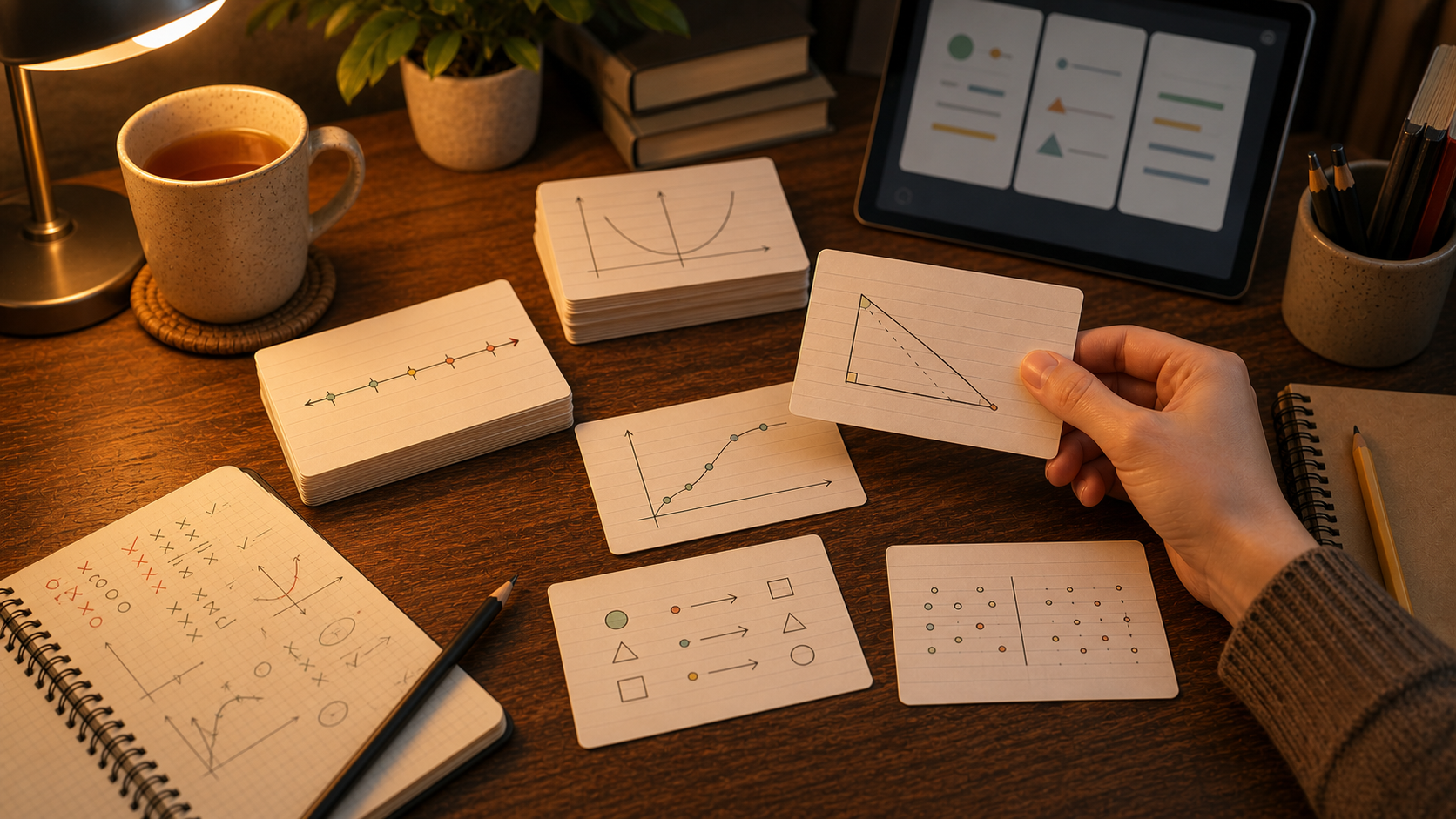
Math flashcards should store decisions, not whole solutions
This is the rule I keep coming back to.
Weak math decks usually fail in one of two directions. Some are too thin: one isolated fact, no context, nothing that helps when the question is phrased a little differently. Others are too heavy: full problem on the front, full worked solution on the back, and a review session that feels like rereading homework.
The better middle is a card that captures the decision you keep needing:
- which formula applies here
- what clue points to this setup
- which condition changes the answer
- what mistake usually breaks the solution
That is why how to study math with flashcards is mostly a card-design problem. A good card should make the next move easier to retrieve. It should not try to store the entire chapter.
If your current cards already feel too broad or too wordy, How to Make Better Flashcards in 2026 is a good reset before you add more.
Start with formulas, but make the cards smaller than your formula sheet
Most people begin with formulas, which is fine. The trouble starts when formula cards become either pure labels or mini-textbooks.
This is too thin:
- Front:
Quadratic formula - Back: the formula
This is too heavy:
- Front: one giant worked problem that happens to use the quadratic formula
- Back: every algebra step from the solution key
Better math formula flashcards aim at one memory target at a time:
- What is the quadratic formula?
- What does the discriminant tell you about the number of real roots?
- In
y = mx + b, which term is the slope? - What is the derivative of
sin(x)? - For independent events, what is the multiplication rule?
Then add the detail that actually prevents mistakes. Maybe you keep flipping a sign. Maybe you mix up what a variable represents. Maybe you forget the condition that has to be true before a rule applies. Those are excellent flashcard targets because they are small, reusable, and painful to miss in the middle of real work.
That is a much better use of flashcards for math than copying a summary page into one card and hoping repetition sorts it out later.
Setup-recognition cards are where math flashcards become worth the effort
This is the part a lot of students skip, and it is usually the highest-value part.
In many classes, the issue is not "I have never seen this formula before." The issue is "I did not recognize the structure fast enough." You get to the solution, look at it, and think, yes, of course. But the page was blank when you needed the idea.
That is why I like cards that connect a cue to a method:
- What clue suggests factoring instead of expanding?
- When is finding a common denominator the clean first move?
- What wording signals that the problem wants the value of an expression, not the variable itself?
- What pattern suggests similar triangles might be the right tool?
- What kind of limit expression usually points toward L'Hopital's rule?
These are still math problem solving flashcards, but they are not trying to memorize a whole solution path. They train recognition. That matters because explanations are cheap now. You can get a walkthrough from a tutor, a video, or an AI tool in minutes. The harder part is seeing the right move before someone shows it to you.
If your raw material mostly comes from corrected homework, quizzes, or mock tests, How to Turn Practice Questions Into Flashcards in 2026 fits this workflow well.
Your mistake log is usually better than a generic math deck
If I had to choose one source for a math deck, I would usually take your repeated mistakes over a public list of formulas.
Your own misses show you where the friction really is:
- setup choices that keep drifting
- sign errors that come back every week
- rules that look similar but behave differently
- conditions you forget to check
- wording that keeps pulling you toward the wrong method
That is exactly what math error log flashcards are good for.
A useful error card does not need to copy the whole original problem. It just needs to preserve the reusable lesson:
- When distributing a negative across parentheses, what do I check before combining terms?
- In a probability question, what clue tells me the events are not independent?
- In a geometry problem, what must be true before I assume triangles are similar?
- Why do I check for extraneous solutions after solving an equation with a square root?
- In a calculus problem, what mistake happens if I differentiate the outside without handling the inside?
This is one reason I like error cards so much for spaced repetition math. They stay close to reality. They come from actual failures, not from a fantasy version of studying where every card is equally important.
Flashcards do not replace doing math
This part should stay blunt.
If you are learning math, you still need to solve actual problems. You need to set up unfamiliar questions, push through multi-step work, draw diagrams, check whether an answer makes sense, and recover after a wrong turn. No deck can do that part for you.
Flashcards sit around problem practice, not on top of it. They help with recall and recognition so that your next practice session starts from a stronger place. If your study plan slowly turns into "review cards instead of doing problems," the system has drifted.
The split I would keep is simple:
- flashcards for memory targets
- problem sets for mathematical performance
That version holds up.
A simple math workflow that works in real classes
I would keep the process boring on purpose.
After homework, a quiz, or a practice set:
- Mark the misses that feel reusable.
- Sort them into formula, setup, or error-pattern problems.
- Write one or two small cards for each real pattern.
- Tag by unit, topic, or mistake type.
- Review due cards daily.
- Go back to fresh problems and see whether the same miss survives.
That last step matters more than people think. If the error disappears in fresh work, the card probably did its job. If it survives, the card is often too vague, too broad, or aimed at the wrong memory target.
If the deck structure starts getting messy, How to Organize Flashcards in 2026 is a better fix than creating a new deck for every worksheet.
AI can draft math cards quickly, but the edit pass still matters
Math is a good example of where AI is useful and still easy to misuse.
It can help you turn notes, screenshots, corrected homework, files, or short summaries of mistakes into draft cards quickly. That is useful clerical work. It saves time, especially when you already know what you want to remember.
But math cards still need editing. AI-generated cards often test three ideas at once, keep the answer too long, hide an important condition, or preserve a local explanation instead of a clean prompt you can review later.
So yes, use AI to draft math flashcards if it speeds up the boring part. Then edit hard. Split overloaded cards. Rewrite vague fronts. Delete the ones that look smart but will review badly next week.
If the cleanup step is the actual bottleneck, How to Fix AI Flashcards in 2026 goes deeper on that editing pass.
FSRS helps math when the cards are narrow enough
Math memory is uneven in a very normal way. One formula sticks after two reviews. One setup cue still disappears under pressure. One recurring algebra mistake keeps showing up until you finally kill it.
That is why spaced repetition math works well with FSRS. Easy cards move out of the way. Stubborn cards come back sooner. Over time, you spend less review time on what already holds and more time on the places where your recall is still unreliable.
The catch is that the scheduler still needs clean cards. If a prompt is vague, your self-grading gets noisy. If a card tests too many things, the difficulty rating becomes muddy. If the answer is a paragraph, you start negotiating with yourself instead of reviewing honestly.
Smaller cards make FSRS much more useful. If you want to tune the scheduling side after the card-writing side is under control, FSRS Settings in 2026: What to Change and What to Leave Alone is the right next read.
Where Flashcards fits in this workflow
Flashcards is a good fit for this kind of math study because the product supports the parts that matter after you identify the memory target:
- front/back cards for formulas, recognition cues, and error patterns
- decks, tags, and filtering when you want to review one topic without breaking your main library
- AI-assisted card creation from text, files, images, and chat workflows
- FSRS review scheduling for the finished deck
- offline-first clients across web, iPhone, and Android
If your study material already lives in text files or you want a more technical workflow, the docs also cover getting started and API / agent onboarding. That is useful if you want the same math workflow to scale from quick manual cards to a more automated setup later.
The useful rule
If you want to use flashcards for math well, do not ask the deck to replace problem solving. Ask it to make your next problem-solving session sharper.
Remember the formula faster. Notice the setup sooner. Stop repeating the same avoidable mistake.
That is enough to make how to use flashcards for math a real workflow instead of a vague study tip.
If you want to try it in practice: