How to Study for Open-Book Exams With Flashcards in 2026: Memorize the Map, Not the Whole Book
Last week I watched someone spend eight minutes in an open-note exam looking for one formula they were sure they had highlighted. The formula was there. The points were not.
That is the trap with open-book exams. People hear "open book" and imagine less memory pressure. Usually the pressure just moves. Instead of recalling everything from scratch, you now have to recognize the problem fast, know which tool fits, and reach the right page before the clock gets rude.
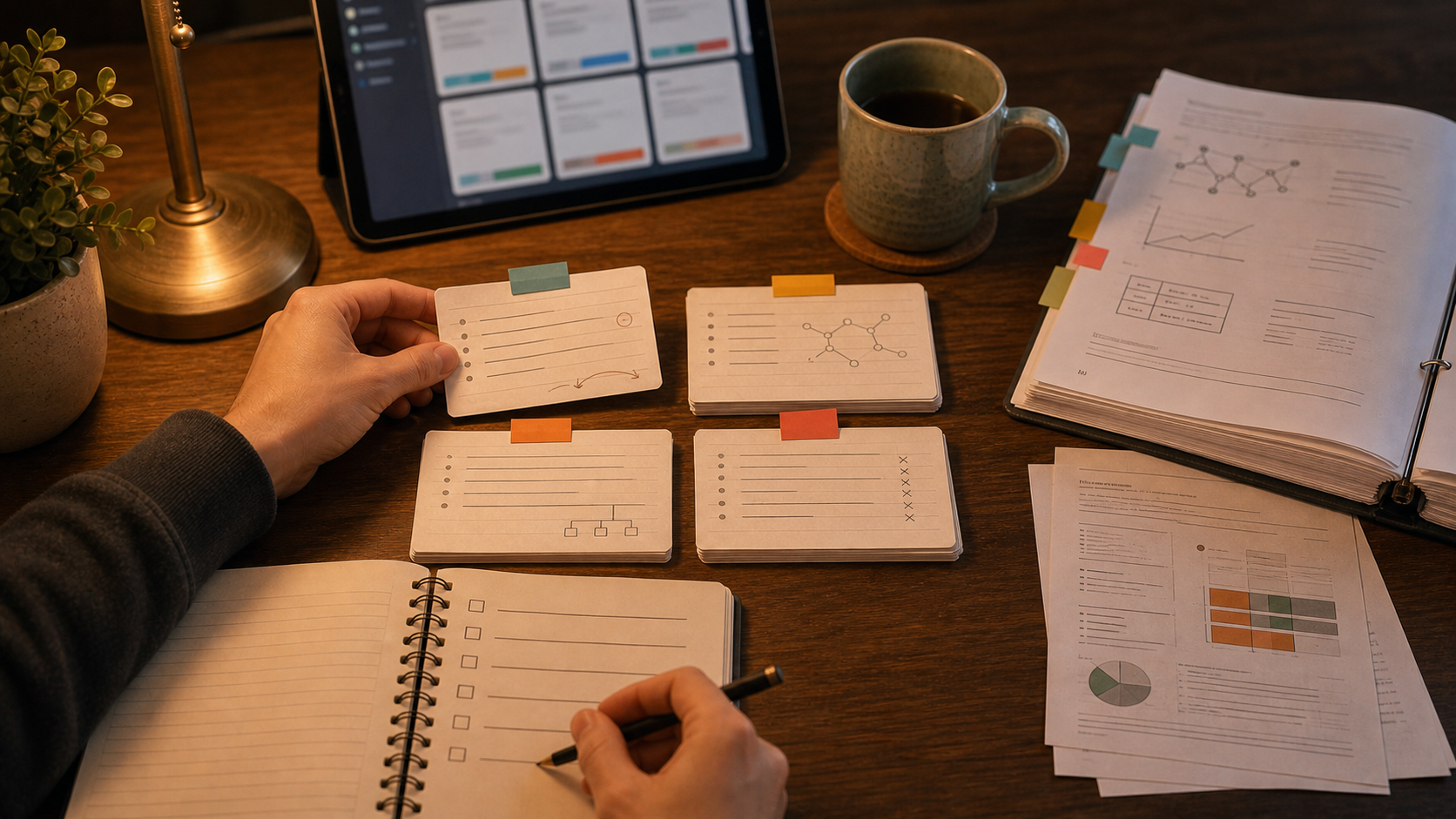
That is exactly where flashcards help. The useful goal is smaller than "memorize the whole book." You want the map, the triggers, the patterns, and the mistakes that keep costing you time.
Why this matters more in 2026
Assessment formats are shifting again. The 2026 HEPI Student Generative AI Survey says 95% of students now use AI in at least one way, and 94% use AI to help complete assessments. That does not mean every course is suddenly open-book. It does help explain why more instructors keep leaning toward application-heavy formats, open-note policies, take-home work, and questions you cannot bluff your way through with a tidy summary.
The study advice from universities has moved in the same direction for years. Cornell's guide on open-book exams says they are often harder than closed-book exams and usually test whether you can apply or analyze information, not just remember it. Indiana University's teaching guide on creating open-book exams says the good versions focus on conceptual questions, case-based reasoning, prediction, explanation, and error correction.
So if your exam is open-note, the useful question is simpler: what should you still know cold so you do not spend the exam opening tabs like a confused librarian?
Open-book exams still punish weak recall
Open-book exams still lean on recall.
They just add navigation on top.
You still need to remember enough to do four things quickly:
- identify what kind of problem you are looking at
- recall the concept, formula, framework, or case family that probably applies
- know where the supporting detail lives in your notes or materials
- use the material to confirm or refine the answer instead of starting from zero
That means flashcards are still useful. The deck just needs a different job.
For a closed-book exam, you may build cards for direct fact retrieval.
For an open-book exam, the best cards often cover:
- recognition of the problem type
- cue-to-tool matching
- formula or rule selection
- exceptions people confuse under pressure
- where in your own materials the deeper detail lives
If your exam is essay-heavy, this companion article is the better next read: How to Study for Essay Exams With Flashcards in 2026.
Do not turn your notes into one giant deck
This is the first mistake I would avoid.
People panic about an open-note exam, dump the whole course packet into AI, and accept 240 cards because it feels productive. Then they spend the next week reviewing definitions they were allowed to look up anyway.
That is backwards.
The deck should cover the things that still need to become automatic:
- the meaning of common cues
- the difference between lookalike concepts
- the rule or formula you should reach for first
- the order of a process that drives the rest of the answer
- the page, section, or document where deeper detail lives
If a fact is rare, low-value, or easy to locate instantly during the exam, it usually does not need flashcard space.
This is the same filter I use in What Should Go on a Flashcard in 2026?: future retrieval value matters more than the feeling of completeness.
The best open-book deck usually has five card types
You do not need a clever card format. You need a narrower one.
1. Trigger cards
These tell you what a cue means.
Examples:
- Front: In a statistics problem, what does "independent samples" tell you to check before choosing the test? Back: Whether you are comparing two separate groups rather than repeated measures on the same group.
- Front: In a law-school issue spotter, what does a facts pattern full of promises and reliance usually make you check? Back: Promissory estoppel and the elements for reasonable reliance.
These cards stop the blank-stare moment where the topic feels familiar but the tool name will not come back.
2. Locator cards
These tell you where the bigger explanation lives.
Examples:
- Front: Where in your notes is the clean summary of enzyme inhibition patterns? Back: Biochem review sheet, page 3, under the comparison table.
- Front: Where is the formula sheet section for confidence intervals? Back: Stats packet, top of page 2.
I would not build hundreds of these. I would build enough that your most-used references become muscle memory.
3. Rule-selection cards
These tell you which rule, formula, or framework fits a certain problem family.
Examples:
- Front: If the problem asks whether demand changes because of a price change in the same good, is this a movement along the curve or a shift? Back: A movement along the demand curve.
- Front: If a networking question asks for guaranteed delivery and ordered packets, which protocol should you think of first? Back: TCP.
These are usually the time savers.
4. Error-pattern cards
These come from the mistakes you keep repeating.
Cornell's five-day study plan explicitly recommends working the problems you missed and using self-testing, not just rereading. For open-note exams, this matters even more. Your wrong answers show you where access to notes still was not enough.
Examples:
- Front: On dilution problems, what mistake did you keep making with the final volume? Back: I kept using the starting volume instead of the total final volume after dilution.
- Front: On torts hypos, what fact pattern kept making you jump to negligence too early? Back: I skipped the intentional-tort analysis when the conduct was deliberate.
If your source is mostly mocks, quizzes, and wrong answers, How to Turn Practice Questions Into Flashcards in 2026 goes deeper on the conversion workflow.
5. Build-the-outline cards
These are useful when the exam asks you to explain, compare, or solve in steps.
Examples:
- Front: What are the first four checks in your thermodynamics problem setup? Back: Identify the system, list known values, define the process, choose the governing relation.
- Front: What is the structure for answering a policy-comparison essay in this course? Back: State the standard, compare both options against it, note the tradeoff, then defend the final choice.
These cards do not store the whole answer. They store the skeleton that keeps you from freezing.
Memorize the map, not the paragraph
This is the main open-book exam principle.
You do not need every sentence from the reading in memory. You want to know:
- what topic each source covers
- where the good examples are
- which chart or table resolves common confusion
- which formula sheet section matters for which problem
- which framework applies before you even open the notes
Princeton's guide on open-book, open-note, and take-home exams recommends labeling materials, building a custom table of contents, and practicing with the layout before the real exam. That is basically the physical version of the same idea.
Your flashcards should make that map easier to recall under time pressure.
Practice closed first, then open
This is where a lot of open-note prep goes soft.
Students review with the materials visible the whole time, so they never find out what they actually know.
I would practice in two passes:
- answer from memory first
- open the notes only after you commit to an answer or get stuck
That second step matters because it teaches you whether your notes are helping with confirmation or rescuing total confusion.
If the notes are always rescuing total confusion, the problem is not organization yet. The problem is understanding.
Flashcards fit the first pass. Notes fit the second.
The reference pack matters almost as much as the deck
Good flashcards will not save a chaotic exam setup.
Cornell says there is such a thing as too much reference material, and Princeton recommends tagging, labeling, and creating a custom topic-to-page sheet. That is the right direction.
I would prepare three layers:
- one small formula or rule sheet
- one topic index that tells you where things live
- the full notes, slides, textbook pages, or printed packet behind them
Your flashcards should point into that system, not compete with it.
If your materials still live as scattered PDFs or slide decks, these setup articles help before you start studying:
A simple five-day open-book workflow
You do not need a dramatic system. You need a repeatable loop.
Day 1: shrink the source material
- group the course into topics
- identify which materials are actually allowed
- make a thin reference pack instead of keeping everything
- mark the formulas, rules, charts, and examples you keep needing
Day 2: build the first card batch
Create cards only for:
- trigger recognition
- rule or formula selection
- locator memory for high-value pages
- repeated mistake patterns
Day 3: self-test without opening the notes first
Do a short closed pass with flashcards, then a short open pass with old questions or practice prompts.
Day 4: clean the deck
Delete cards that are too broad. Split cards that ask three things at once. Add a few build-the-outline cards for problems or essay structures that still feel slippery.
Day 5: rehearse the real exam environment
Lay out the exact materials you will use. Princeton specifically recommends practicing with the layout so you already know where everything is. Do at least one timed run where you have to answer first and reference second.
That is much better than spending the last night color-coding tabs you never practiced with.
Use AI for drafting and sorting, not for fake confidence
AI can help here, but the failure mode is obvious.
If you ask AI to summarize the chapter, generate 80 cards, and tell you what matters, you will probably end up with a clean-looking deck that did not come from your real exam demands.
I would use AI for smaller jobs:
- turning your own notes into candidate cards
- extracting formulas or rule statements from your allowed materials
- grouping weak spots by topic
- converting missed questions into shorter prompts
Then I would edit aggressively.
The useful workflow in 2026 is closer to this: let AI reduce setup time so you can spend your actual study energy on retrieval practice.
If you are working from a tutor-style AI session first, How to Use AI for Active Recall in 2026 is the closest companion article.
Where Flashcards Open Source App fits
Flashcards is a good fit for open-book exam prep because this kind of studying is small and precise. You are not trying to warehouse the course. You are trying to keep a clean deck of the prompts that still need to become automatic:
- problem-type recognition
- rule selection
- formula selection
- step order
- source-location memory for the pages you will reach for under time pressure
The product-specific part is straightforward:
- make one deck per exam, not one giant deck for the whole semester
- tag cards by
trigger,locator,rule, andmistakeso weak spots stay visible - attach the allowed PDF, notes export, or slide deck when you need to draft cards from the real materials
- keep the final cards short enough that FSRS review still feels honest
That works well with a simple front/back workflow and FSRS scheduling. A small open-book deck reviewed honestly is much more useful than a giant "just in case" deck you stop trusting after two days.
If you are new to the product, start with the getting started guide, then build one deck for one exam instead of one deck for the whole semester.
Common mistakes that make open-book flashcards worse
I see the same ones over and over:
- copying textbook paragraphs onto the back of the card
- making cards for facts that are easy to find during the exam
- keeping the notes open during every review
- ignoring repeated wrong-answer patterns
- building no locator memory, then acting surprised when the index fails
- creating a huge deck instead of a high-value one
If your cards already feel vague or bloated, How to Make Better Flashcards in 2026 and How to Fix AI Flashcards in 2026 are the two cleanup guides I would use first.
Start smaller than your panic wants
If your open-book exam is coming up, do not start by making 150 cards.
Start with 20:
- 8 trigger cards
- 4 locator cards
- 4 rule-selection cards
- 4 error-pattern or outline cards
Review them once without notes.
Then do one short practice set with the real materials laid out the way you plan to use them.
That is usually enough to expose the next batch of cards you actually need.
Open-book exams reward people who can recognize the problem, recall the map, and confirm the detail fast. That is a very flashcard-friendly job.