How to Study for Essay Exams With Flashcards in 2026: Blue-Book and Short-Answer Prep That Actually Sticks
The blue book opens, the first prompt says "Compare" or "Assess," and suddenly the problem is not your handwriting. It is that the definition, example, or contrast point you could recognize last night will not come back cleanly on command.
That is what makes essay exams, blue-book exams, and short-answer finals feel so strange. They look like writing tests, but the first failure is usually retrieval. You still have to remember the rule, the date, the case, the quote, the mechanism, the compare-and-contrast frame, and the mistake your professor kept marking in the margin.
That is why essay exam flashcards make sense when you use them for the right layer of the job.
Not for storing full essays.
For storing the building blocks that let a solid answer appear faster under pressure.
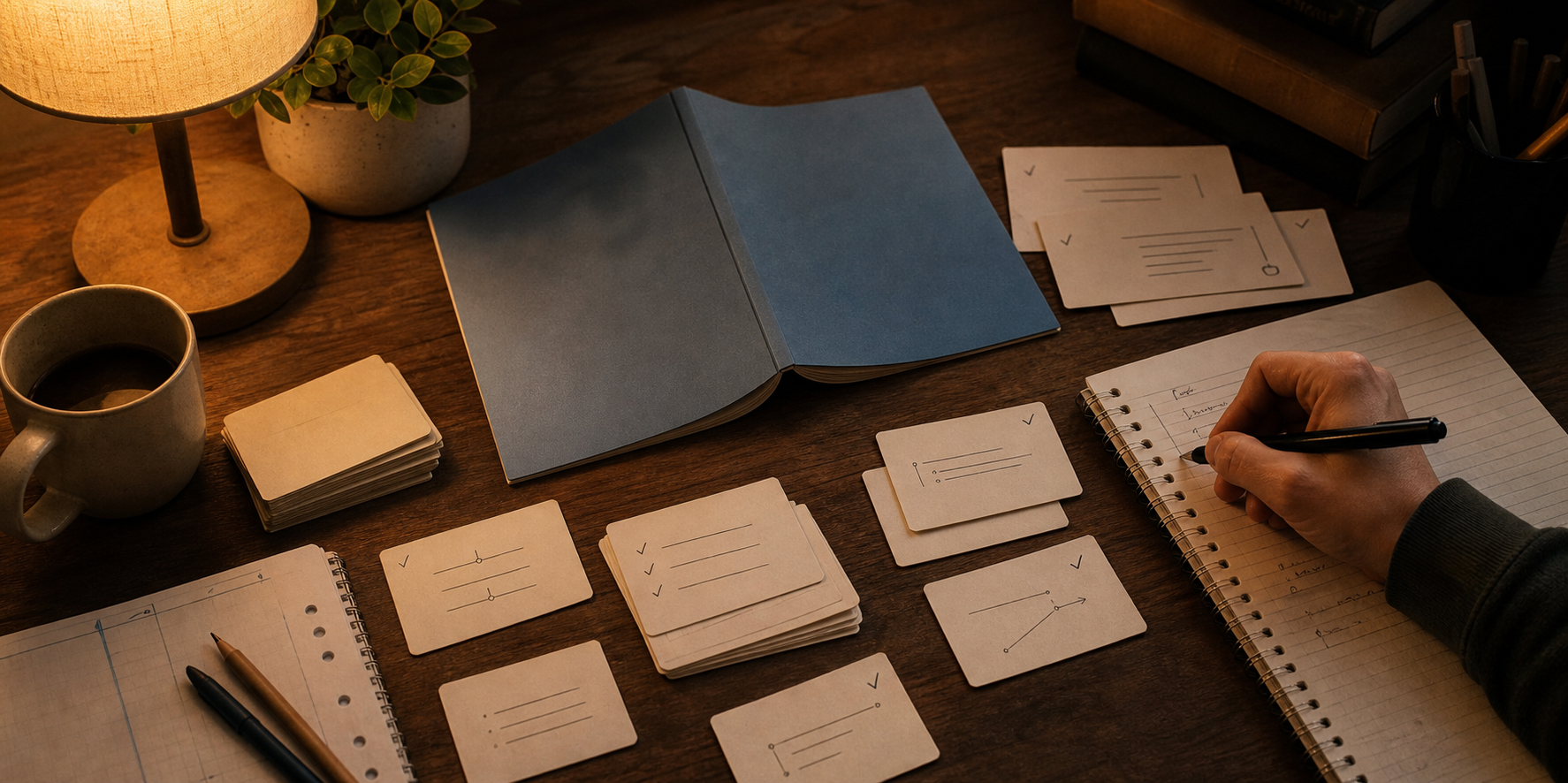
Flashcards help with essay exams when the cards are smaller than the essay
This is the part people often get backwards.
They hear how to use flashcards for essay exams and imagine something like this:
- Front: Explain the causes of World War I.
- Back: a paragraph so long you already do not want to review it
or:
- Front: Write a constitutional law essay about equal protection.
- Back: an outline pasted into card form
That is not a flashcard workflow. It is just your notes wearing flashcard formatting.
The better move is to split the essay task into recall units:
- definitions you must state cleanly
- prompt verbs you need to react to correctly
- thesis patterns that fit common question types
- evidence clusters for major themes
- compare-and-contrast pairs you keep mixing up
- cause-and-effect links
- common counterarguments
- mistakes from practice essays and short-answer sets
If the exam asks you to write a coherent answer fast, these are the parts worth making retrievable.
Essay exams are closer to retrieval practice than most students realize
The writing matters, but the memory layer matters first.
A 2021 review by Pooja Agarwal and colleagues screened nearly 2,000 abstracts, coded 50 experiments, and found retrieval-practice benefits across education levels, subjects, and test formats, with most reported effect sizes landing in the medium-to-large range. That is a useful reminder for active recall for essay exams: asking memory to produce information is part of learning, not only part of testing. The paper is here: Retrieval Practice Consistently Benefits Student Learning.
That matters for essay prep because essay exams feel like "writing tasks," so students often study them like writing tasks only:
- reread the chapter
- reread the outline
- reread the sample answer
Then the exam asks for recall, selection, and organization all at once.
Flashcards do not replace practice essays. They make the raw material easier to retrieve when the prompt is staring at you.
What to put on essay-exam flashcards
If you want a practical how to study for essay exams workflow, I would start here.
1. Definitions you must produce cleanly
These are the easiest wins.
If a sloppy definition weakens the whole answer, it belongs on a card.
Examples:
- What does "opportunity cost" mean in one sentence?
- What is judicial review?
- What is natural selection?
- What counts as dramatic irony?
These cards are boring in the best way. They keep you from burning exam time trying to remember wording you should already own.
2. Prompt-verb cards
This is underrated.
A lot of students know the topic and still answer the wrong task.
Essay prompts often hinge on verbs like:
- compare
- contrast
- evaluate
- analyze
- assess
- justify
- explain
- trace
Make cards that force the distinction.
Examples:
- On an essay exam, what does "compare" require?
- What is the difference between "analyze" and "summarize" in a short-answer response?
- If a professor says "assess," what kind of judgment usually needs to appear in the thesis?
That is especially useful for short answer exam study, where one bad read of the verb can waste half the response before you notice.
3. Thesis-pattern cards
You do not need to memorize one perfect sentence.
You do want fast access to the structure of a strong answer.
For example:
- For a causes question, what is a reliable thesis shape?
- For a compare-and-contrast prompt, what should the thesis do beyond naming both sides?
- For a "to what extent" question, what must the thesis make clear?
These cards help you start faster without turning your deck into canned prose. You are memorizing the move, not the exact sentence.
4. Evidence-cluster cards
This is where essay exam flashcards become much more useful.
Do not make one card per lecture if the answer really needs three or four pieces of support. Make a card that asks for a tight bundle you would genuinely use.
Examples:
- Give three pieces of evidence that support the argument that Reconstruction was unfinished.
- What three facts best support the claim that enzymes depend on structure for function?
- Which two cases and one principle best support a narrow reading of executive power?
This works well for history essay exam study, literature courses, political science, sociology, and any class where the answer rises or falls on whether you can produce support fast.
5. Contrast cards for ideas that collapse under pressure
Essay exams love nearby concepts.
Students hate nearby concepts when the clock is running.
Make cards for distinctions like:
- correlation vs causation
- mitosis vs meiosis
- nationalism vs imperialism
- descriptive claim vs normative claim
- due process vs equal protection
If your answers keep getting fuzzy at the exact point where one idea should separate from another, that is flashcard material.
6. Mistake cards from practice essays
This is probably the highest-value category.
A returned essay, marked-up blue book, or corrected short-answer set already tells you where your answer broke.
Turn those misses into cards such as:
- What evidence did I fail to include in the last practice answer on federalism?
- Which step did I skip when answering causation prompts?
- What detail keeps turning my biology explanation from correct to incomplete?
If you want the broader version of that workflow, How to Turn Practice Questions Into Flashcards in 2026 fits directly.
What not to put on the cards
Some material belongs in outlines, not in spaced repetition.
I would usually skip:
- full sample essays
- giant paragraph answers
- broad prompts like "Explain everything about Chapter 7"
- decorative quotations you do not actually need
- every sentence from your lecture notes just because you highlighted it
If the back side feels like a page you would rather reread than retrieve, the card is too big.
This is the same rule behind How to Make Better Flashcards in 2026: small prompt, direct answer, one real memory target at a time.
A practical essay-exam flashcard workflow
This is the version I would actually trust for blue book exam study or short answer exam study.
Step 1: Start from likely prompts, not from the whole course
Pull from:
- study guides
- past essay prompts
- review sheets
- practice short answers
- professor emphasis in lecture
- mistakes from old responses
If the source is still messy, clean it first with How to Turn Notes Into Flashcards in 2026.
Step 2: Build cards for the reusable parts
Do not ask, "What whole essay should I memorize?"
Ask:
- What definition has to be exact?
- What evidence do I keep forgetting?
- What contrast point keeps collapsing?
- What thesis shape fits this kind of question?
- What mistake keeps costing me points?
That question set produces a much smaller and better deck.
Step 3: Do one timed recall pass without writing the full essay
This is where the flashcards start doing real work.
Before you write a full response, try this:
- read a likely prompt
- close your notes
- say or jot the thesis
- list the evidence you think you would use
- notice what went missing
- add cards only for the missing pieces
That pairs well with How to Use the Blurting Method With Flashcards in 2026, especially if your subject rewards structure more than perfect wording.
Step 4: Write at least some full answers
Flashcards are not a substitute for writing.
They are prep for writing.
At some point, you still need to practice:
- selecting evidence under time pressure
- sequencing paragraphs
- writing transitions
- managing the clock
The card deck helps the ingredients come back faster. Writing practice teaches you to turn them into an answer.
Step 5: Mine every bad answer for new cards
This is where the system improves.
Every weak practice response creates better future cards:
- forgot key evidence
- defined the term vaguely
- mixed up two theories
- answered "describe" when the prompt wanted "evaluate"
- wrote a thesis with no clear position
Those are not failures to hide. They are precise card prompts.
Blue-book exams need faster retrieval, not prettier notes
Handwritten in-class essays create a very specific kind of pressure. You are not preparing to recognize the material on a screen. You are preparing to retrieve it with no search bar, no copied outline, and no easy backspace.
That is why blue book exam study benefits from flashcards aimed at:
- fast definition recall
- evidence bundles
- compare-and-contrast triggers
- thesis structures
- common omissions from prior essays
The goal is not to memorize a performance word for word. The goal is to shorten the blank-page pause when you first open the booklet.
AI can help the workflow, but it should not become the workflow
Tutor-style AI can help with essay prep, especially when it forces you to answer before it explains.
Still, I would use AI for narrow jobs:
- quiz me on likely prompts
- challenge my thesis
- ask for missing evidence
- turn my weak spots into candidate cards
- rewrite vague cards into cleaner front/back pairs
I would not use AI to generate one giant "essay exam deck" from the whole class and trust it blindly. That is how you end up reviewing filler.
If that is the part you want to sharpen, How to Use AI for Active Recall in 2026 and How to Fix AI Flashcards in 2026 are the better follow-ups.
Where Flashcards fits
Flashcards is a practical fit for how to use flashcards for essay exams because essay prep is usually not only a generation problem. It is an editing, storage, and review problem.
You need one place to:
- keep front/back cards for definitions, evidence, and contrasts
- tag cards by course, unit, or prompt type
- clean up AI-drafted cards before they enter your real deck
- review mistakes from practice essays and short answers
- keep the material in a deck you control instead of scattering it across notes and chats
- let FSRS schedule the follow-up instead of guessing when to revisit a topic
That matters because essay performance is built from reusable pieces. When those pieces are easier to retrieve, the writing gets calmer.
The useful goal is not memorizing the essay
If you are trying to figure out how to study for essay exams, I would keep the target simple.
Do not memorize the whole response.
Memorize the parts that make a strong response easier to build:
- the definition
- the distinction
- the evidence
- the thesis pattern
- the common mistake
Then practice writing with those parts until the answer stops feeling improvised every time the prompt changes.
That is the version of essay exam flashcards I would trust.