California Permit Test Flashcards: Study the DMV Handbook
A flashing red traffic signal and a flashing yellow traffic signal differ by one word on the page. At flashing red, stop and proceed only when it is safe. At flashing yellow, slow down and stay alert; the flashing light alone does not require a stop. If you miss that distinction on an official Class C sample test, it deserves a card.
Useful California permit test flashcards start with the live California DMV handbook. The deck should then get smaller and more personal as official sample tests expose weak spots. Aim for a compact set of signs, rules, scenario triggers, and numbers that you can retrieve without answer choices.
Set the source hierarchy before you make cards
Driving rules can change, and a polished third-party deck can still be stale. I checked the linked DMV pages on August 2, 2026. This guide does not treat the handbook as a fixed “2026 edition.” Reopen the live sources near your test date.
Use this order:
- The live English California Driver’s Handbook controls the content of your deck. Its online table of contents links the current sections on traffic control, right-of-way, road navigation, safe driving, alcohol and drugs, and other tested knowledge.
- The DMV’s knowledge and drive test preparation page explains the relationship between the tests and the handbook. DMV says knowledge-test questions come from the handbook and recommends giving yourself a few days to review it.
- The official Class C sample knowledge tests show how knowledge is presented and reveal what you cannot yet apply. DMV says it periodically adds new sample questions.
- The DMV handbooks page gives you the full handbook in other formats and a shorter Quick Reference version. Use the shorter document for orientation or review; return to the live full handbook when a rule needs its conditions and exceptions.
If a card, search result, video, app, or AI answer conflicts with the current handbook, fix the card or tag it needs-source and suspend it. Do not average the two versions together.
DMV’s website translation disclaimer identifies its English web pages as the official and accurate source for DMV program information. A DMV-published translation can help you understand the material, but resolve any difference in meaning against the live English page.
This article is limited to regular California Class C knowledge preparation. It does not cover motorcycle or commercial tests, renewal eLearning, other states, or the administrative steps for getting a permit or license.
Four categories for California permit test flashcards
Do not transcribe the handbook page by page. Read a section, close it, try an official sample test, and keep only material that deserves repeated recall. Four categories cover most useful cards.
1. Signs and signals
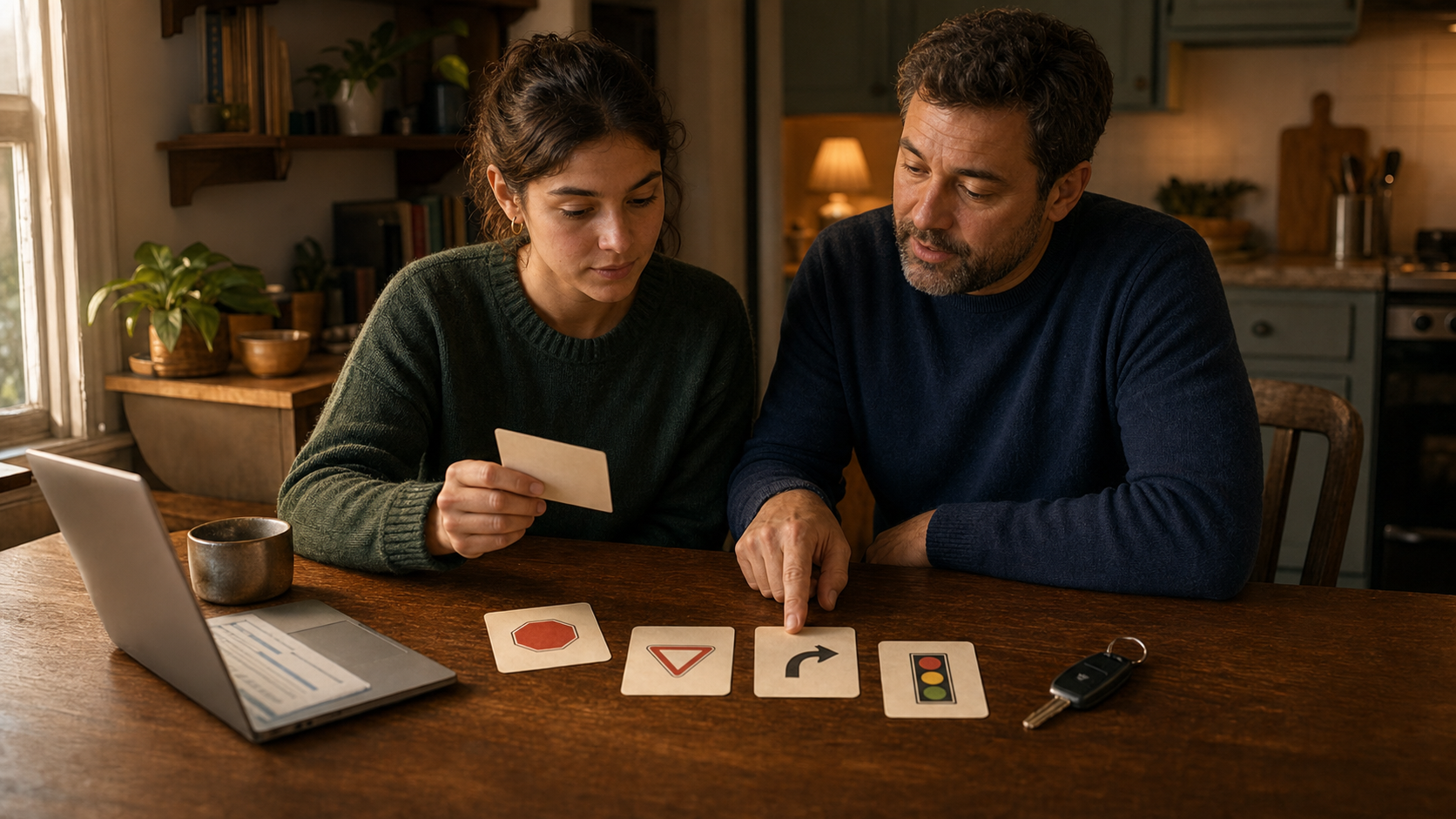
Signs work well as visual cards when the image tests one meaning or action. Signals often work better as comparison cards because a color, arrow, or flashing state changes what you do.
The DMV’s traffic-control section is the source for signal states and common sign shapes. It says a five-sided sign means you are near a school, a diamond-shaped sign warns of road conditions or dangers ahead, and a white rectangular sign communicates a rule you must obey.
Try a pair that forces the distinction:
Front: How do your actions differ at a flashing red light and a flashing yellow light?
Back: Flashing red: stop, then proceed when safe. Flashing yellow: slow down, stay alert, and proceed with caution; a stop is not required solely because the light is flashing yellow.
Source checked: California Driver's Handbook, Traffic Control, 2026-08-02
For a sign card, put the image or a clear description on the front and ask for both meaning and required response. Naming “railroad crossing” without recalling that you should look, listen, slow down, prepare to stop, and let trains pass leaves half the lesson behind.
Keep one full sign chart outside the deck. Small crops train recognition; a mixed chart checks whether you can find the relevant sign among similar shapes. How to Turn Images Into Flashcards has a practical workflow for keeping image cards focused.
2. Right-of-way and scenario triggers
Right-of-way questions are rarely helped by a card that says only “yield.” The prompt needs the trigger: who arrived first, whether the intersection is controlled, where each road user is, and which movement is planned.
The handbook’s right-of-way rules say that at an intersection without STOP or YIELD signs, the first arrival has the right-of-way. If two vehicles arrive at the same time, yield to the vehicle on your right. The same section covers T intersections, turns, pedestrians, roundabouts, and entering traffic.
Front: Two vehicles reach an uncontrolled intersection at the same time. Which vehicle should you yield to?
Back: Yield to the vehicle on your right. Check for pedestrians and bicyclists, and give up your right-of-way if doing so helps prevent a collision.
Source checked: California Driver's Handbook, Right-of-Way Rules, 2026-08-02
Keep the card narrow. Then practice fresh scenarios outside the deck by changing arrival order, road layout, pedestrian position, or turn direction. Memorizing one diagram can make you good at one diagram.
3. Numbers, distances, and timing rules
California driving material includes legal requirements and safety guidance with distances or times that are easy to blur together. Store each number with its unit, action, and condition. A back that says 100 is useless.
The handbook’s introduction to driving says to signal at least 100 feet before a turn and at least five seconds before changing lanes on a freeway. Its safe-driving section recommends the three-second rule for following distance and more space in conditions that need it.
Front: When should a driver begin signaling before a turn?
Back: At least 100 feet before the turn.
Source checked: California Driver's Handbook, Signaling, 2026-08-02
Do not build an isolated “numbers deck” from an anonymous study sheet. Attach each threshold to the exact handbook context and tag the card number-or-threshold. If you repeatedly swap two numbers, make a comparison card or add the condition to both fronts.
4. Official sample-test misses
The official sample tests are diagnostic material. Take one after reading, then capture every wrong answer and every correct answer that was a guess. A guessed answer reveals the same weak retrieval even when the score screen gives you credit.
Do not copy the whole official question and its options into your deck. The wording may change, and recognition of a familiar option is weaker than producing the rule. DMV periodically adds sample questions, so a personal deck should preserve the reusable lesson rather than freeze one sample set.
Tag these cards with sample-miss, the handbook section, and the date checked. That gives you a small repair queue without turning an official practice resource into a copied question bank.
Turn an official sample-test miss into one useful card
Use this source-linked repair workflow after each Class C sample test:
- Record the reason for the miss. Mark it as an unknown rule, a mixed-up distinction, a missed scenario cue, a number error, or careless reading.
- Find the rule in the live handbook. Search the handbook wording and read the surrounding paragraph. The context may contain a condition that the short answer does not show.
- Explain the rule without the answer choices. If you cannot state it in plain language, keep reading before making a card.
- Write one retrieval target. Ask for the action, distinction, meaning, or threshold that would prevent the same error. Put the direct answer first on the back.
- Add the section link and checked date. This makes near-test maintenance possible.
- Return to a different scenario. A correct card review proves recall of the card. A fresh sample question checks whether you can select and apply the rule.
Suppose a sample miss showed that you treated a red arrow like an ordinary red light. Your repair card can ask for the action at a red arrow, with the back stating that you must stop and remain stopped until a green signal or green arrow appears. The handbook supports that rule in the traffic-control section. You do not need the sample question’s story, option order, or exact sentences.
This is the same principle used in the broader guide to turning practice questions into flashcards. How to Make Better Flashcards helps when a repair card grows into a paragraph or asks several things at once.
A realistic seven-day study loop
Seven days can organize your work. It cannot guarantee a passing result, and it may not be enough if the handbook is new to you. Extend the loop when your sample-test misses remain broad or your due reviews become rushed.
Day 1: Map the current handbook
Open the online table of contents and identify the sections relevant to Class C knowledge. Read the DMV test-preparation guidance, take one official sample test as a baseline, and create only a few cards from clear misses.
Day 2: Read traffic control and build visual recall
Study signals, signs, and road markings. Make small visual or comparison cards. Review the full DMV sign material after the cards so the images do not become detached from the road context.
Day 3: Work through right-of-way scenarios
Read the intersection, pedestrian, roundabout, turn, and entering-traffic rules. Sketch several layouts on paper. Add cards for the triggers you confuse, then solve a new layout without notes.
Day 4: Collect numbers with their conditions
Review signaling, following distance, headlights, lanes, parking, passing, and any other number-heavy areas in the current handbook. Delete any card that contains a bare number without a unit and situation.
Day 5: Take another official sample test and repair it
Use a different Class C sample set. Investigate wrong answers and guesses through the live handbook. Add only compact, reusable cards, then review the cards already due.
Day 6: Mix recall with application
Review due cards, identify signs in mixed order, and work through fresh right-of-way situations. Take another official sample test if it will reveal useful gaps. Flashcards and practice tests train different jobs, so keep both in the week.
Day 7: Audit the deck and retest
Check source links, checked dates, vague fronts, overloaded backs, and duplicate rules. Suspend anything you cannot verify. Complete another mixed official sample test, then spend the remaining time on the handbook sections behind your misses rather than adding a large final batch.
Check the deck again near test day
A small maintenance pass matters because the live handbook controls and DMV can add sample questions.
- Reopen the handbook and official sample-test index.
- Review every card tagged
number-or-threshold,sample-miss, orneeds-source. - Confirm that linked sections still support the complete back, including its conditions.
- Update the checked date after verification; do not change it just because the card still looks familiar.
- Suspend conflicting, ambiguous, or unverified cards until you resolve them.
- Remove screenshots or copied explanations from unofficial question dumps.
- Check English DMV wording when a translation changes a legal distinction.
The fastest final audit comes from preserving sources while you build. A deck of uncited facts forces you to research everything again at the worst possible time.
Keep knowledge review separate from driving practice
Flashcards can strengthen recall of signals, signs, right-of-way triggers, number-based rules, and lessons from sample-test misses. They cannot teach steering, braking feel, vehicle control, scanning in motion, hazard perception, space judgment, or safe decisions under real traffic pressure.
DMV describes the behind-the-wheel test separately: it evaluates safe vehicle operation, driving habits, and applying traffic-law knowledge in real situations. Follow the current DMV requirements for lawful behind-the-wheel instruction and practice. A strong card streak is not evidence that someone can control a vehicle safely or pass a drive test.
Where Flashcards Open Source App fits
Flashcards Open Source App supports plain front/back cards, decks, tags, and due reviews. FSRS (Free Spaced Repetition Scheduler) uses your review history to schedule when each card returns, which helps distribute a small permit deck across the week.
AI assistance is optional, and you control which draft cards get saved. AI does not verify driving rules or legal accuracy. Compare every AI-produced card with the current DMV handbook, and do not paste private identifiers, application documents, or license records into hosted AI tools. The privacy guide explains that boundary in more detail: Private Flashcards With AI.
The app supports offline mobile study with sync across web, iOS, and Android. The project is MIT-licensed and has a documented self-hosting path. The California Permit Test Flashcards: Driver Handbook Rules & Road Signs deck contains 236 independently authored English cards with no media. It is unofficial, and neither the deck nor the app is affiliated with or endorsed by the California DMV. The Getting Started guide covers the current ways to create and review your own cards.
California permit test flashcards FAQ
Can flashcards replace the California Driver’s Handbook?
No. The handbook supplies the rules, conditions, and current wording. Cards help you retrieve selected parts after you understand them. Read the relevant handbook section again whenever a card feels incomplete or conflicts with another source.
How many cards should I make?
There is no official target. Start with the distinctions, scenario triggers, numbers, and sample-test misses that you cannot reliably recall. A small verified deck is more useful than hundreds of copied questions.
Should I memorize official sample questions?
Use them to practice the format and find gaps. Store the underlying rule in your own words, link it to the handbook, and test it again in a different scenario. Do not rely on recognizing exact wording or answer positions.
Can AI make the deck for me?
AI can draft or clean up cards, but it cannot guarantee that a traffic rule is current, complete, or legally accurate. Keep user control over saved cards and verify every draft against the live English DMV source.
Does this method cover the drive test too?
No. This workflow covers regular California Class C knowledge preparation. Behind-the-wheel skills require lawful real-world instruction and practice, and motorcycle, commercial, renewal, and other-state tests need their own current sources.
Finish with the handbook open
Good California permit test flashcards are easy to trace and easy to grade. Build them from the live handbook, use official Class C sample-test misses to decide what deserves spaced review, and keep signs, scenarios, and number-based rules small enough to retrieve without multiple-choice clues.
Then return to the source. Verify the deck near your test date, keep sample tests in the loop, and treat behind-the-wheel practice as a separate responsibility. Flashcards can make the rules easier to remember. They cannot promise a pass or make the driving decisions for you.