How to Use Flashcards for COMLEX Level 1 in 2026: OMM, COMSAE Misses, and Dedicated Study That Actually Sticks
One COMLEX review session can leave you with a very specific kind of mess: a sacral diagnosis you narrowed to two answers and still flipped, a viscerosomatic level you know when you see it but cannot pull fast enough, one anatomy relationship that was solid last month and gone this week, and a pharmacology stem where two toxicities blended together at exactly the wrong moment.
That is why COMLEX Level 1 flashcards still matter in 2026. Level 1 is pass/fail, but the memory load is still broad enough to expose weak retrieval across OMM, systems content, and question-bank cleanup. The deck only helps if it stores the misses you actually make, not every fact you touch during dedicated.
NBOME's current COMLEX-USA Level 1 and examination format pages matter here because the structure changed for the 2026 cycle. For exams on or after May 7, 2026, Level 1 is a one-day exam with 320 single-best-answer questions, split across two 4-hour sessions and eight sections of 40 questions. NBOME also publishes the testing windows and score release dates, so your review load should be built backward from your real exam window instead of from a fuzzy sense that dedicated is "basically here."
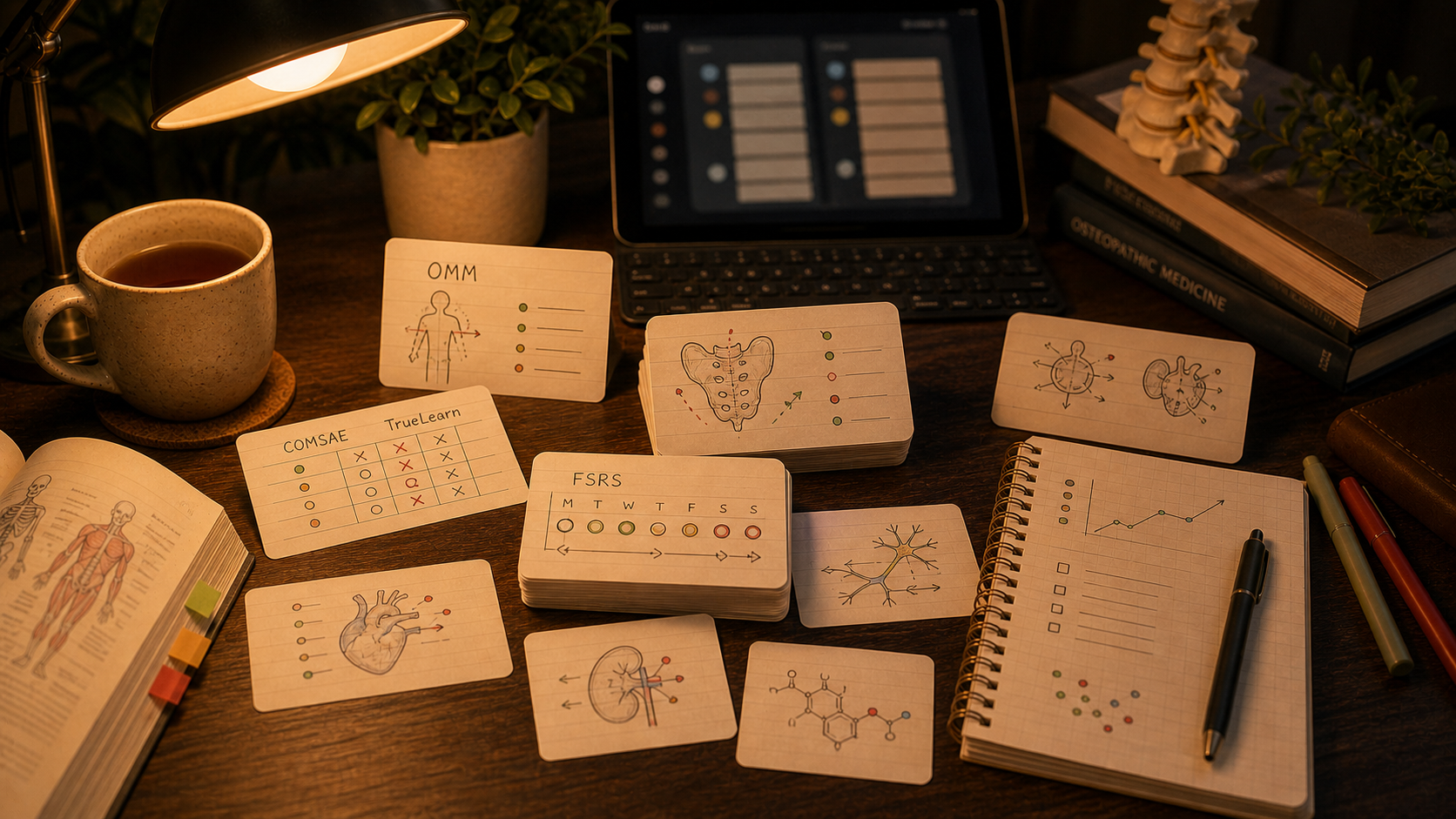
COMLEX Level 1 is not just Step 1 with a small OMM add-on
This quietly breaks a lot of decks.
People build one giant board deck, then tack on an OMM tag at the end as if that covers the osteopathic side. Usually it does not. The current COMLEX-USA Blueprint is organized around competency domains and clinical presentations, and it includes osteopathic principles, practice, and manipulative treatment in the competency framework. Your review cannot live as one endless stream of isolated facts and still feel sharp on test day.
For practical studying, I would treat COMLEX as several different memory jobs happening at once:
- OMM and osteopathic reasoning
- anatomy and neuromusculoskeletal relationships
- pathology and physiology distinctions
- pharmacology mechanisms and toxicities
- question-bank corrections from TrueLearn, COMSAE review, or a second bank if you use one
The point of flashcards for COMLEX Level 1 is to keep those memory jobs from collapsing into each other once the stems get mixed.
OMM cards should test diagnosis and decision points, not full scripts
OMM is where deck bloat gets especially bad. Students are nervous about missing points, so they try to turn every table, every setup, and every treatment sequence into giant cards.
That usually creates a review queue full of cards like this:
- Front: Explain how to diagnose and treat a left-on-left sacral torsion.
- Back: half a page of landmarks, axis logic, tissue findings, setup details, and treatment steps.
That is not a useful flashcard. It is a study guide pretending to be one.
OMM flashcards work better when each card handles one clean job:
- identify the dysfunction from the findings
- recall the key landmark pattern
- distinguish two diagnoses you keep mixing up
- remember one treatment setup detail you repeatedly forget
- connect a viscerosomatic level or reflex pattern to the tested organ system
Examples:
- Which seated flexion finding points you toward a forward sacral torsion?
- What rib motion clue separates exhalation dysfunction from inhalation dysfunction here?
- Which stem detail should push you toward a Chapman point answer instead of a pure anatomy answer?
Keep OMM cards tightly tied to your own misses. If you never confuse radial head diagnoses, you do not need fifty radial head cards because somebody else did.
COMSAE misses are high-value because they show what still breaks under pressure
This is one of the cleanest sources of signal.
A lot of students build decks from class slides first, then board books, then random AI batches, and only later look at what their self-assessments actually exposed. Once dedicated starts, I would reverse that priority.
When you review a COMSAE, ask four blunt questions:
- What did I fail to retrieve cleanly?
- What did I almost know but answer too slowly?
- What nearby concept did I confuse it with?
- Is this a knowledge miss, or was it only a rushing problem?
Only the first three usually deserve cards.
That makes COMSAE flashcards much more personal than a generic imported deck. Your weak areas might be:
- viscerosomatic levels that still do not feel automatic
- parasympathetic versus sympathetic distinctions
- lower-extremity anatomy relationships
- autonomic pharmacology toxicities
- micro or pathology stems where you recognize the pattern too late
Those are excellent card targets because they already survived one round of testing pressure and still failed there.
TrueLearn incorrects should become small correction cards, not a second question bank
This is the other big trap in dedicated COMLEX study.
You miss a TrueLearn question, open the explanation, and feel the urge to save everything:
- the stem summary
- the correct answer explanation
- the wrong-answer explanations
- the learning objective
- the chart
- the pearl at the bottom
A few days later, your deck feels thorough and completely unreviewable.
I would turn TrueLearn incorrects flashcards into one of these smaller shapes instead:
- one fact you failed to retrieve
- one distinction between two answer choices
- one stem clue you ignored
- one mechanism that explains why the correct answer was right
Examples:
- What viscerosomatic level keeps showing up with this organ?
- Which finding separates neurogenic claudication from vascular claudication in a board-style stem?
- Which adverse effect should make this drug class recognizable in two seconds?
- Which clue tells you this is a counterstrain setup question rather than a diagnosis question?
If the card tries to preserve the whole explanation, cut it. The explanation did its job already.
For the upstream workflow, How to Turn Practice Questions Into Flashcards in 2026 is the closest companion article.
Dedicated COMLEX review gets lighter when you stop storing low-yield confidence
This part is less glamorous, but it is where most decks either stay useful or turn into homework.
During dedicated, people tend to add cards for three different reasons:
- because something is truly weak
- because something feels important
- because something looked scary in a long explanation
Only the first reason is reliable.
If your due count is climbing fast, I would delete or never add cards that sound like any of these:
- "I know this when I see it"
- "This entire topic seems high yield"
- "I should probably memorize all of this table"
- "This explanation was long, so it must all matter"
That is how you end up hoarding content instead of training retrieval.
The useful question is simpler:
What am I likely to miss again unless I see one clean prompt for it later?
That one filter keeps a COMLEX Level 1 Anki workflow from turning into deck maintenance.
If the queue already feels heavy, How Many New Flashcards Per Day in 2026 and How to Avoid AI Flashcard Overload in 2026 fit this stage directly.
Anatomy and pharmacology usually fail on distinctions, not on total ignorance
This is why big summary cards feel productive right up until they stop working.
Most anatomy misses on COMLEX are not "I have never seen this before." They are closer to:
- I mixed up the relationship
- I knew the structure but not the innervation
- I recognized the region but missed the most testable association
Most pharmacology misses are similar:
- I knew the class but not the toxicity
- I knew the mechanism but confused the side effect
- I narrowed it to two drugs and chose the wrong one
So I would write cards for the distinction that keeps repeating.
Examples:
- What nerve lesion most cleanly explains this weakness pattern?
- What structure is most likely injured with this fracture?
- What toxicity should separate this drug from the other class I keep confusing it with?
- What mechanism makes this autonomic agent predictable in this stem?
That is more useful than asking yourself to explain the whole brachial plexus or the whole autonomic pharmacology chapter from memory.
If you want the broader non-COMLEX version of this workflow, How to Use Flashcards for Medical School in 2026 is the better starting point. If you are also dual-prepping, How to Use Flashcards for USMLE Step 1 in 2026 covers the more systems-heavy Step 1 angle.
FSRS helps COMLEX prep when the card quality is already under control
FSRS is useful here for the same reason it is useful anywhere else: your memory does not decay evenly.
Some OMM distinctions stick after two reviews. Some still wobble after six. Some pharmacology toxicities feel obvious until you hit a mixed block and realize two adverse-effect profiles are blending together again.
That is the kind of uneven forgetting FSRS handles well.
What FSRS does not do is rescue a bloated deck. If you keep feeding it broad cards, duplicate cards, and cards made from every explanation you read, the scheduler is being asked to organize chaos.
I would keep the order strict:
- make the card smaller
- keep only the misses that matter
- let FSRS decide the timing
If you want the settings and review logic in more detail, FSRS Settings in 2026 and How to Study for an Exam With FSRS in 2026 are the right follow-ups.
A practical weekly workflow for COMLEX Level 1
This is the version I would actually repeat during dedicated:
- Review one narrow source at a time: one TrueLearn block, one COMSAE review section, one OMM topic cluster, or one anatomy/pharm weak area.
- Mark only the misses, hesitations, and repeated confusions.
- Draft candidate cards from that short list, not from the whole explanation set.
- Split any card that needs more than one answer.
- Delete cards that are vague, duplicative, or obviously "nice to know."
- Review due cards daily and watch whether the same weak spots keep returning.
That last part matters. If the same topic keeps reappearing, the fix may be better cards or a cleaner first-pass understanding of the source, not simply more cards.
Using AI for drafting is fine, but the final filter has to stay yours
This is where people either save time or waste a lot of it.
AI is good at turning an explanation into candidate flashcards. It is not good enough to decide what belongs in your long-term review queue without supervision. That matters even more for OMM, anatomy, and question-bank cleanup, where one slightly vague card can create weeks of fuzzy review.
The workflow I trust is:
- paste the miss or weak-spot notes
- ask for short front/back cards only from those misses
- reject anything broad, repetitive, or too polished
- keep the cards that still make sense without the original explanation open
That keeps AI in the drafting role instead of letting it quietly bloat the deck.
If that is the part you want to tighten, How to Make Better Flashcards in 2026 and How to Use AI for Active Recall in 2026 pair well with the COMLEX workflow.
Where Flashcards fits
Flashcards fits best once you know what deserves retention.
For COMLEX Level 1 flashcards, the useful setup is usually:
- decks or tags by system, OMM topic, and source
- a small pipeline for COMSAE and TrueLearn misses
- AI drafting for candidate cards from messy explanations
- FSRS scheduling once the card set is clean enough to trust
The real goal is a review system that still feels usable in the second half of dedicated, when your brain is already full and the tempting move is to keep adding material instead of trimming it.
If you want the product overview, Features is the short version. If you want the setup path, Getting Started is the practical one. If you are deciding whether a hosted plan makes sense for a dedicated study window, Pricing has the current details.
The rule I would keep for COMLEX
Make cards from the misses that actually cost you time or points.
That sounds obvious, but it cuts through most of the bad habits around osteopathic medical flashcards:
- saving whole explanations
- treating every OMM table like mandatory memorization
- importing giant decks you will never truly maintain
- confusing scary content with personally weak content
COMLEX Level 1 in 2026 still asks you to retrieve quickly across osteopathic reasoning, systems knowledge, and mixed-question cleanup. The deck that survives dedicated is usually the smaller one: built from OMM distinctions, COMSAE weak spots, anatomy and pharmacology confusions, and question-bank misses you are genuinely likely to repeat.
That is the version that actually sticks.