How to Use Flashcards for USMLE Step 1 in 2026: Systems, Question Bank Misses, and Images That Actually Stick
You finish a mixed Step 1 block and the misses seem unrelated: a renal physiology question because you forgot a transporter, a pathology image because you recognized the pattern too late, a pharmacology stem because two toxicities blurred together, and an embryology detail you were sure you would remember from last month. That is Step 1 in miniature. The exam is pass/fail, but the memory load is still broad, integrated, and unforgiving once similar facts start collapsing into each other.
USMLE Step 1 flashcards still help in 2026, but only if the deck is built for board-style retrieval rather than course-by-course note storage. Step 1 follows an integrated systems and processes outline. If you take it before May 14, 2026, the format is seven 60-minute blocks in one 8-hour session, with up to 280 questions, at least 45 minutes of break time, and a 15-minute optional tutorial. If you take it on or after May 14, 2026, it changes to fourteen 30-minute blocks in one 8-hour session, with up to 20 questions per block, at least 55 minutes of break time, and a 5-minute optional tutorial. The May 2026 software update also adds updated navigation plus settings and image contrast controls.
None of that changes the real job of the deck. It has to help you retrieve the right mechanism, image pattern, drug distinction, or question-bank correction quickly inside a mixed exam.
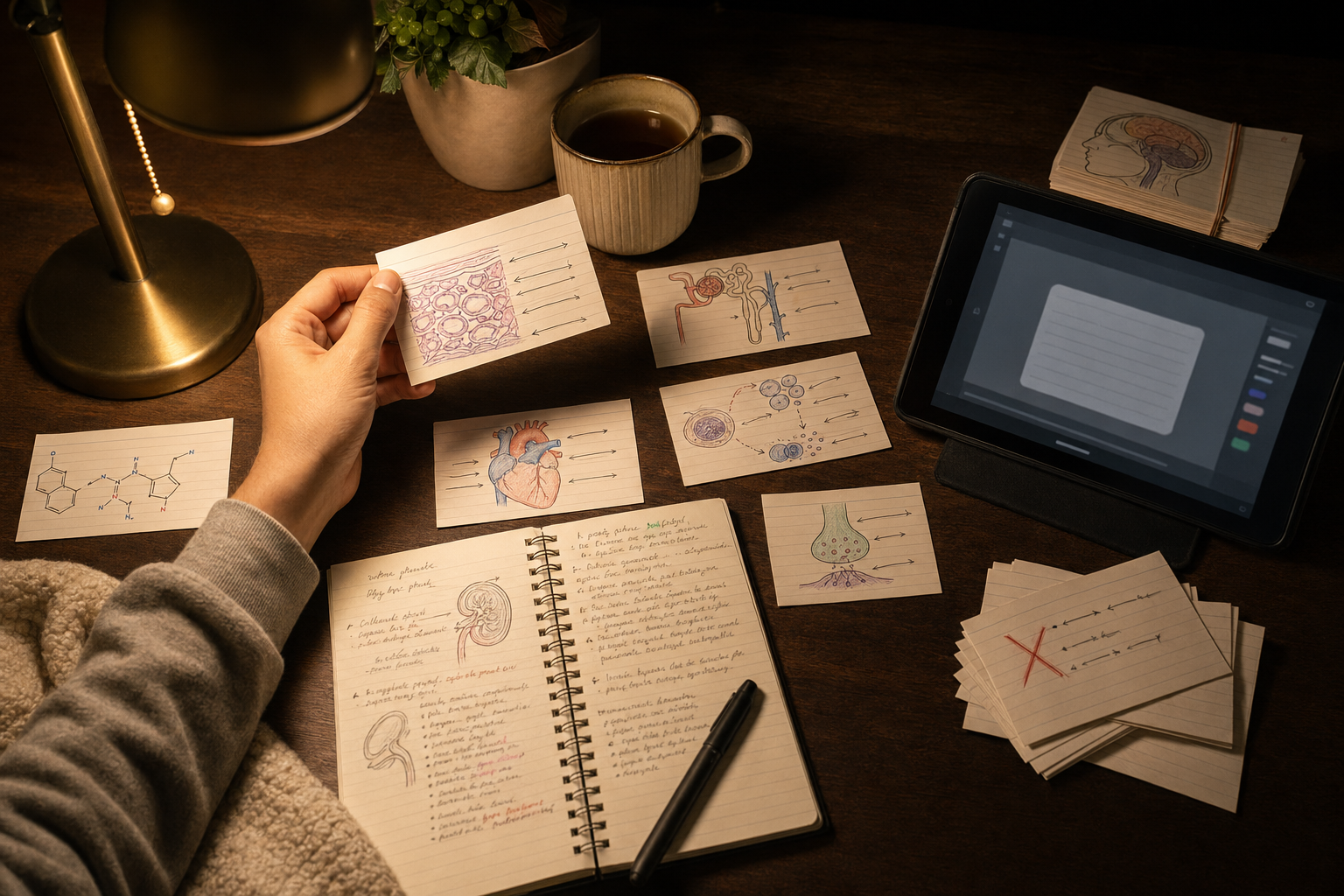
Step 1 is one exam, but it contains several different memory jobs
Many students still build one giant Step 1 deck as if every fact should be stored the same way:
- disease name on the front
- paragraph on the back
That breaks quickly because Step 1 is not testing one kind of recall. Official discipline ranges still cluster around:
- pathology: 45 to 55
- physiology: 30 to 40
- pharmacology: 10 to 20
- microbiology: 10 to 20
- gross anatomy and embryology: 10 to 20
- behavioral sciences: 10 to 15
Those ranges do not mean you need six disconnected decks. They do mean your flashcards for USMLE Step 1 should reflect the kinds of misses that happen most often.
| Area | What you usually need to retrieve | What weak cards usually do |
|---|---|---|
| Pathology | mechanism, hallmark finding, image pattern, key distinction | make you recognize the disease name without being able to explain the pattern |
| Physiology | cause and effect, compensatory change, what goes up or down | store a polished explanation you cannot reproduce inside a stem |
| Pharmacology | mechanism, use, toxicity, classic confusion | turn one drug family into one long answer block |
| Microbiology | bug, toxin, virulence clue, treatment-relevant distinction | blur similar organisms into one vague memory |
| Anatomy and embryology | relationship, derivative, defect, structure-function link | make you remember the lecture image but not the tested point |
| Behavioral science and biostats | term, study design clue, bias, interpretation | leave you with general familiarity instead of a clean rule |
A dedicated Step 1 deck should feel more like a set of narrow retrieval tools than a compressed textbook.
Integrated systems matter more than chapter order
This is where Step 1 diverges from a general preclinical flashcards workflow.
If you are still studying organ systems in school, a broader routine may be enough. If you are in dedicated or close to dedicated, the exam cares much less about whether you learned renal, cardio, or endocrine in a tidy sequence. It cares whether you can move from mechanism to presentation to pathology to pharmacology inside one mixed block.
So I would organize cards around system plus task:
cardio-mechanismrenal-physiologyendo-pharmheme-path-imagemicro-missed-qbiostats-bias
That creates a better review queue than one endless stream of disconnected facts.
For example, a renal card should usually not ask you to explain the whole nephron. It should ask one narrower question:
- What transporter is inhibited here?
- What acid-base change follows this defect?
- What finding distinguishes nephritic from nephrotic patterns in this context?
- What drug toxicity or electrolyte effect keeps showing up with this class?
That is closer to what mixed Step 1 review actually feels like.
If you want the broader med-school version of this topic rather than the dedicated Step 1 version, read How to Use Flashcards for Medical School in 2026.
Pathology cards should separate pattern recognition from mechanism
Pathology is one of the highest-value places to tighten your deck. It dominates Step 1 more than most decks admit, and pathology cards often fail because they mix several memory tasks into one:
- disease label
- underlying mechanism
- gross or micro image pattern
- classic association
- common confusion
That is too much for one review.
I would usually split pathology into at least three card types:
1. Hallmark pattern cards
Use these when the main job is recognizing the finding that should trigger the disease.
Examples:
- What histologic pattern is most characteristic here?
- What gross finding should make you think of this process first?
- What clue in the stem points to this pathology instead of the similar one?
2. Mechanism cards
Use these when you keep recognizing the disease but missing why it happens.
Examples:
- What mechanism produces this lesion?
- Why does this disease cause this lab pattern?
- What pathophysiology explains the image finding?
3. Distinction cards
Use these when two disease processes keep blending together.
Examples:
- How does minimal change disease differ from focal segmental glomerulosclerosis in the most testable way?
- What separates Crohn disease from ulcerative colitis on pathology and distribution?
- What clue favors central pontine myelinolysis over another demyelinating process in a board-style stem?
Step 1 pathology image flashcards work best when they teach one stable pattern at a time instead of asking you to reconstruct an entire pathology chapter from one screenshot.
If your image workflow is the weak point, How to Turn Diagrams Into Flashcards in 2026 is the closest companion article.
Image cards should train what you can see quickly, not what you can reread slowly
This is especially important now that the May 2026 Step 1 software update includes image contrast controls. Better display controls are useful. They do not replace image familiarity.
The most common mistake is treating image cards like caption cards:
- Front: image
- Back: full disease explanation
That usually creates fake confidence. You glance at the image, think the slide looks familiar, then miss the actual question because the board stem asked for the mechanism, complication, or distinction.
Build image cards around one visual job:
- identify the key pattern
- name the most likely diagnosis
- distinguish it from the nearby lookalike
- connect the image to the mechanism or complication that keeps getting tested
Examples:
- What visual clue makes this a psammoma-body pattern question instead of just a thyroid nodule question?
- What finding in this peripheral smear matters most here?
- What is the most testable association with this skin lesion image?
Keep image cards clean. If the visual itself is busy, the answer should be short.
Pharmacology cards should help you choose, not just recite
Pharmacology is where many Step 1 decks quietly become unusable.
One card starts with a drug class and ends up carrying:
- mechanism
- indications
- toxicities
- contraindications
- metabolism
- two exceptions
- one mnemonic you barely trust
That is not one card. That is a small pharmacology lecture.
For Step 1 pharmacology flashcards, separate the jobs:
- What is the core mechanism?
- What adverse effect is most board-relevant?
- What is the classic use worth remembering?
- What nearby drug or class do I keep confusing this with?
- What toxicity or contraindication keeps appearing in question explanations?
Examples:
- What toxicity should immediately separate this antiarrhythmic from the similar class?
- What mechanism makes this antimicrobial different from the related drug you keep confusing it with?
- What electrolyte abnormality or organ toxicity is the highest-yield thing to retrieve for this medication?
Pharmacology sticks much better when the card trains a choice you actually have to make, not a paragraph you were never going to reproduce under exam pressure.
Question-bank misses should become the most personal part of the deck
This is probably the most valuable part of the whole workflow.
A lot of Step 1 students build cards from First Aid, lectures, or old notes. That is normal. The part that makes the deck yours is what keeps going wrong in UWorld, Amboss, NBME review, or whatever practice source you use.
I would not ask, "How do I save this whole explanation?"
I would ask:
- What did I fail to retrieve?
- What distinction did I miss?
- What stem clue did I ignore?
- What image pattern did I recognize too late?
- What reasoning error is likely to happen again?
Most Step 1 misses fit a few repeated shapes:
- mechanism known, consequence forgotten
- disease recognized, image distinction missed
- drug class known, toxicity confused
- physiology relationship reversed
- micro clue seen, organism not retrieved
- biostats term familiar, interpretation still wrong
Those are excellent flashcard targets.
What usually does not deserve a card:
- I rushed the block
- I changed the answer for no reason
- I was tired and read too fast
Those are real problems. They are just not flashcard problems.
If the source of your best cards is missed questions, How to Turn Practice Questions Into Flashcards in 2026 goes deeper on the conversion workflow.
Physiology cards should usually be about direction of change
This is where Step 1 review often becomes clear quickly or stays fuzzy for weeks.
Weak physiology cards often ask for full explanations:
- Explain shock.
- Explain acid-base disorders.
- Explain the RAAS system.
Those are not realistic review prompts.
Step 1 physiology is much easier to retain when the cards focus on one directional relationship:
- what increases
- what decreases
- what compensates
- what happens first
- what happens if one part fails
Examples:
- In primary adrenal insufficiency, what happens to ACTH and why?
- What is the expected acid-base change after this respiratory problem?
- If afterload rises, what immediate cardiac effect matters most?
- What lab pattern should you expect after this endocrine mechanism changes?
That is how USMLE Step 1 flashcards start matching the exam instead of imitating a lecture.
Microbiology, anatomy, embryology, and biostats deserve narrower cards than you think
These areas get overstuffed quickly because students are afraid of missing "small details." That fear is understandable. The fix is still smaller cards, not bigger ones.
For microbiology, I would bias toward:
- the distinguishing clue
- toxin or virulence factor
- classic syndrome link
- treatment-relevant difference when it is truly high yield
For anatomy and embryology, I would bias toward:
- derivative
- nerve, vessel, or space relationship
- defect and consequence
- structure tied to one classic clinical presentation
If cranial nerve basics are one of those weak spots, the 84-card Cranial Nerve Flashcards deck covers names, numbers, classification as sensory, motor, or mixed, core functions, and high-level assessment cues. It does not cover lesion localization, diagnosis, treatment, or board-style clinical reasoning.
For behavioral science and biostats, I would bias toward:
- study design clue
- bias definition through an example
- what measure or interpretation the question is really asking for
- what makes one ethics or communication concept different from the nearby one
The more these cards look like one clean retrieval move, the more useful they stay during dedicated.
A Step 1 weekly workflow should stay a little boring
For Step 1, that is usually a good sign.
Keep the loop this simple:
- Do a mixed or system-focused question block.
- Review the misses and near-misses on the same day.
- Convert only reusable facts, distinctions, image cues, and mechanism errors into cards.
- Tag by system and problem type.
- Delete or rewrite anything that reads like an explanation paragraph.
- Review due cards every day.
That loop is enough.
The mistake is trying to turn every serious study session into both a massive content import and a full review day. Dedicated Step 1 prep already has enough moving pieces. The deck should reduce friction, not become another curriculum.
FSRS helps once the Step 1 deck stops trying to do everything
FSRS is the scheduling layer I would trust.
Step 1 review is uneven in a very normal way. Some pharmacology toxicities stick after two passes. Some physiology relationships keep flipping in your head. Some pathology images feel obvious until the stem wording changes. Some missed-question cards disappear unless they came from a mistake vivid enough to last a week.
That is exactly where FSRS helps.
What it does not do is rescue a bloated deck.
So I would keep the order simple:
- make the card smaller
- keep image cards, mechanism cards, and missed-question cards distinct
- delete weak cards early
- keep new-card volume realistic during dedicated
- let FSRS handle the timing after the deck is worth scheduling
If you want the scheduling side in more detail, How to Study for an Exam With FSRS in 2026 is the direct companion. If your queue is already getting out of hand, How Many New Flashcards Per Day in 2026 is the next useful read.
Where Flashcards fits in a Step 1 workflow
If you want to run this inside Flashcards, the value is not a vague promise that AI will learn medicine for you.
The value is that the product already covers the practical middle of the workflow:
- AI chat for drafting candidate cards from notes or pasted explanations
- front/back cards for narrow retrieval prompts
- tags and decks for systems, images, and question-bank misses
- FSRS review once the cards are clean enough to trust
- the hosted web app plus offline-first clients when you want to clear due cards away from your desk
That is a good fit for Step 1 because the bottleneck usually is not finding more information. It is keeping the right information reviewable long enough to survive a mixed exam day.
If your main problem is that AI keeps drafting cards that look polished but review badly, How to Fix AI Flashcards in 2026 is the right follow-up.
The useful rule for Step 1 flashcards in 2026
Do not build a Step 1 deck that tries to preserve everything you touched in preclinical study.
Build a deck that remembers what actually fails:
- the integrated system link you keep missing
- the pathology image pattern you recognize too slowly
- the pharmacology toxicity you keep swapping
- the physiology direction-of-change question you keep reversing
- the question-bank mistake that is likely to happen again
That is the version of flashcards for USMLE Step 1 I would trust during dedicated.