How to Use Flashcards for Pharmacology in 2026: Drug Classes, Side Effects, and Medication Confusions That Actually Stick
Last spring I watched a student miss metoprolol, propranolol, and labetalol in the same review block even though she could explain beta blockers pretty well out loud. The problem was not effort. Her deck had turned each drug family into one giant summary card, so every review felt like a mini oral exam. Pharmacology gets messy quickly. If the cards are too broad, the names start sounding related and none of them sticks when you need it.
That is why pharmacology flashcards still help in 2026, but only if the deck is built around discrimination instead of recitation. Pharmacology is less about storing one polished paragraph per drug and more about remembering what separates one class, mechanism, adverse effect, or contraindication from the nearby one that keeps trying to steal the answer.
This matters across several paths. If you are studying for NCLEX-RN, the 2026 NCSBN candidate bulletin still lists Pharmacological and Parenteral Therapies as an RN client-needs subcategory in the test plan effective April 1, 2026 through March 31, 2029. If you are in medical training, NBME still maintains a standalone Pharmacology Subject Exam content outline. So the memorization problem is still very real. The better question is how to build the deck without making it miserable.
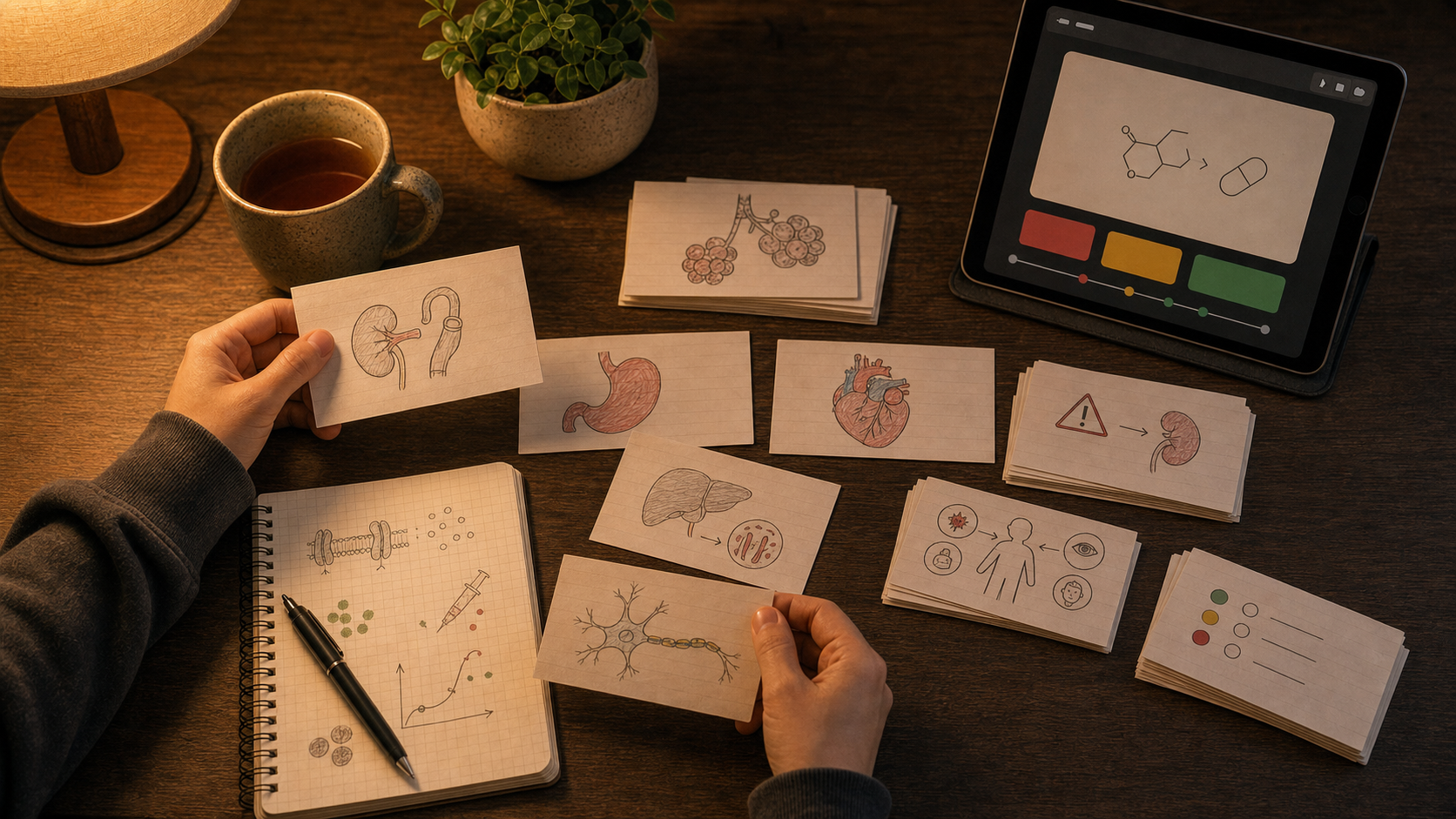
Pharmacology is usually four memory problems wearing one label
A lot of people say they are making flashcards for pharmacology as if that were one thing.
Usually it is at least four:
| Area | What you usually need to retrieve | What weak cards usually do |
|---|---|---|
| Drug classes | class identity, prototype, suffix or naming pattern, what the class basically does | turn the whole family into one wall of text |
| Mechanisms | core action, receptor or pathway, what changes downstream | make you memorize wording instead of the decision point |
| Adverse effects and contraindications | the one or two high-yield risks that keep showing up in questions | bury the useful warning inside a paragraph |
| Medication confusions | lookalike names, similar classes, same disease but different mechanism | make everything feel vaguely familiar and therefore easy to miss |
That is the first thing I would fix.
The deck should follow the memory job. A card that works for -pril recognition is not the same kind of card you need for opioid adverse effects, insulin timing, or antiarrhythmic toxicities.
Do not make one card that asks for everything about a drug
This is the most common pharmacology mistake I see.
One card tries to hold:
- the class
- the mechanism
- the indication
- the adverse effects
- the contraindications
- the monitoring
- the patient teaching point
- three random lecture details you were afraid to delete
That is not one flashcard. It is a cram sheet with extra steps.
If you are trying to memorize drug names and side effects, big summary cards create the exact kind of review friction that makes pharmacology feel harder than it already is. You recognize the drug. You half remember the class. You mostly know the mechanism. Then you spend twenty seconds negotiating whether your answer was close enough.
That is how a 150-card session turns into something you avoid.
If your bigger issue is card quality in general, How to Make Better Flashcards in 2026 is the right companion piece.
Drug class flashcards should come before trivia
Most pharmacology decks get too specific too early.
People start collecting details about individual medications before the class structure is stable in memory. Then the details have nowhere to attach. That is how losartan, lisinopril, and aliskiren end up feeling like unrelated facts instead of parts of the same blood-pressure story.
I would usually build drug class flashcards in this order:
- class name or naming pattern
- one prototype drug
- core mechanism
- one high-yield adverse effect
- one common confusion
That gives each later fact a place to live.
Examples of useful early prompts:
- What suffix usually points to an ACE inhibitor?
- What class does
metforminbelong to? - What is the core mechanism of loop diuretics?
- What adverse effect should make you slow down on aminoglycosides?
- What makes a beta-1 selective blocker different from a nonselective beta blocker?
Those are much better than "Tell me everything important about beta blockers."
The best pharmacology cards usually test one decision
This is where pharmacology study tips stop being generic and start helping.
A strong pharmacology card usually asks you to do one clean thing:
- identify the class
- explain the mechanism in plain language
- recall the main adverse effect
- distinguish one class from a nearby class
- remember the warning or contraindication that changes the question
That means the card should feel a little plain.
Plain is good here.
Examples:
- What class is
amlodipinein? - What is the main mechanism of statins?
- Which adverse effect is the one you most need to remember for opioids?
- What is the common confusion between ACE inhibitors and ARBs?
- Which clue separates a beta blocker question from a calcium channel blocker question?
The fastest pharmacology cards are rarely the smartest-looking ones. They let you answer cleanly in a few seconds.
Side effects should be carded as anchors, not as lists
This is where many nursing pharmacology flashcards go bad.
Students make a card for a medication and then dump six adverse effects onto the back because they all appeared somewhere in lecture. During review, none of them stands out. The back turns into a warning paragraph instead of a retrieval cue.
I would rather anchor the card around the adverse effect that is most likely to:
- show up in a test question
- change your judgment between two answer choices
- make you confuse one class with another
That does not mean the other effects never matter. It means the flashcard should store the ones you keep missing first.
This works better:
- What adverse effect is most associated with ACE inhibitors?
- What serious toxicity should you remember first for aminoglycosides?
- What insulin mistake do you keep making about onset or peak?
- What class is most tied to cough versus angioedema confusion in your notes?
This works worse:
- List all adverse effects, contraindications, and teaching points for this drug.
If the back of the card reads like a textbook margin note, split it.
Medication confusions are where pharmacology flashcards really earn their place
Pharmacology punishes near-misses more than most subjects.
You often do not fail because you knew nothing. You fail because two nearby things blended together:
- ACE inhibitors vs ARBs
- beta-1 selective vs nonselective beta blockers
- heparin vs warfarin
- benzodiazepines vs barbiturates
- opioid intoxication findings vs opioid withdrawal findings
- one insulin timing pattern vs another
Those are excellent flashcard targets because they expose the exact distinction that needs repetition.
I would actively create cards in formats like:
- What is the simplest difference between class A and class B?
- Which adverse effect belongs to one but not the other?
- Which naming pattern should push you toward the right family?
- What mechanism clue in the stem makes the answer obvious if you notice it?
This is also the best way I know to make pharmacology spaced repetition feel useful instead of theatrical. Repetition helps most when the cards preserve small distinctions that really do slip over time.
“Top 200 drugs flashcards” only works if you stop treating all 200 drugs equally
I understand why people search top 200 drugs flashcards. A big list feels concrete. It also feels safer than deciding what matters.
Still, a flat 200-drug deck often becomes a mess for one simple reason: the drugs do not all deserve the same amount of attention.
Some medications are core class anchors. Some are common confusions. Some are exam favorites. Some are just present because a list said they should be.
I would not start with all 200 as equal citizens. I would sort them:
- class anchors you must know cold
- high-yield adverse-effect drugs
- common lookalike or same-use confusions
- course-specific or exam-specific additions
That gives you a real deck instead of a census.
If you are in nursing school, pharmacology also sits inside a broader exam frame. The NCSBN 2026 RN plan still keeps pharmacological and parenteral therapies as a named content area, so it makes sense to bias the deck toward medication safety, adverse effects, and decision-changing distinctions rather than obscure fact collection. If you are in medical school, the NBME pharmacology outline stays system-based, which is another good reason to organize cards by class plus organ system instead of alphabetically.
Question-bank misses should shape the second half of the deck
Lecture notes give you the first version of the pharmacology deck.
Missed questions give you the version that actually starts working.
That is especially true in pharmacology because many misses are not pure memorization failures. Usually they look like one of these:
- class recognized, mechanism forgotten
- mechanism known, adverse effect confused
- adverse effect remembered, contraindication missed
- name looked familiar, wrong family chosen
- class known, two similar drugs still blended together
Those are perfect card targets.
After a missed question, I would not save the whole rationale by default. I would ask:
- What exact fact or distinction failed here?
- Was this a class problem, mechanism problem, or confusion problem?
- What is the smallest card that would stop this same miss next week?
If most of your best cards come from questions rather than notes, How to Turn Practice Questions Into Flashcards in 2026 is the direct follow-up.
Pharmacology needs revisitation more than heroic cramming
This part is less glamorous, but it holds up better.
A recent meta-analysis on spaced repetition in medical education found better objective-test performance overall, and a 2024 scoping review on electronic flashcards in health professions education described this workflow as common across medical and nursing learners. That does not prove every pharmacology deck will work well, but it does support revisiting material over time instead of trying to brute-force it in one sitting.
That also matches what pharmacology usually feels like.
You do not forget drug facts all at once. You forget them by erosion:
- one suffix goes soft
- one mechanism gets fuzzy
- one toxicity swaps places with another
- one class distinction stops feeling sharp
That is why pharmacology spaced repetition is a better fit than binge review. The subject decays through small confusions, so the review system should repair small confusions.
If you want the exam-scheduling side rather than the card-writing side, How to Study for an Exam With FSRS in 2026 fits directly here.
This is study guidance, not medical advice
The boundary here matters.
Pharmacology flashcards are for studying class structure, mechanisms, adverse effects, contraindications, and medication confusions. They are not a dosing reference, not a treatment guide, and not a substitute for course materials, licensed supervision, formularies, or current clinical policy.
If a card starts turning into a bedside decision tool, it has left the job I would trust a flashcard to do.
A workable pharmacology deck is smaller than most people want
Usually the better deck looks less impressive:
- fewer cards per drug
- more class anchors
- more confusion cards
- more question-derived cleanups
- fewer giant summary backs
That is how you actually memorize drug names and side effects without turning the deck into a second pharmacology textbook.
If your queue is already getting heavier than it should, these two articles usually solve the next problem:
Where Flashcards fits in this workflow
Flashcards is a reasonable fit for this kind of pharmacology study because the useful part is not handing the pharmacology over to AI. I would not study that way.
The useful part is narrower:
- upload notes, slides, or source files to draft candidate cards
- clean the cards before they enter the long-term queue
- review the survivors with FSRS
- keep editing when one bad pharmacology card keeps wasting time
That is a practical workflow for pharmacology flashcards because the subject rewards repeated cleanup. You usually do not need more words. You need cleaner distinctions.
The rule I would keep
If you are building flashcards for pharmacology in 2026, I would keep the rule simple:
- learn classes before trivia
- make one card do one job
- anchor side effects instead of listing everything
- build extra cards around common medication confusions
- let missed questions tell you where the deck is still weak
That is the version that actually sticks. The goal is a deck that still works when metoprolol, propranolol, and labetalol show up in the same session and your brain is already tired.