How to Memorize a Speech With Flashcards in 2026: Use Cues, Not a Script
You close the laptop, stand up, and begin the eight-minute presentation. The opening lands. The first story is fine. At slide six, your brain offers one unhelpful word: “Anyway.”
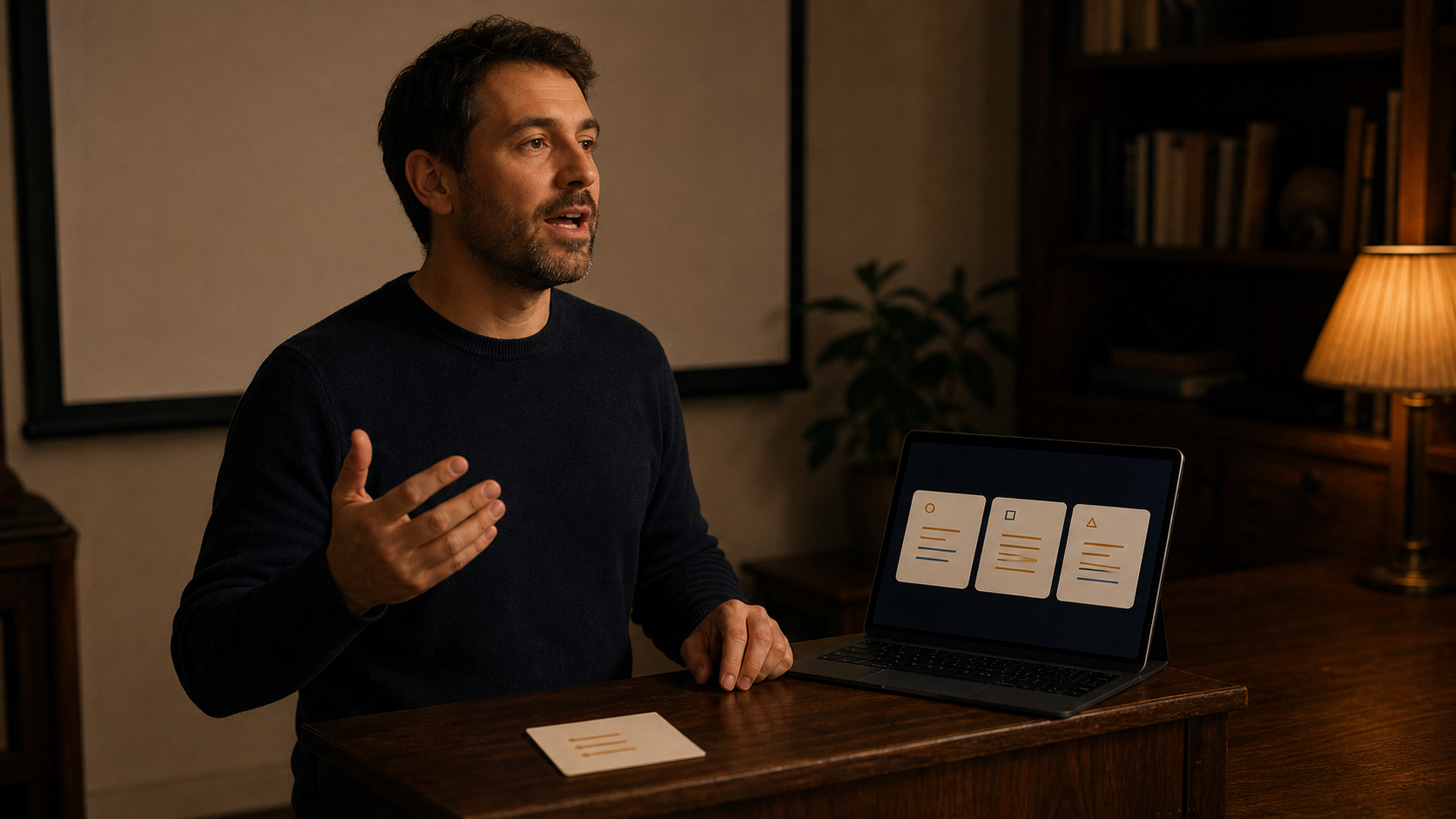
Learning how to memorize a speech usually means learning its route: where each section begins, why it follows the previous one, which lines must be exact, and where you can restart after a blank. To memorize a speech with flashcards, train those decisions as cues. A tiny script split across twenty cards only gives you twenty places to reread it.
Decide what “memorized” needs to mean
A wedding toast, a research presentation, and a legal statement do not need the same kind of recall.
For many talks, the best target is an internalized structure. You know the opening, the order of the main points, the evidence attached to each point, the transitions, and the ending. The wording between those anchors can change slightly each time. Toastmasters describes this as extemporaneous speaking: the content is prepared in advance, while the exact language remains flexible (Toastmasters, 2024).
Some parts may still need verbatim recall:
- the first and last lines
- a quotation
- a technical definition
- a number with its unit and source
- legal, medical, safety, or otherwise sensitive wording
- a sentence timed to a slide, caption, interpreter, or accessibility aid
Mark those parts as exact. For everything else, preserve the meaning and sequence while allowing the phrasing to move.
This distinction matters because losing one word in a fully memorized script can make the next sentence feel unreachable. A section-based talk gives you more places to recover. Toastmasters recommends practicing a speech in chunks, including the transitions around each chunk. Its guidance also suggests memorizing the first sentence or two and the ending even when the rest is internalized rather than recited (Toastmasters, 2020).
Build the speech map before you build the deck
Flashcards cannot repair a speech with no clear structure. Start with a one-page outline.
Imagine a seven-minute workplace presentation proposing fewer status meetings. Its map might be:
- Opening: the team spent 14 hours in status meetings last week.
- Cost: repeated updates interrupt focused work.
- Pilot: one team replaced two meetings with a written update.
- Result: decisions stayed visible and the team recovered time.
- Proposal: run the same pilot for four weeks.
- Close: choose the pilot team and starting date today.
Read that list once, then hide it and recreate the route from memory. For each jump, say why the next point belongs there. If point four could swap with point two and nobody would notice, the logic probably needs more work. Tighten the outline before adding cards.
A logical structure is itself a memory aid. Toastmasters recommends arranging a talk around a clear pattern—such as chronological, compare-and-contrast, cause-and-effect, or problem-cause-solution—and keeping only material that supports the main message (Toastmasters, 2020).
Now divide the outline into chunks small enough to start independently. A chunk may be an opening, one main point, a story, a demonstration, or the close. Include the transition into and out of it. Try starting at each chunk without replaying the opening in your head. Any section that needs a long mental run-up is still too dependent on the sequence.
Use four card types to memorize a speech with flashcards
You do not need a card for every sentence. Most useful speech decks are built from four card shapes.
Section cue → main point
This card checks whether a heading can unlock the content beneath it.
- Front:
Cost of weekly status meetings - Back:
Repeated updates fragment focus; connect the 14-hour total to the two developer examples.
Keep the back compact. It is a checkpoint, not the paragraph you plan to say. If you can speak the section accurately in fresh words, the card worked.
Previous point → next transition
Speakers often know each section and still lose the bridge between them. Give transitions their own retrieval practice.
- Front:
Pilot result → proposal - Back:
The pilot recovered time without hiding decisions. Now ask whether the same setup can work across one more team.
Say the transition aloud, then continue for another two or three sentences. You are training forward movement, not merely naming what comes next.
Exact fact or quotation → verified wording
Put the accuracy check on the back.
- Front:
Opening meeting-cost figure - Back:
14 team-hours last week, from the calendar audit completed July 24.
For a quotation, include the exact words, speaker, and source. For a statistic, include the number, unit, date, and source. Check the card against the original material when you create it, and recheck anything that changes during revisions.
That source check matters. In three experiments with educational passages, expanding the intervals between repeated retrievals improved recall one week later compared with using uniform intervals, but only when the task between retrievals was highly interfering with memory for the passage (Storm, Bjork, and Storm, 2010). Retrieval is still not an accuracy check. A separate laboratory memory study found better retention after 24 hours and more false memories after retrieval practice; it did not test speeches (Zhuang et al., 2022). The practical limit is straightforward: use recall to learn the line, but keep the original source as the authority for quotations and numbers.
Random section cue → restart point
This is the recovery card.
- Front:
Start cold: pilot - Back:
One team replaced the Tuesday and Thursday meetings with a written update.
The back gives you the first idea or verified first line, not the whole section. Shuffle these cards and practice beginning from wherever the deck sends you.
Rehearse from random sections, not only from the beginning
Starting at the opening every time feels natural. It also gives the opening far more practice than the close.
Toastmasters highlights this exact failure pattern: speakers repeatedly restart after a mistake, so the introduction becomes strong while later sections remain fragile. Its recommendation is to begin at a random section and continue from there, then connect the pieces with rehearsed transitions (Toastmasters, 2024).
Use your deck like this:
- Shuffle the section and restart cards.
- Draw one without looking ahead.
- Stand up and speak from that point.
- Continue through the next transition.
- Compare what you said with the outline, then reveal the back.
- Fix the speech if the logic failed; fix the card if the cue was vague.
Do a few reverse checks as well. Look at the proposal and recall which evidence sets it up. Look at the closing line and recall the last main point before it. You will not deliver the talk backwards; the exercise checks whether you know the map rather than one long chain.
Add controlled interruptions once the route feels stable. Stop midway through a section, take a breath, and restart at the next anchor. Practice one calm recovery phrase, such as “Let me return to the main point,” followed by the section cue. Recovery is part of preparation, and Toastmasters explicitly recommends planning phrases or actions for a memory lapse (Toastmasters, 2024).
Space the card practice across several sessions
One long evening can make the speech feel familiar. Several shorter sessions make you prove that the route still comes back after a gap.
The memory research supports the broad method, with a clear limit. In two experiments with foreign-language word pairs, successive relearning—reaching a recall criterion again across multiple sessions—produced substantially better long-term retention than one learning session (Rawson et al., 2018). The study did not test public speaking. It supports spacing retrieval attempts, not the claim that successful card recall makes a talk stage-ready.
A practical one-week sequence could look like this:
- Seven days before: finish the speech map and create cards.
- Five or six days before: recall each section aloud, then repair weak prompts.
- Three or four days before: draw random restart cards and drill transitions.
- Two days before: run the whole talk with slides, props, and a timer.
- One day before: review due cards, check exact wording, and do a calm full run.
- On the day: use the deck only for brief recall checks, then put it away.
If you have longer, spread the same work out. If you have one evening, prioritize the route, exact high-risk wording, transitions, and at least one complete aloud run. There is no card schedule that turns silent rereading into delivery practice.
In Flashcards, answer before revealing the back and rate that card attempt with Again, Hard, Good, or Easy. Let FSRS schedule later card reviews from those ratings. Rate whether the cue produced the required content, not whether the whole delivery felt polished. The broader review-frequency guide explains why due reviews are more useful than rereading the entire deck every day.
Training flashcards and on-stage cue cards are different tools
The deck you use during preparation can contain questions, answers, source checks, tags, and many restart points. It exists to make you retrieve.
A physical cue card carried on stage should be much sparser. It exists to help you glance, orient yourself, and keep speaking.
Hamilton College’s Oral Communication Center recommends putting only enough words on physical notecards to jog memory, separating main points clearly, placing direct quotations on their own cards, marking delivery cues in a distinct style, numbering cards, and rehearsing with the same cards before the speech. It also suggests adding rough time markers when pacing matters (Hamilton College).
For the example talk, one stage card might contain:
14 HOURS
Cost → Pilot → Result
ASK: 4 weeks / 1 team / start date
That is a navigation aid. Bringing twenty dense question-and-answer cards to the lectern creates a new task: searching the deck while an audience waits.
If notes make the talk safer or more accessible, use them. Speaking without notes is not a moral achievement. The goal is a clear, accurate presentation with a recovery plan.
Full run-throughs still decide whether the speech is ready
A clean flashcard session can tell you that the speech map was retrievable in that session. It cannot tell you whether the talk runs for seven minutes, whether slide four appears at the right moment, or whether your pace becomes hard to follow when you are nervous.
At least some rehearsals need the real conditions:
- speak aloud at presentation volume
- stand if you will stand during delivery
- use the actual slides, demonstrations, and props
- time the complete talk
- practice eye contact and pauses
- test the room and equipment when possible
- recover from a deliberate interruption without starting over
- ask a listener what main point and evidence they heard
Toastmasters recommends rehearsing in the physical manner you expect to deliver, including standing and moving if that is how you will speak (Toastmasters, 2024). The deck helps you remember what comes next. Delivery rehearsal teaches your voice and body what to do with it.
Where Flashcards fits—and where it does not
Flashcards is useful during the memory-training part of speech preparation:
- front/back cards can hold section cues, transitions, restart points, and verified exact lines
- tags can mark cards as
transition,exact, orrestart, and a deck can save the matching filter for one talk - due reviews and FSRS can bring weak cues back across several days
- Again, Hard, Good, and Easy record how well each retrieval attempt went
- AI chat with a pasted outline or file attachment can draft candidate cards, which you should edit and verify
- connected agents can create or edit cards through the API when you prefer that workflow
- the hosted web app and offline-first mobile clients let you review away from your desk
The free, open-source core can also be self-hosted. Start with the getting-started guide if you want the current hosted, mobile, agent, and self-hosted entry points.
The app does not listen to your speech, transcribe a rehearsal, grade delivery, judge eye contact, run your slides, or tell you whether an audience understood you. It is not a teleprompter or presentation mode. FSRS schedules card reviews; it does not schedule whole spoken rehearsals or guarantee performance.
Keep the boundary clean: use flashcards to retrieve the route, then use full rehearsal to test the talk.
Common mistakes that make speech cue cards worse
Pasting the script onto card backs is the fastest way to turn practice into rereading. If you reveal a paragraph and think “yes, that looks familiar,” you practiced recognition. Split it into a section cue, a transition, and any exact line that truly needs verification. What Should Go on a Flashcard? has a stricter filter for overloaded cards.
Do not rate a cue from silent familiarity. For speech cards, the attempt should usually be spoken. If the cue produced no words until you flipped it, recall failed even if the answer looked obvious afterward.
Rehearsing only in order hides weak restart points. Random starts feel awkward because they expose sections that have been borrowing momentum from everything before them.
A perfect deck review is not a perfect rehearsal. Cards do not measure timing, pace, slide coordination, room setup, eye contact, or audience understanding.
Leave the training deck offstage. If you need notes, convert it into one or a few sparse physical cue cards and practice with those exact cards.
Questions people ask about memorizing a speech
Should I memorize a speech word for word?
Memorize exact wording where accuracy, timing, or confidence requires it. For the rest, learn the structure and meaning well enough to express them naturally. Openings, closings, quotations, figures, and sensitive language are common candidates for verbatim recall.
Can flashcards help me memorize a speech overnight?
They can help you identify the route and drill weak transitions in a short session. They cannot compress every part of speaking practice into one night. If time is tight, build restart cues, verify exact lines, practice aloud, and complete at least one timed run.
How many flashcards should a speech have?
Let the structure determine the count. Make one card for each section you need to start cold, each transition that keeps failing, and each exact item that must be checked. A clear five-part talk may need only a small deck. A technical presentation with many figures may need more exact-answer cards. Do not add cards merely to reach a target number.
Should I use flashcards during the speech?
Use digital flashcards for training before the event. If you want notes during delivery, convert the result into sparse, numbered physical cue cards and rehearse with them. Do not scroll through a study deck at the lectern.
The speech should survive a missing sentence
The practical answer to how to memorize a speech is to learn its map deeply enough that one forgotten sentence does not erase the route.
Build a clear outline. Mark the few lines that must be exact. Turn sections, transitions, verified facts, and restart points into compact cards. Retrieve them aloud from random positions across several sessions. Then close the deck and practice the speech without notes, using the slides, timing, room, and delivery you will actually have.
Cues get you back to the next idea. The audience never needed your hidden script.