Periodic Table Flashcards in 2026: Elements, Symbols, and Atomic Numbers
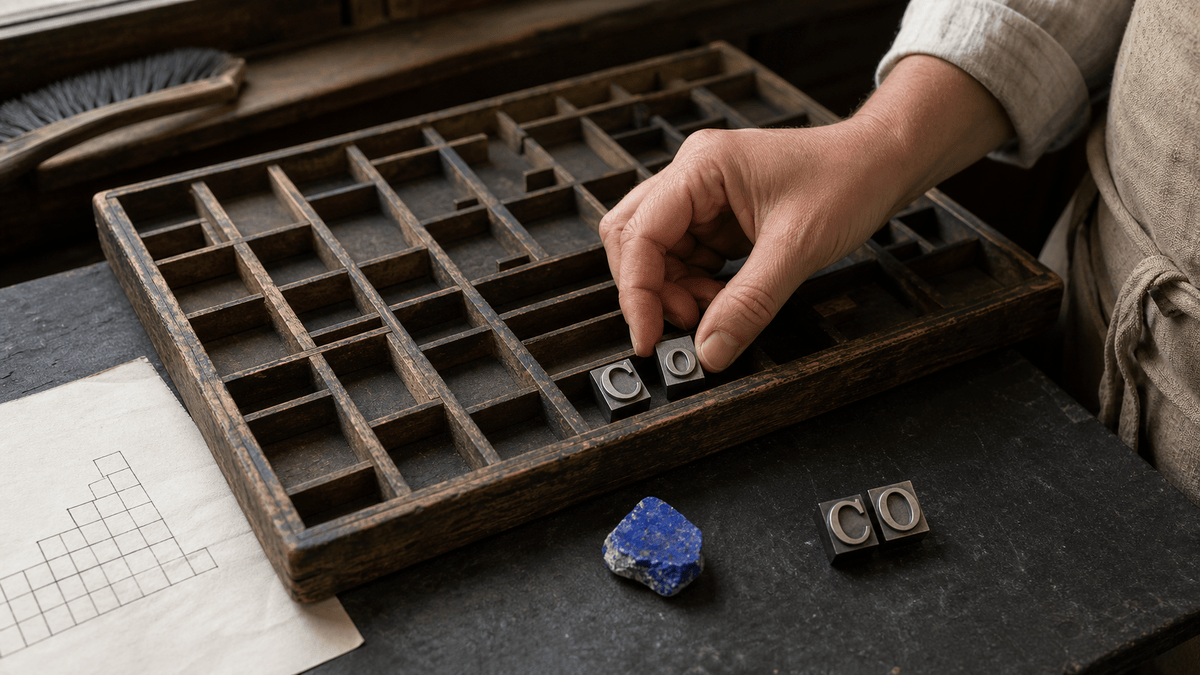
Co is cobalt. CO is carbon monoxide, written from the separate element symbols C and O. One lowercase letter changes the answer. Sodium has another easy trap in its square: Na has atomic number 11, while the larger decimal printed on many classroom tables refers to a different property.
Useful periodic table flashcards keep those jobs separate. One card tests the symbol, another tests atomic number, and another might test location or a course-required trend. Put the whole element square on one card and a partly correct answer becomes surprisingly hard to grade.
Start with your course, not all 118 elements
The periodic table contains 118 known elements, arranged by increasing atomic number. Its rows are periods and its columns are groups. That arrangement also makes trends in properties visible. It still does not follow that every student needs to memorize all 118.
Before making cards, check the scope of the class, quiz, or exam:
- which elements you must identify by name and symbol
- whether you need name-to-symbol, symbol-to-name, or both directions
- which atomic numbers must be recalled without a supplied table
- whether group, period, family, electron configuration, or trend questions appear
- which table edition, property labels, and rounding rules the course uses
- whether assessments provide a periodic table
The American Chemical Society's middle-school Lesson 4.2 focuses on the first 20 elements and introduces name, symbol, atomic number, and atomic mass. It also teaches that atomic number equals proton count. That is a useful example of a bounded beginner set. It is not a standard telling every beginner to stop at 20, or every advanced student to learn all 118.
Use the teacher, syllabus, assigned table, and textbook as the controlling sources. ACS, NIST, and CIAAW are strong references for checking facts, but the label or rounding expected on a test may still come from the course. Anonymous “complete periodic table” decks often get this order backward: they choose the facts first and leave you to discover whether they match your work.
Make one card for one periodic-table fact
Most useful element flashcards fit into four categories. Keep each front narrow enough to have one expected answer.
Element names and case-sensitive symbols
Element symbols are case-sensitive. The first letter is uppercase and a second letter is lowercase. Co, C, O, and CO should never collapse into the same visual pattern.
Front: Which element has the symbol Na?
Back: Sodium.
Source: Course periodic table

Front: Write the symbol for sodium. Preserve letter case.
Back: Na.
Source: Course periodic table
Those prompts test different retrieval directions. Keep both if the course asks you to read symbols and write them. Add a contrast card only when a real confusion shows up:
Front: Which element has the symbol Co?
Back: Cobalt.

Front: In the formula CO, which two element symbols are present?
Back: C for carbon and O for oxygen.
The second card tests formula reading, not another symbol for cobalt. You still need to read symbols inside real formulas; the card just repairs the capitalization mistake.
Atomic numbers, element identity, and protons
Atomic number is the clean, stable identity field. It equals the number of protons in the nucleus. Isotopes of one element can have different neutron counts, but their proton count and atomic number remain the same.
Front: What is sodium's atomic number?
Back: 11.

Front: Which element has atomic number 11?
Back: Sodium (Na).

Front: How many protons are in a sodium nucleus?
Back: 11.
There is rarely a reason to make all three cards for every element. Start with the direction your course tests. Add the proton-count card when that relationship is slow or repeatedly missed; otherwise one fact has quietly turned into three due reviews.
Groups, periods, and family relationships
Location prompts need an explicit numbering convention. Current group numbers run from 1 to 18, while some teaching materials also print older labels. Copy the convention used by the course instead of mixing two systems on the back.
Front: Which period contains Na?
Back: Period 3.

Front: Using group numbers 1–18, which group contains Na?
Back: Group 1.

Front: In Group 1, which element sits directly below Na?
Back: Potassium (K).
A few relationship cards can do more useful work than two coordinate cards for every element. They make you read the table as a structure rather than as 118 unrelated boxes.
Periodic trends within a stated scope
Trend cards can hold a direction, comparison rule, or named exception required by the course. Put the region and direction in the prompt:
Front: What is the general atomic-radius trend from left to right across a period?
Back: Atomic radius generally decreases.
Source: Course trend chart, section 3.2
General and across a period matter here. “Atomic radius trend?” does not say which direction, which part of the table, or how much explanation the answer needs. Use cards for the compact rule. Explain causes, handle the exceptions taught in class, and compare unfamiliar elements in written problems.
If a back starts collecting several properties and caveats, use the approach in how to make better flashcards and split the target.
Atomic-number cards stay stable; atomic-weight cards need versioning
The number called “mass” in a periodic-table square deserves a closer look. Course materials do not always use the terms with the same precision, and four related ideas are easy to blur:
- atomic number is the proton count and identifies the element
- mass number is the whole-number total of protons and neutrons in a particular nuclide
- isotopic atomic mass is the mass of a particular isotope
- relative atomic mass and standard atomic weight describe weighted atomic-mass information, with standard atomic weight applying to normal materials under the CIAAW definition
Follow the exact property name your course teaches. A rounded classroom value may be the expected answer even when a scientific reference shows more digits or an interval. Copying a decimal with no label is how a card that looked fine on Monday starts disagreeing with a worksheet on Friday.
Every atomic-weight card should record:
- the exact property named in the prompt
- the assigned table or textbook edition
- the required precision or rounding rule
- the date the value was checked
The NIST Periodic Table of the Elements contains NIST's latest critically evaluated atomic-property data. The current table says it was last updated in June 2024; the web page itself was updated on February 12, 2025. NIST is a strong verification source, not the only “official” periodic table and not a reason to overwrite the convention used for grading.
CIAAW's latest definitive table is Standard Atomic Weights 2024. Some elements have interval values because normal materials can vary in isotopic composition. CIAAW also revised the standard atomic weights of gadolinium, lutetium, and zirconium in 2024. A deck full of precise decimals therefore needs its source and checked date.
Radioactive elements do not have standard atomic weights. Many periodic tables show the mass number of a selected isotope in square brackets instead. That bracketed integer is a mass number, not an atomic weight that happens to lack decimals.
Unless the course explicitly requires atomic-weight recall, practice reading its supplied table and applying its rounding rule. That is usually the skill the chemistry work needs.
Reverse cards only when the reverse skill matters
Automatic reversal can turn one element into name-to-symbol, symbol-to-name, element-to-atomic-number, and atomic-number-to-element cards. Add group, period, family, weight, and trends, and the deck becomes huge before you have solved a chemistry problem.
Keep a reverse card when that direction appears in real work or exposes a real gap. Reading Na as sodium and writing Na from “sodium” are both common tasks. Identifying element 57 from atomic number alone may add little in a course that always supplies a table.
Start with the tested direction. Add the reverse after a quiz, blank-table exercise, or chemistry problem shows that you need it. If new cards are growing faster than your available study time, adjust the intake from the due-review load instead of chasing completeness.
How to memorize the periodic table without turning it into trivia
A small repair deck is more useful than a giant deck built in advance. Begin with a blank periodic table, a symbol quiz, or a current chemistry problem without looking at notes. Record the precise miss: “wrote CO for cobalt,” “put sodium in period 2,” or “read the decimal as atomic number.” Verify the correction before saving it.
Then use this loop:
- Choose one course-defined set, such as the first 20 elements or the elements in the current unit.
- Learn one new category in a short block: names to symbols, atomic numbers, or locations.
- Test the larger shape outside the deck by filling a blank table, reading an unfamiliar table, or solving a problem.
- Turn important or repeated misses into small cards with one target and a source note.
- Mix close categories once they are accurate. Put
C,O,Co, andCOnear each other, or mix neighboring elements whose atomic numbers keep swapping. - Review due cards, then return to formulas, equations, trend explanations, and calculations.
- Delete duplicates and rewrite ambiguous prompts. Repetition does not repair a broken card.
Blocking helps while a new category is still being understood. Mixing later makes you choose among similar answers without a deck label giving the category away. In a classroom study of 155 students in grades 9–12, students took weekly science quizzes for four weeks and a later test one month after the final quiz. Mean performance on material tested through interleaved retrieval was higher than on material tested through blocked retrieval. That is useful evidence for adding deliberate mixing after the basics; it is not a guarantee for every learner or a reason to randomize a new deck immediately.
The interleaving guide explains how to choose related categories. Flashcards Open Source App does not create those mixes automatically, so organize the contrasts yourself with decks or tags.
For a miss taken from a worksheet or table image, crop only the useful region and verify every visible label before making the card. The image-to-flashcards workflow covers the cleanup. Keep full blank-table reconstruction outside the deck: recognizing one cropped square and rebuilding the spatial map are different tasks.
If you truly must learn all 118 elements, use the same loop across manageable course-approved sections, then mix sections and rebuild the full table regularly. The target is still one connected periodic system, not 118 isolated trivia answers.
Keep real chemistry work outside the deck
Periodic table flashcards are good at quick retrieval. They cannot replace:
- reading a full table and its legend
- rebuilding element positions on a blank table
- explaining why a periodic trend occurs and where the taught exceptions apply
- writing and interpreting chemical formulas and equations
- balancing equations and doing calculations
- solving unfamiliar multi-step problems
- laboratory observation, measurement, and safety
Cards make selected facts available for those jobs. The jobs still need to be done. The AP Chemistry flashcards guide uses the same division at course scale: keep reusable distinctions and repeated misses in review, then do calculations, lab interpretation, and free-response work elsewhere.
Where Flashcards Open Source App fits
Flashcards Open Source App supports front/back cards, decks and tags, and FSRS due reviews rated Again, Hard, Good, or Easy. You can use the hosted web app, and the web, iOS, and Android clients are offline-first for card study. The code is MIT licensed and the project supports self-hosting.
AI chat can work with workspace data and file attachments to draft candidate cards from a lesson, course table, or list of misses. Check every element name, symbol, number, property label, and rounding rule against the controlling source before saving. The app has no dedicated chemistry editor, automatic fact verification, automatic interleaving, or official element deck. The Getting Started guide covers card creation and due reviews.
Periodic table flashcards FAQ
Should I memorize all 118 elements?
Only when your course or another real requirement asks for all 118. Begin with the tested scope. The first 20 elements are one common teaching example, while other courses emphasize selected families, common ions, transition metals, or elements used in current problems.
What is the best way to memorize the first 20 elements?
First confirm that elements 1–20 are your actual target. Learn names and case-sensitive symbols in a short block, add the atomic numbers your course requires, and use a blank-table exercise to keep the spatial layout. Then mix neighboring and confusable elements while continuing to use them in formulas and problems.
How can I remember confusing element symbols?
Use a direct card in the tested direction, followed by one contrast card for the exact confusion. Co versus C and O is more useful than a broad card about “similar symbols.” Preserve capitalization and read the symbols inside real chemical formulas too.
Should atomic mass or atomic weight go on flashcards?
Only if your course expects you to recall it. Use its exact property name, source table, precision or rounding rule, and checked date. Never treat a bracketed mass number for a radioactive element as a standard atomic weight.
Can flashcards teach periodic trends?
They can keep a required direction, relationship, or named exception ready for recall. You still need to explain the trend, compare unfamiliar elements, interpret a table, and solve problems. Avoid broad rules with no stated direction or scope.
Are premade element flashcards reliable?
Treat them as drafts. They may contain the wrong scope, another group-numbering convention, different rounding, outdated atomic-weight data, or simple symbol errors. Check every card you keep against the source that controls your course.
Let the periodic table stay connected
Good periodic table flashcards make a defined set of names, case-sensitive element symbols, atomic numbers, locations, and required trends quick to retrieve. Build them from the course scope, version any atomic-weight answers, reverse only the directions you need, and add repair cards from real misses.
Then put the full table back in front of you. Rebuild the map, explain the trend, write the formula, and solve the chemistry problem. The cards have done their job when they make that work smoother.