How to Use Flashcards for USMLE Step 2 CK in 2026: Shelf Misses, Clinical Management, and Vignette Traps That Actually Stick
You finish a Step 2 CK block and the misses have a familiar shape. One stem gave you the diagnosis, but you picked the wrong next step. Another really came down to one contraindication you half-knew from medicine shelf review. A third was an OB management sequence you could explain out loud after the block, just not fast enough inside the vignette. That is usually the point where people start searching for USMLE Step 2 CK flashcards and quietly wonder whether flashcards are even the right tool for a clinical exam.
They can be, but not if you build them like Step 1 leftovers or copied clerkship notes.
Flashcards for USMLE Step 2 CK have a different job. Step 2 CK is still one 9-hour exam, but the 2026 software change makes the pacing feel different. If you take it before May 7, 2026, it is eight 60-minute blocks with up to 318 total items, at least 45 minutes of break time, and a 15-minute optional tutorial. If you take it on or after May 7, 2026, it shifts to sixteen 30-minute blocks in the same 9-hour testing session, with at least 55 minutes of break time and a 5-minute optional tutorial. USMLE also says the updated software adds improved keyboard navigation, a settings menu, and image contrast adjustment.
That change is a useful hook, but it does not really change how you should study. The exam still rewards fast clinical recognition: what matters now, what rules out your favorite answer, what changes management, and what shelf-style trap you keep falling for.
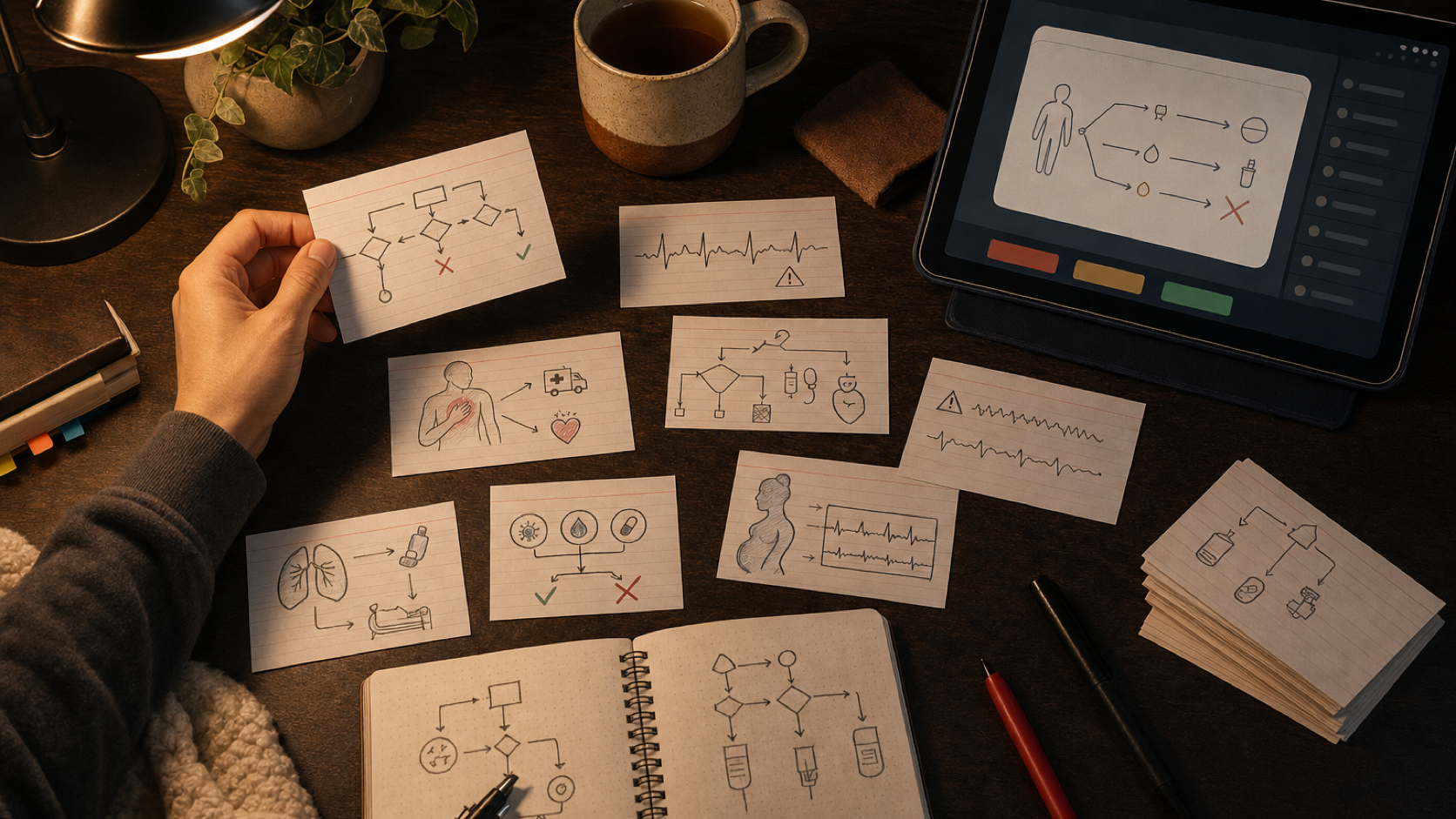
Step 2 CK is a management exam, not a fact-hoarding exam
This is the first thing I would keep in view.
A lot of students build one giant clinical deck that mixes:
- clerkship pearls
- question-bank explanations
- guideline fragments
- disease definitions
- drug facts
Then review starts feeling heavy for a simple reason: the exam is not asking for one kind of memory.
Official Step 2 CK specifications emphasize physician tasks more than disease memorization: diagnosis, interpretation of labs and diagnostic studies, management, pharmacotherapy, interventions, prevention, and professionalism. In normal study language, that means your misses usually come from a few recurring memory jobs:
| What the vignette is really testing | What your card should train | What weak cards usually do |
|---|---|---|
| diagnosis from a noisy presentation | the cue or contrast that points to the right diagnosis | store the whole disease summary |
| next best step | the decision point that changes what happens next | ask for a paragraph about management |
| test selection | the clue that makes one test appropriate and another unnecessary | turn workup into a long list |
| pharmacotherapy | the treatment choice, contraindication, or adverse effect that matters here | dump the whole drug class onto one back side |
| clinical intervention | the threshold or trigger for escalation | make you reread an algorithm instead of retrieving the hinge |
| ethics, safety, and prevention | the clean rule or priority | blur several rules together because they sound adjacent |
That is where Step 2 CK management flashcards actually earn their space. They should feel like fast retrieval drills for clinical decisions, not like a second textbook hiding in a deck.
If you are earlier in training and need the broader version of this workflow, How to Use Flashcards for Medical School in 2026 is the better upstream article. If you are still in the Step 1 memory world of mechanisms, pathology images, and integrated systems, How to Use Flashcards for USMLE Step 1 in 2026 is the closer match.
Shelf misses should drive more of the deck than your reading does
This is where the best Step 2 CK decks usually separate themselves.
Reading, lectures, review videos, and ward notes can all give you candidate material. Fine. But the most valuable cards usually come from places where the exam already proved you were shaky:
- UWorld or Amboss misses
- NBME shelf explanations
- repeat traps from clerkship practice exams
- patient presentations that made sense only after someone explained the management logic
I would not ask, "How do I save this whole explanation?"
I would ask:
- What did I fail to notice in the vignette?
- What management branch did I choose too early?
- What diagnosis did I anchor on?
- What contraindication or exception did I flatten into a rule?
- What shelf-style trap is likely to hit me again?
Those are excellent flashcard targets.
What usually does not deserve a flashcard:
- I was tired and clicked too fast.
- I changed from the right answer to the wrong one for no reason.
- I misread the stem because I was rushing.
Those are real problems. They are just not flashcard problems.
If the raw material is mostly missed questions, How to Turn Practice Questions Into Flashcards in 2026 is the direct companion workflow.
Build cards around the decision hinge, not around the disease label
This is the most useful Step 2 CK rule I know.
Weak clinical cards usually start with a disease name and end with a short lecture. That feels responsible. It is also why the card still feels fuzzy three days later.
I would rather build around the exact point where management changes.
1. Next-step cards
Use these when the real miss was "I knew what this was, but I still did the wrong thing next."
Good prompts sound like this:
- What is the next best step after this presentation and this stability clue?
- What should happen before treatment starts here?
- What makes observation wrong in this scenario?
The answer should be short. If the back side turns into a flowchart paragraph, the card wants to become more than one card.
2. Management-change trigger cards
These are some of the highest-yield Step 2 CK vignette traps because management often stays reasonable right up until one extra detail shows up.
Examples:
- What finding turns outpatient management into inpatient management?
- What instability clue changes this from medication to immediate intervention?
- What piece of the history makes the usual drug choice wrong here?
This is closer to actual Step 2 performance than memorizing "disease -> treatment" in the abstract.
3. Algorithm hinge cards
Students often say they "know the algorithm" when what they really know is the topic title.
I would break algorithms into hinge points:
- first step
- escalation trigger
- branch that depends on one key lab, symptom, or stability clue
- branch that depends on pregnancy status, age, timing, or contraindication
That keeps clinical management flashcards reviewable. You are not trying to replay the whole flowchart from memory every time. You are trying to retrieve the branch you keep missing.
4. Vignette cue cards
These are for pattern recognition rather than pure management.
Examples:
- What clue in this stem should make you stop thinking of the tempting wrong answer?
- What detail separates the likely diagnosis from its common lookalike?
- What part of the presentation is the real anchor, not the distracting symptom?
This is especially useful for shelf-style stems that bait you toward a disease you know better than the one actually being tested.
5. Contraindication and "do not do this" cards
Step 2 CK loves management errors that sound superficially reasonable.
Those cards might ask:
- What treatment is inappropriate because of this one finding?
- What test should not come first in this situation?
- What medication becomes the wrong choice because of this history detail?
These cards are small, but they stop a surprising number of repeated misses.
Clerkship notes should be compressed hard before they become cards
A lot of Step 2 material does not come from polished resources. It comes from quick notes you wrote after rounds, shelf review sessions, or one patient discussion that finally made a concept click.
That is useful source material.
It is not card-shaped yet.
Most clerkship notes still need one compression step before they belong in a deck:
- pull out the decision, rule, distinction, or sequence that actually matters
- throw away the case details that only made sense in that one conversation
- write one front/back card that would still be understandable in two weeks
For example, do not store:
- full patient story
- entire differential
- long attending explanation
Store the part that might save you later:
- the clue that changed the diagnosis
- the trigger that changed management
- the reason one test came before another
- the reason the usual treatment was wrong in that case
If you can say, "This was the one piece I wish I had retrieved ten seconds earlier," that is probably a card.
Shorter Step 2 CK blocks make slow cards feel even worse
This is the 2026 piece that actually matters for deck design.
On May 7, 2026, Step 2 CK moves from eight 60-minute blocks to sixteen 30-minute blocks while keeping the same total exam-day length. That does not mean you need a radically new study method. It does mean the exam rhythm leans even more toward quick resets and fast recognition.
A card that requires you to slowly reconstruct half a guideline was already weak.
Now it looks worse.
I would pressure-test your Step 2 cards with one question:
Could I answer this cleanly during a tired, mixed block without rereading the whole back?
If not, the card probably needs to become:
- smaller
- narrower
- more cue-driven
- less lecture-like
USMLE also says the new interface adds updated navigation and image contrast control. That is helpful for test-day familiarity. It does not rescue broad cards or vague retrieval.
Organize Step 2 CK cards by rotation plus problem type
I would keep the structure boring.
One main Step 2 CK deck is usually enough. Then use tags for the moving parts.
Useful tags might look like:
im-shelfsurgery-shelfobgyn-shelfpeds-shelfpsych-shelfnext-stepmanagementvignette-trapcontraindicationneeds-rewritemissed-q
That gives you a cleaner study pattern than building a separate permanent deck for every tiny topic that passes through your service for one week.
If organization is already becoming its own hobby, How to Organize Flashcards in 2026 is the right corrective.
A workable Step 2 CK workflow is boring on purpose
This is the routine I would trust more than any heroic weekend cleanup session.
During clerkships
- do your questions
- mark only the misses worth preserving
- turn those into small cards the same day or the next day
- review due cards daily
- rewrite or delete cards that still feel broad
Before each shelf
Bias harder toward:
- repeat next-step misses
- management algorithms that keep splitting in the wrong place
- common lookalike diagnoses
- ethics and safety rules you keep flattening
During dedicated
Shift the deck away from "everything I touched this year" and toward:
- repeated question-bank failures
- unstable management decisions
- cue-recognition problems
- cards that represent common test-day traps
That is how Step 2 CK shelf misses and dedicated review start working together instead of becoming two separate study systems.
If you want the scheduling side in more detail, How to Study for an Exam With FSRS in 2026 is the direct follow-up.
FSRS helps once the cards stop trying to do five jobs at once
This is where spaced repetition actually starts pulling its weight.
Step 2 CK memory is uneven in a very normal way:
- some management branches stick after two reviews
- some contraindications keep slipping
- some diagnoses are easy until the wording changes
- some algorithms feel obvious until one branch disappears under time pressure
That is the kind of memory pattern FSRS handles well.
What it does not do is rescue a bloated clinical deck filled with half-summaries and copied explanations.
So the order matters:
- make the card smaller
- keep the deck focused on real misses
- let FSRS handle the timing
If you keep feeding vague cards into the scheduler, you still end up reviewing vague cards.
Why Flashcards fits this Step 2 CK workflow
If you want to run this inside Flashcards, the useful part is not that it replaces the clinical thinking. It gives you a faster path from messy Step 2 source material to smaller, reviewable cards.
What matters is simpler:
- AI chat for drafting candidate cards from question explanations, clerkship notes, or copied text
- file attachments and plain text uploads when your source material is messy
- front/back card creation and editing when the draft needs to become smaller
- decks and tags for keeping rotation material, shelf misses, and management traps organized
- FSRS review once the cards are clean enough to trust
- offline-first study across web, iPhone, and Android once the deck is worth keeping
That combination matters because Step 2 CK source material is scattered by default. Shelf questions, ward notes, explanations, and review docs all live in different places. The better system is the one that lets you turn those into narrower cards without turning deck maintenance into its own clerkship.
If the core problem is card quality rather than medical content, How to Make Better Flashcards in 2026 is the better next read.
The useful rule
If you want flashcards for USMLE Step 2 CK that still help late in the study cycle, do not store the whole case and do not preserve the whole explanation.
Store the part that failed:
- the cue you missed
- the management branch you chose wrong
- the contraindication you blurred away
- the trap answer you keep falling for
- the algorithm hinge you still cannot retrieve on demand
That is the version of USMLE Step 2 CK flashcards I would actually trust in 2026.