How to Use Flashcards for AP World History in 2026: Timelines, Themes, and DBQ Evidence That Actually Stick
1200, 1450, 1750, 1900, 1945. Most AP World students can recognize those anchors on sight. Then a document set shows up in Bluebook, and suddenly the real problem is not the date. It is whether you can connect that date to a region, a theme, and one piece of outside evidence fast enough to use it.
That is why AP World History flashcards still help in 2026, but only if the deck is built for AP World History: Modern instead of for generic memorization. On the official College Board exam page, the 2026 exam is listed for Thursday, May 7, 2026, at 8 a.m. local time, and it is a fully digital Bluebook exam. The format is still the familiar split: 55 multiple-choice questions in 55 minutes, 3 short-answer questions in 40 minutes, then the DBQ and LEQ in 1 hour 40 minutes.
That matters because AP World flashcards are only good at certain jobs. They can make chronology faster. They can help you stop mixing up themes across regions. They can store outside evidence and sourcing patterns. They can help you fix the same writing mistake before it shows up again on a timed DBQ. They do not replace reading sources, outlining arguments, or writing under time pressure.
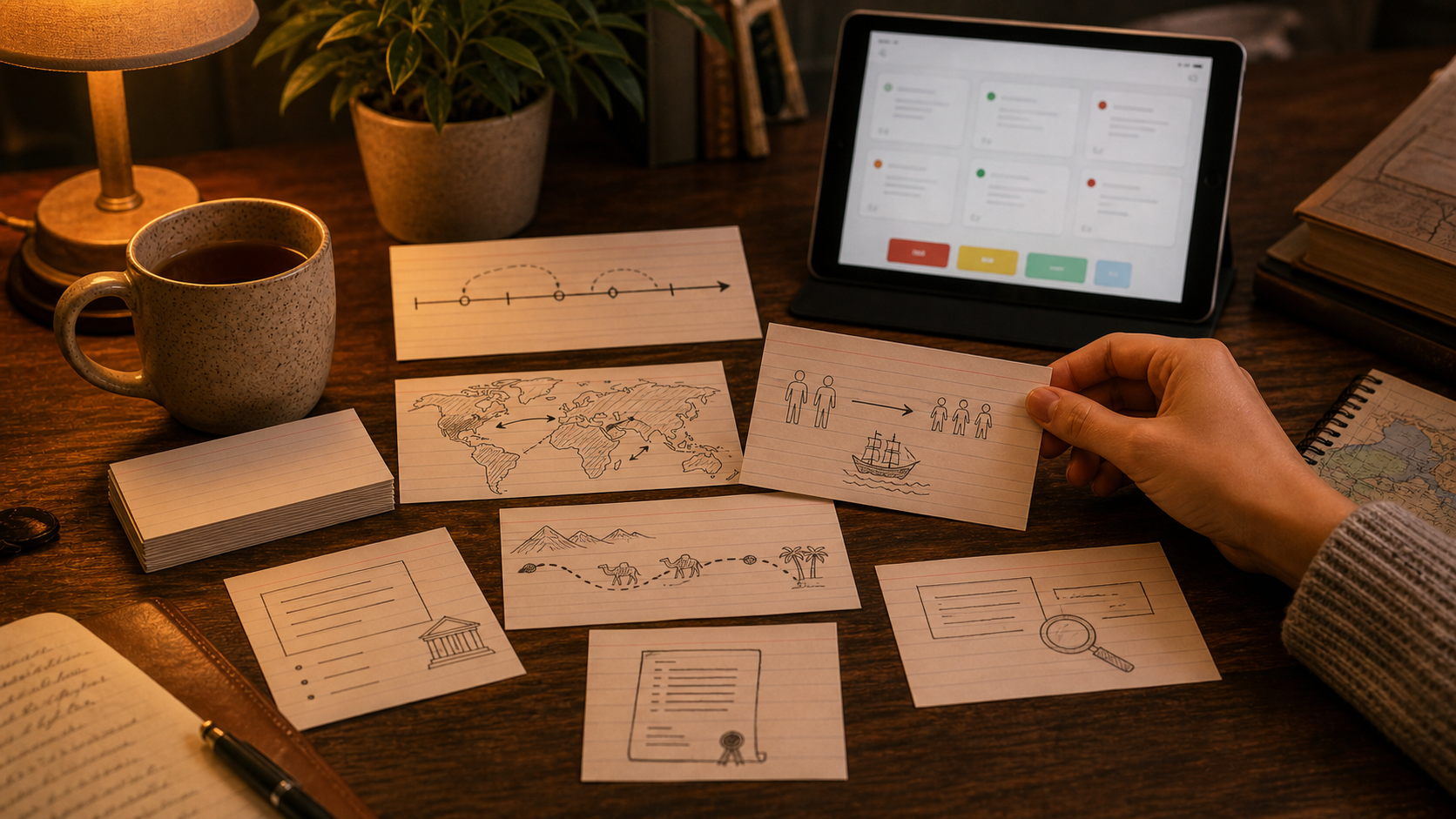
AP World is really four memory problems
Weak decks usually treat the course like one giant vocabulary list. The exam does not.
What you actually need to recall quickly is:
- where a development belongs in time
- how it fits one of the course themes
- what evidence you can attach to it
- what kind of historical reasoning the prompt is asking for
That is a much better answer to how to study for AP World History than "memorize more."
If a card does not help you place a development, compare it, explain it, or use it as evidence, it is probably too weak to survive the course.
Build a timeline spine first
The official course page still frames AP World from c. 1200 CE to the present across nine units. It also puts Units 3 through 6 at 12% to 15% each, which is a useful reminder that your review time should not be distributed evenly just because your notebook is.
I would build the deck around timeline relationships, not isolated years.
Good AP World History timeline cards usually ask one thing:
- What changed between Unit 2 and Unit 4 in trade networks?
- Which empire best fits this administrative clue?
- What continuity links Mongol-era exchange to later maritime empires?
- Which development belongs after the Columbian Exchange, not before it?
That works better than front: 1450-1750 and back: a compressed chapter summary.
For AP World, I like timeline cards that keep one foot in chronology and one foot in place:
- Ottoman, Safavid, and Mughal state-building
- Atlantic slavery and plantation labor
- silver flows across the Americas, Europe, and East Asia
- Meiji reforms and industrial state-building
- anti-colonial nationalism after World War II
- Cold War pressure on newly independent states
Those are not random fact buckets. They are reusable anchors.
If your deck already feels bloated, How to Make Better Flashcards in 2026 is the right cleanup pass before you add more cards.
Themes are what make the facts reusable
One reason AP World feels slippery is that the course keeps asking you to move between regions without losing the argument. The official framework helps by organizing the course around recurring themes: humans and the environment, cultural developments and interactions, governance, economic systems, social interactions and organization, and technology and innovation.
This is where a lot of AP World History vocabulary cards fall apart. A plain definition is rarely enough.
Front: syncretism
Back: a clean definition
That is not wrong. It is just not enough to win on the exam.
A stronger card asks for the term in motion:
- What makes this example syncretism instead of simple religious spread?
- Which development is a better example of state building than cultural diffusion?
- How does industrialization change labor systems outside Europe in this case?
- Why does this example fit nationalism better than local rebellion?
I would tag or group cards by both unit and theme so the same fact can do more than one job:
unit-4 + economic-systemsunit-5 + governanceunit-8 + social-interactionsunit-9 + technology-and-innovation
That is how the Haitian Revolution, the Meiji Restoration, the Berlin Conference, or the Bandung Conference stop being one-off facts and start becoming usable evidence.
If the bigger problem is organization rather than volume, How to Organize Flashcards in 2026 is the direct follow-up.
Your DBQ deck should be an evidence bank
This is where AP World flashcards can become genuinely useful.
On the current College Board exam page, the DBQ still has a recommended 60 minutes, including a 15-minute reading period, uses 7 documents, and covers historical developments from 1450 to 2001.
That does not mean you should turn each DBQ into twenty cards.
The useful move is smaller. Build cards that store evidence and reasoning moves you can reuse:
- one outside-evidence example tied to a recurring theme
- one sourcing move you keep missing
- one grouping pattern that makes historical sense
- one continuity or causation claim that actually fits the documents
- one repeat mistake from your last practice set
Bad DBQ cards usually keep too much:
- the full prompt
- all seven documents
- a copied sample essay
- rubric phrases you never want to reread
Good AP World History DBQ cards usually come from misses like these:
- I described the document instead of using it
- I knew the region but not the broader process
- I had outside evidence in my head and still did not deploy it
- I wrote
audienceorpurposewithout explaining why it mattered - I grouped documents by label instead of by argument
The official past AP World free-response questions are useful raw material here because they show released prompts, scoring materials, and sample responses. That is much better source material than generic "DBQ hacks" posts.
Missed questions are better than pretty notes
Most students still build decks from reading first and treat missed questions as an afterthought. For AP World, I would reverse that.
College Board still describes the SAQ section like this:
- Question 1 is required, uses 1 or 2 secondary sources, and covers 1200 to 2001
- Question 2 is required, uses 1 primary source, and covers 1200 to 2001
- For the last SAQ, you choose between 1200 to 1750 and 1750 to 2001
The LEQ still gives three broad time windows and asks you to reason through comparison, causation, or continuity and change instead of just recall facts.
That is why missed questions are such good input for flashcards. A wrong answer usually points to a specific failure:
- chronology
- regional confusion
- weak outside evidence
- vague comparison
- causation with no support
- using a source without actually analyzing it
Those are excellent card targets.
Examples:
- What makes this development a continuity rather than a change?
- Which outside evidence best supports a claim about imperial expansion in this period?
- Why does this example fit governance better than economic systems?
- What is the difference between naming a source's point of view and using it?
That is also why How to Turn Practice Questions Into Flashcards in 2026 pairs so well with AP World. Your misses already contain the exact reasoning gaps that need repetition.
Use AI for drafting, then verify like a skeptic
AI can speed up AP World deck creation a lot. It should not get the final vote.
The workflow I would trust is simple:
- Take one narrow source chunk: class notes, a teacher handout, a corrected SAQ, or a DBQ outline.
- Ask AI for short front/back card drafts split into timeline anchors, theme comparisons, vocabulary, and evidence.
- Verify every survivor against your teacher's materials and the official framework.
- Delete vague cards immediately.
- Rewrite anything that sounds polished but slightly wrong.
That verification step matters more in history than in a lot of other subjects. A card can sound smart and still blur a region, flatten causation, or attach the wrong example to the right theme.
So yes, use AI to move faster. Just make it your drafting assistant, not your historian.
FSRS should make the deck boring
Once the cards are clean, the best review system for AP World is usually the one that keeps daily work predictable.
That is where FSRS helps. You review with four ratings, let the scheduler handle timing, and stop pretending you need the same interval for every card. The hard part is not the algorithm. The hard part is keeping the deck small and sharp enough that the algorithm is working on good material.
For AP World, I would keep the weekly rhythm boring on purpose:
- add a small batch from one unit or one practice session
- add more cards from misses than from highlights
- keep evidence cards and timeline cards separate enough to edit well
- review due cards daily
- cut weak cards before they multiply
If you want the scheduling side in more detail, How to Study for an Exam With FSRS in 2026 is the best companion article.
Where Flashcards fits this AP World workflow
If you want one place to run this system, Flashcards Open Source App fits the workflow without requiring a weird study stack.
The current product already supports the useful middle of the job:
- front/back card creation and review
- AI chat for drafting from notes or corrected practice
- file attachments when your source is a handout, worksheet, or exported review packet
- FSRS scheduling with four ratings
- open-source code with self-hosting if you want control
- web, App Store, and Google Play availability
- a hosted cloud beta that is free during beta
That does not mean the product "does AP World for you." It means the app is a practical place to build, trim, and review the kind of deck AP World actually rewards.
The AP World deck I would trust in 2026
I would trust a deck that is smaller than your notes, more specific than your glossary, and built around historical use instead of fact storage.
That means:
- timeline anchors with regional context
- theme-based cards that make facts reusable
- DBQ evidence cards instead of essay dumps
- missed-question cards that fix repeatable errors
- AI-assisted drafting that gets checked against class materials and the official framework
- FSRS reviews after the deck is clean enough to deserve them
That is the version of AP World History flashcards I would want going into May 7, 2026: a deck built for a fully digital exam, for source-based history, and for the gap between "I remember this topic" and "I can actually use it."