How to Use Flashcards for the NREMT in 2026: CAT Misses, Primary Assessment, and TEI Practice That Actually Sticks
A lot of NREMT misses feel annoyingly small. You recognized the sick patient, but not fast enough. You knew the trauma sequence, then blanked on what had to happen next. A drag-and-drop item looked manageable until the order actually mattered. That is usually when flashcards start sounding useful again.
They can help a lot in 2026, but only if the deck matches the exam you are actually taking.
Generic EMT-class decks tend to break here. They are usually too broad for a computer-adaptive exam, too chapter-shaped for fast decisions, and too passive to fix the kind of near-misses that show up in primary assessment and TEI items.
If you want flashcards for the NREMT that still feel useful close to test day, build them around repeated misses, primary assessment decisions, ordered actions, classification mistakes, protocol-level recall from your training, and the exact cues your question bank keeps exposing.
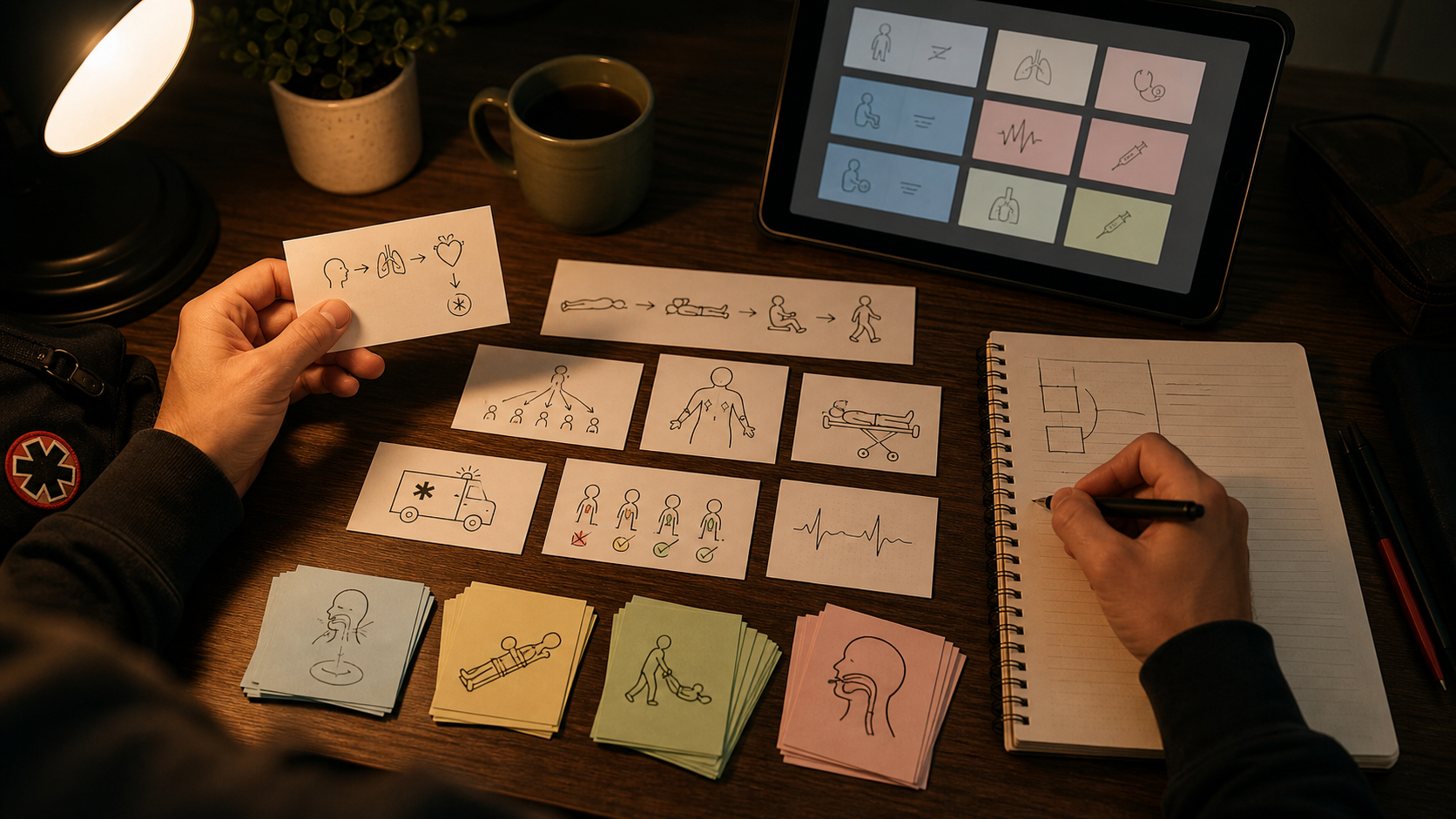
Start with the real NREMT exam shape in 2026
The current NREMT EMT exam is still the updated version that launched on April 7, 2025. That update matters because it changed what a useful deck should look like.
According to the official EMR and EMT Certification Examinations page, the EMT cognitive exam is still a computer adaptive test with 70 to 120 items, including 10 pilot or unscored items, and a 2-hour testing window. The EMT candidate handbook also says the exam is a computerized adaptive test, which means your question count and difficulty shift based on performance.
The domain breakdown matters even more:
- Scene Size-Up and Safety: 15% to 19%
- Primary Assessment: 39% to 43%
- Secondary Assessment: 5% to 9%
- Patient Treatment and Transport: 20% to 24%
- Operations: 10% to 14%
That one line about Primary Assessment: 39% to 43% should change how you study.
If your deck gives the same weight to every chapter, it is probably ignoring the biggest part of the exam.
The updated exam also includes Technology Enhanced Items. NREMT's exam page says EMT candidates may now see Build List, Drag-and-Drop, and Option/Check Box items. That does not mean you need a flashy deck. It means your cards should train sequence, sorting, and classification instead of only one-step fact recall.
Do not turn your textbook into a deck
The NREMT does not reward the kind of card that asks you to explain an entire emergency topic from memory.
Those cards feel serious for about two days. Then they become something you dodge during review.
I would not make cards like:
- Explain respiratory emergencies.
- Explain shock.
- Explain trauma assessment.
- List everything about diabetic emergencies.
That is basically rewriting your textbook into worse software.
The cards that tend to hold up better are smaller:
- Which finding makes this patient immediately unstable?
- What comes first in this sequence?
- Which intervention is indicated next?
- Which cue changes the category?
- Which sign should make you stop and reassess?
If your front side starts sounding like a lecture objective, it is probably too big.
Primary assessment deserves the biggest share of your deck
This is the highest-yield change I would make for most EMT students.
Because the official NREMT blueprint puts Primary Assessment at 39% to 43% of the EMT exam, I would let that domain dominate card-writing time. Not by turning it into one giant section of copied notes, but by breaking it into quick decisions.
Good primary assessment cards usually test things like:
- airway versus breathing versus circulation priority
- immediate life-threat recognition
- mental status changes that matter now
- signs of poor perfusion
- unstable respiratory patterns
- what finding forces oxygenation, ventilation, or transport thinking earlier
The key is to store the decision point, not the whole paragraph around it.
Examples:
- Which finding during primary assessment should move airway concerns to the front?
- What detail suggests respiratory failure instead of simple distress?
- Which sign of shock changes your urgency immediately?
- What finding means you should reassess after an intervention before moving on?
That is much closer to how the exam feels than a card that says, "Describe primary assessment."
CAT misses should drive most of the deck
This is where NREMT prep usually becomes practical.
The official examination preparation page says NREMT does not recommend one specific study guide and does not provide your specific weaknesses. In real life, that means your own misses matter a lot.
Your question bank, class exams, and instructor feedback are usually the cleanest way to see what keeps failing:
- you recognized the complaint but missed the unstable cue
- you knew the skill but not the order
- you confused two interventions that sound similar
- you remembered the disease and forgot the first move
- you rushed past one contraindication or transport clue
Those are great card sources.
What usually does not deserve a card:
- one careless click you would never repeat
- a question you missed only because you read too fast once
- a full rationale paragraph pasted onto the back
- a giant copied algorithm you will never honestly review
I would keep the miss workflow simple:
- Do a mixed block of NREMT-style questions.
- Review only the repeated or meaningful misses.
- Write one sentence about what actually failed.
- Turn that sentence into the smallest reusable card.
One quick template works well here:
- front: short scenario plus the decision point
- back: next action, classification, or sequence step
- extra note if needed: one line on why the wrong choice was tempting
That format is plain on purpose. It is easier to review honestly than a card back stuffed with the whole rationale.
If you want a deeper version of that process, this practice-question workflow is the direct companion.
TEI practice works best as approximations, not fake exam recreations
This is where people can overcomplicate things.
You do not need to rebuild the NREMT interface inside your flashcards app. You do need to train the memory jobs behind those item types.
The official NREMT update page says EMT candidates may see:
- Build List items, where you arrange options in order
- Drag-and-Drop items, where you sort options into categories
- Option/Check Box items, where you classify or select choices in a table
Those map cleanly to a few card patterns.
Build list cards
Use these for ordered actions and sequences.
Examples:
- Put the steps of this assessment in order.
- What comes immediately after this finding?
- Which action should happen before transport in this scenario?
If the sequence is long, split it. Four short sequence cards are usually better than one card that recreates an entire skill station.
Drag-and-drop cards
Use these for classification.
Examples:
- Which findings belong under airway, breathing, or circulation concern?
- Which symptoms fit compensated shock versus decompensated shock in your course materials?
- Which equipment belongs to this scenario and which does not?
These are not perfect simulations. They are still useful because they train sorting under pressure.
Option or check-box cards
Use these when more than one choice can be right, but only for a reason you can explain clearly.
Examples:
- Which findings support immediate transport?
- Which interventions are appropriate at this stage?
- Which details make this patient higher risk right now?
The trick is to preserve the reasoning break, not every answer option from the source question. If a question missed you because you confused two categories, write the category split. If you missed it because the order mattered, write the order.
NREMT also provides official sample packets and interactive sample items on the updated exam page. Those are worth using because they show the item feel more accurately than random social media screenshots.
Protocol recall should stay local, specific, and decision-based
This part matters because EMT students often build protocol cards that are either too vague or oddly generic.
Your deck should follow your course materials, the current American Heart Association guidance your training expects, and the protocols or treatment expectations you are actually being taught. The official NREMT examination preparation page explicitly tells candidates to study their textbook and class notes thoroughly and to review the current AHA CPR and emergency cardiovascular care guidance.
That means protocol cards should sound like:
- Which intervention comes first after this finding?
- What contraindication changes the decision here?
- Which reassessment point matters before the next step?
- What detail moves this from monitor-and-transport to immediate action?
I would avoid cards that ask for entire protocol recitations unless your program explicitly tests that way.
Most of the time, the reusable memory target is smaller:
- one trigger
- one priority shift
- one contraindication
- one sequence break
- one transport decision
That keeps the cards useful for both classroom prep and NREMT-style review.
Tag the deck like the exam, not like the textbook
One giant undifferentiated deck gets messy fast.
I would keep one main review deck, then use tags aggressively:
primary-assessmentscene-size-upsecondary-assessmenttreatment-transportoperationsairwaybreathingcirculationshocktraumamedicalpedstei-build-listtei-drag-droptei-checkboxmissed-q
This gives you two useful review modes:
- mixed daily review, which feels closer to CAT
- filtered review, when one weak area keeps repeating
That second mode matters more than people think. If five recent misses all came from airway decisions inside primary assessment, you should be able to review exactly that without splitting your whole system into ten permanent decks.
FSRS helps once the cards stop trying to do everything
This is the scheduling layer I would trust for the actual review side of exam prep.
FSRS is useful because EMT recall is uneven. Some sequences stick quickly. Some shock cues keep slipping. Some treatment distinctions feel obvious in class and blurry three days later. That is exactly the kind of memory problem spaced repetition is good at.
But FSRS does not rescue bloated cards.
If one card is secretly testing three decisions, one sequence, and a paragraph of rationale, the scheduler cannot fix that. It can only keep serving you a bad card on a schedule.
The better setup is:
- make the cards small
- tag them by weakness
- review them in mixed order
- let FSRS decide when they come back
That is where the features page and getting-started guide fit nicely if you want one place for front/back cards and FSRS review. Flashcards Open Source App is just the study tool here, not an official NREMT product.
If you want the scheduling side in more detail, this FSRS exam guide is the next read.
A weekly NREMT flashcards loop that actually holds together
I would keep the workflow plain on purpose:
1. Do mixed practice first
Start with mixed EMT-style questions, not chapter review. CAT is mixed, so your prep should keep forcing quick switches too.
2. Pull only the misses with a pattern
Do not make cards from everything. Pull the misses that expose a repeatable weakness:
- unstable cue recognition
- order mistakes
- airway and breathing confusion
- transport timing
- classification mistakes on TEI-style items
3. Write one to three cards per meaningful miss
One bad question can contain a few separate failures. That does not mean you should preserve the whole question. Split it into the actual lessons.
4. Review due cards daily
Keep review boring and consistent. The official examination preparation page says most successful candidates spend about 30 to 60 seconds per question during the exam. Your flashcard reviews should support that kind of quick retrieval, not train you to reread mini essays.
5. Use filtered review in the final stretch
As test day gets closer, filter by the tags that still feel slippery:
primary-assessmentshocktei-build-listoperationsmissed-q
That gives you targeted cleanup without rebuilding the whole deck.
Build the part of the deck that fixes decisions
That is the version of NREMT flashcards I would trust in 2026.
The useful deck is smaller and more specific. It is built around CAT misses, primary assessment decisions, TEI-style ordering and sorting, and protocol-level recall anchored to what your course is actually teaching.
If you want a tool that supports that workflow, start with the getting-started guide or read the features page. Flashcards Open Source App is an open-source study tool built around FSRS review. It is not affiliated with NREMT, and it works best when you feed it small cards from real misses instead of giant summaries.