How to Study a Premade Anki Deck in 2026: What to Keep, What to Rewrite, and What to Learn First
One of the fastest ways to ruin a normal study week is to import 3,000 cards on Sunday night and trust the deck more than your own syllabus.
That is the basic trap with a premade Anki deck. Shared decks can save real time. They can also dump somebody else's structure, wording, priorities, and mistakes straight into your review queue.
In 2026, this got more common because more people start with shared Anki decks and AI-generated decks instead of writing everything from scratch. The upside is speed. The downside is that you can inherit duplicate facts, weak prompts, off-syllabus sections, and cards for material you have not even learned yet.
Short version: imported cards should earn their place. A clean import does not mean a good study plan.
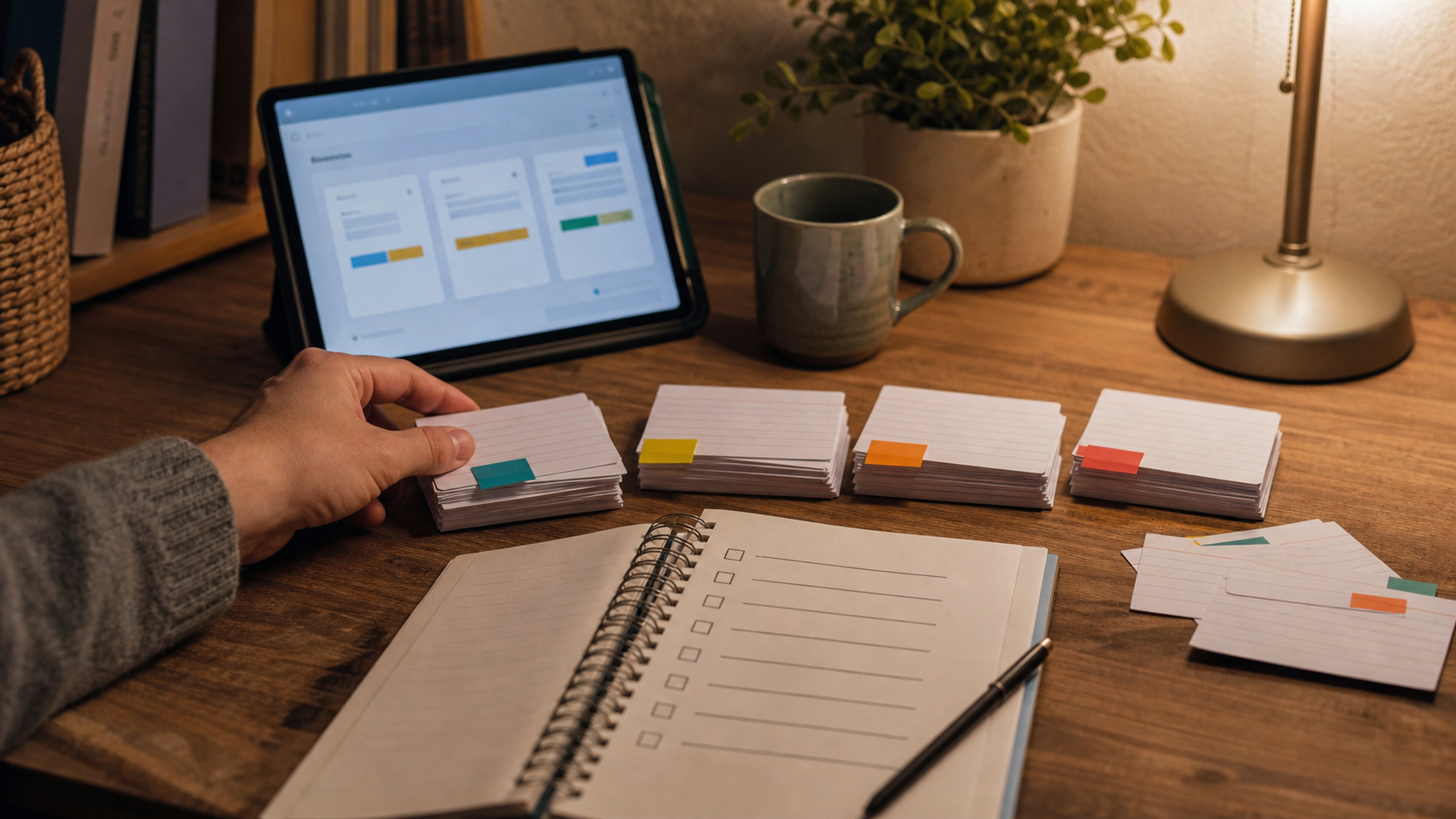
A premade deck is raw material, not a study plan
A premade Anki deck is useful when it saves typing and gives you a decent starting structure. It stops being useful when you let it choose what you should learn, in what order, and at what depth.
That is the big mindset shift. The deck is not the course. The deck is a pile of possible review items.
Real examples:
- a shared anatomy deck can help after lab or lecture
- a premade language deck can help after reading, listening, and correction
- a certification deck can help after you understand the exam blueprint
What usually fails is the reverse order. People import first, then try to memorize their way into understanding.
If you are figuring out how to use premade Anki decks, start with a simple filter:
- use them to review material you already covered
- use them to save time on straightforward facts and definitions
- use them to spot gaps in your notes
- do not use them as your main explanation source for a hard topic
That one rule prevents a lot of fake progress.
Do not use reviews as first exposure
This is the mistake that burns people out fastest.
If a card asks about a pathway, grammar pattern, legal rule, or algorithm you never properly learned, the session turns into weird theater. You are not recalling. You are guessing, re-reading, and hoping repetition will create understanding later.
It usually does not.
When people search for review material you never studied, they are usually trying to rescue a bad workflow. The answer is still no. Do not turn your review queue into first exposure.
If a section of the deck keeps feeling opaque, stop and go back to the source:
- textbook chapter
- lecture notes
- worked examples
- teacher explanation
- practice problems
Then come back to the cards once the topic is real in your head.
This is also why editing matters. The original deck creator already had context. You probably do not share the same teacher, textbook, examples, or class order.
Audit the deck before your first serious session
Most people open an imported Anki deck, hit study, and inspect quality only after the deck starts annoying them.
Do the opposite. Spend ten quiet minutes on inspection before it becomes a daily obligation.
Check:
- deck size
- subdeck structure
- whether sections match your course or exam outline
- note types
- obvious duplicates
- whether cards are mostly basic, cloze, image occlusion, or a random mix
- whether prompts make sense without the original lecture or book
- whether tags or subdecks reveal old chapters you do not need
You are looking for early warning signs:
- 6,000 new cards for a six-week class
- cloze cards hiding half a paragraph
- definitions that differ only by one synonym
- cards with answers so long you cannot grade them quickly
- whole subdecks outside your syllabus
One practical trick: sample 15 to 20 cards from each major section before you start. That tells you more than staring at the card count.
If the deck already looks messy in inspection, it will feel worse in live review.
Strip inherited scheduling and old noise
One problem with a shared deck Anki workflow is that you may inherit more than card text. Depending on how the deck was packaged, you can also inherit review history, intervals, tags, or other cleanup leftovers that made sense for the original author and make no sense for you.
That is useful when moving your own deck between devices. It is usually bad when the deck came from somebody else.
If a newly imported deck already shows strange intervals, old learning states, or noisy tags, clean that up before you trust the schedule. Do not let somebody else's history decide what you should see this week.
If you want to tune scheduling later, read FSRS Settings in 2026. Just do not start there. First make sure the cards are actually yours now.
Limit new cards before the deck earns trust
The most common failure with a premade Anki deck is not one terrible card. It is intake volume.
An imported deck feels cheap because you did not type it. But every accepted card still creates future work. Large intake is how a decent deck turns into a backlog.
Start with a cap that feels almost conservative:
- 10 new cards per day if the subject is hard or your week is busy
- 15 to 20 if the material is straightforward and your review load is already calm
- lower than that if the deck still needs heavy cleanup
That gives you room to inspect what the deck is really like. It also keeps you from discovering on day five that your "helpful" import became a second unpaid job.
If you want a more detailed intake rule, How Many New Flashcards Per Day is the closer companion. If AI is feeding extra cards into the same system, How to Avoid AI Flashcard Overload in 2026 matters even more.
Make only four decisions in week one
This is the cleanest way I know to study shared Anki decks without turning deck management into a hobby.
Every questionable card in the first week gets one of four outcomes:
| If the card is... | Action | Why |
|---|---|---|
| clear, useful, and aligned with what you are actually learning | Keep | It deserves future reviews |
| maybe useful later, but not part of the current plan | Suspend | Saves it without taxing today |
| important idea, badly written | Rewrite | Keeps the concept, removes friction |
| duplicate, trivial, wrong, or irrelevant | Delete | Removes future review debt |
That is the whole system behind how to study shared decks.
You do not need a more philosophical framework. You need a faster one that you can apply card after card.
Rewrite cards that depend on someone else's context
Imported decks often contain cards that look polished and still fail as study material.
You know the type:
- front side too vague
- back side too long
- multiple facts stuffed into one answer
- cloze deletion hiding half the reasoning instead of one recall point
- wording that only makes sense if you used the same textbook as the author
These cards should not stay in rotation just because they are technically correct.
Rewrite them into something you can grade in a few seconds. Usually that means:
- one fact or one tight relation per card
- shorter answer
- enough context on the front to avoid guessing
- splitting overloaded cards into two or three smaller ones
Here is a good test: if you need to remember the original author's class context to answer the card, rewrite it.
If the deck needs a broader cleanup pass after import, How to Prune a Flashcard Deck in 2026 is the companion guide.
Treat AI-generated shared decks as drafts
This matters more now because many "shared decks" are no longer fully human-written decks. They are AI-assisted exports, scraped notes turned into cards, or mixed bundles that never got a serious quality pass.
That does not make them useless. It changes the trust level.
My rule for AI-generated flashcards quality is simple: if I cannot tell where a card came from or why it is phrased that way, it starts as a draft.
Check for:
- hallucinated details
- repeated paraphrases of the same fact
- polished wording hiding a weak prompt
- cards written from summaries instead of source material
- answer choices or explanations that quietly drift from the syllabus
If the deck feels suspicious, compare a handful of cards directly against your source. Five minutes of spot-checking can save weeks of low-value review.
If you are also using AI to draft or rewrite cards in Flashcards, keep the same standard there too. Draft first. Edit second. Review third.
Know when a shared deck is helping and when it is stealing time
Some decks save time immediately. Others only look efficient because the work was front-loaded by somebody else.
A deck is helping when:
- you already studied the source material
- the card wording is mostly clear
- the subdecks match what you need
- you are deleting or suspending only a minority of cards
- reviews feel like recall, not first-time interpretation
A deck is stealing time when:
- you keep opening reference material to understand basic prompts
- too many cards need rewriting
- large sections are off-syllabus
- duplicates keep surfacing
- you are memorizing the author's wording instead of the idea
When that second list starts winning, stop being loyal to the import. Suspend the bad sections or abandon the whole deck. Anki is a tool, not a sunk-cost ritual.
Your first week with a premade Anki deck should look boring
That is good news. Boring usually means sustainable.
Here is the first-week workflow I would actually trust:
- Import the deck and strip any inherited scheduling noise.
- Inspect size, structure, note types, and a small sample of real cards.
- Suspend whole sections that are clearly off-plan.
- Set a low new-card cap.
- Study only the section tied to material you already learned.
- During review, keep, suspend, rewrite, or delete questionable cards immediately.
- At the end of the week, decide whether this deck deserves a second week.
That is the practical answer to how to use premade Anki decks. Import, audit, and shrink.
Where Flashcards Open Source App fits
This site is not Anki, and I would not pretend otherwise. But the workflow problem is the same across modern flashcard tools: weak cards get expensive once they enter live review.
Flashcards fits this workflow in a straightforward way:
- you can create or edit plain front/back cards
- you can organize material into decks and tags
- you can review with FSRS after the cleanup pass
- you can use AI to draft or rewrite cards without handing quality control over to AI
If you are just setting up the basics, Getting Started is the shortest path. If you want agent or automation workflows around deck creation and cleanup, the public API docs and self-hosting guide are there for that.
The useful overlap is simple: whether the cards came from Anki, a shared deck, or an AI draft, human quality control still decides whether the next month of reviews feels sharp or miserable.
The best imported deck is the one you will cut apart
People often treat a downloaded deck like a finished product. It is usually closer to raw material.
That mindset shift fixes most imported Anki deck problems. You do not need to respect every card equally. You do not need to preserve the original structure. You definitely do not need to review every fact just because it arrived in a neat package.
Keep what helps. Rewrite what matters. Suspend what is not active. Delete the junk early.
That is how a premade Anki deck becomes useful in 2026. It becomes yours only after you cut it down to match what you are actually trying to learn.